


Lactic Acid Bacteria (LAB) and Their Bacteriocins for Applications in Food Safety Against Listeria monocytogenes
- PMID: 40558162
- PMCID: PMC12190153
- DOI: 10.3390/antibiotics14060572
Lactic Acid Bacteria (LAB) and Their Bacteriocins for Applications in Food Safety Against Listeria monocytogenes
Abstract
Background/objectives: Listeria monocytogenes is a major foodborne pathogen responsible for listeriosis, a serious illness with high morbidity and mortality, particularly in vulnerable populations. Its persistence in food processing environments and resistance to conventional preservation methods pose significant food safety challenges. Lactic acid bacteria (LAB) offer a promising natural alternative due to their antimicrobial properties, especially through the production of bacteriocins. This study investigates the competitive interactions between Lactococcus lactis and L. monocytogenes under co-culture conditions, with a focus on changes in their secretomes to better understand how LAB-derived bacteriocins can help mitigate the Listeria burden.
Methods: Proteomic approaches, including Tricine-SDS-PAGE, two-dimensional electrophoresis, and shotgun proteomics, were employed to analyze the molecular adaptations of both species in response to bacterial competition.
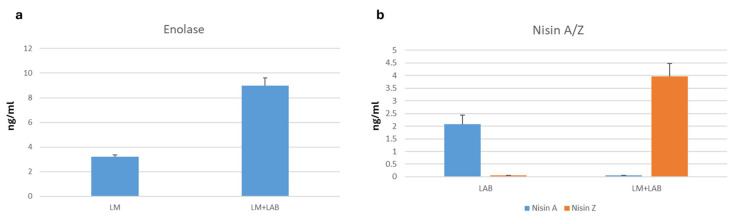
Results: Our results reveal a significant increase in the secretion of enolase by L. monocytogenes when in competition with L. lactis, suggesting its role as a stress-responsive moonlighting protein involved in adhesion, immune evasion, and biofilm formation. Concurrently, L. lactis exhibited a shift in the production of its bacteriocin, nisin, favoring the expression of Nisin Z-a variant with improved solubility and diffusion properties. This differential regulation indicates that bacteriocin production is modulated by bacterial competition, likely as a defensive response to the presence of pathogens.
Conclusions: These findings highlight the dynamic interplay between LAB and L. monocytogenes, underscoring the potential of LAB-derived bacteriocins as natural biopreservatives. Understanding the molecular mechanisms underlying microbial competition could enhance food safety strategies, particularly in dairy products, by reducing reliance on chemical preservatives and mitigating the risk of L. monocytogenes contamination.
Keywords: Listeria monocytogenes; bacteriocins; lactic acid bacteria; microbial competition; proteomics.
Conflict of interest statement
The authors declare no conflict of interest.
Figures



References
LinkOut - more resources
Full Text Sources
Miscellaneous
