Review
. 2025 Jun 14;14(6):606.
doi: 10.3390/antibiotics14060606.

Antimicrobials in Livestock Farming and Resistance: Public Health Implications

Affiliations
Review

Antimicrobials in Livestock Farming and Resistance: Public Health Implications

Marilena Trinchera et al. Antibiotics (Basel). .

Abstract

The accelerated spread of bacterial resistance has been demonstrated to reduce the effectiveness of antibiotic treatments for infections, resulting in higher morbidity and mortality rates, as well as increased costs for livestock producers. It is expected that the majority of future antimicrobial use will be in animal production. The management of antimicrobial resistance (AMR) in the livestock sector poses significant challenges due to the multifaceted nature of the problem. In order to identify appropriate solutions to the rise of antimicrobial resistance, it is imperative that we have a comprehensive understanding of the disease dynamics underpinning the ways in which antimicrobial resistance is transmitted between humans and animals. Furthermore, in consideration of the anticipated requirement to satisfy the global demand for food, it is imperative that we guarantee that resistance is not transmitted or propagated during the treatment and disposal of animal waste, particularly from intensive farming. It is also crucial to formulate a research agenda to investigate how antibiotic resistance in animal faeces from livestock farming is affected by intensified farming activities. The review analyses the environment's role in the transmission resistance chain and reviews methodologies for disrupting the link. A particular focus is placed on the limitations of the applied methodologies to reduce antimicrobial resistance in global animal production.

Keywords: antimicrobial resistance policies; intensive livestock farming; transmission of multidrug resistance.


Conflict of interest statement

The authors declare no conflicts of interest.

Figures
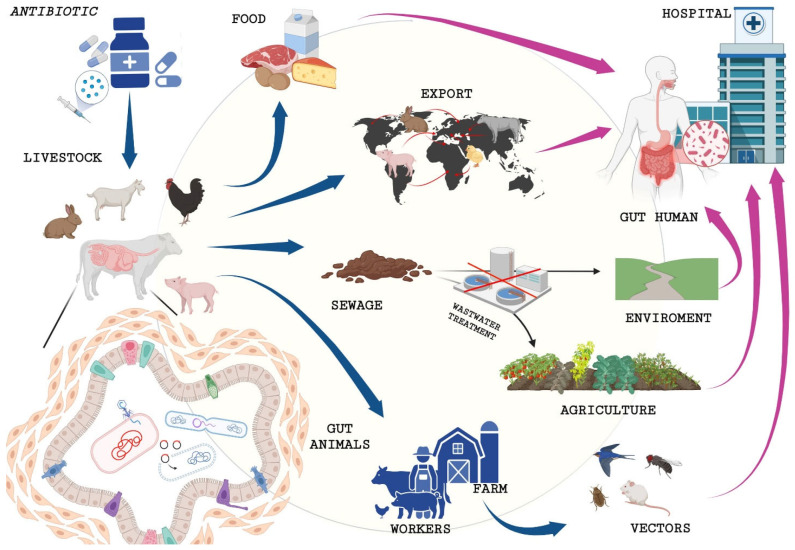
Figure 1
Figure 1
Pathways of antibiotic-resistant bacteria. Antibiotics used in veterinary medicine have the potential to contribute to the emergence of antimicrobial resistance (AMR) if not regulated effectively. The mechanisms by which resistance genes are transferred are more rapid in the gut tract of animals due to prolonged contact between different species, the greater number of microorganisms, and their close proximity. The following mechanisms have been identified: conjugation, transduction, and transformation. The subsequent transmission of these genes to bacteria can occur through diverse routes.
Figure 2
Figure 2
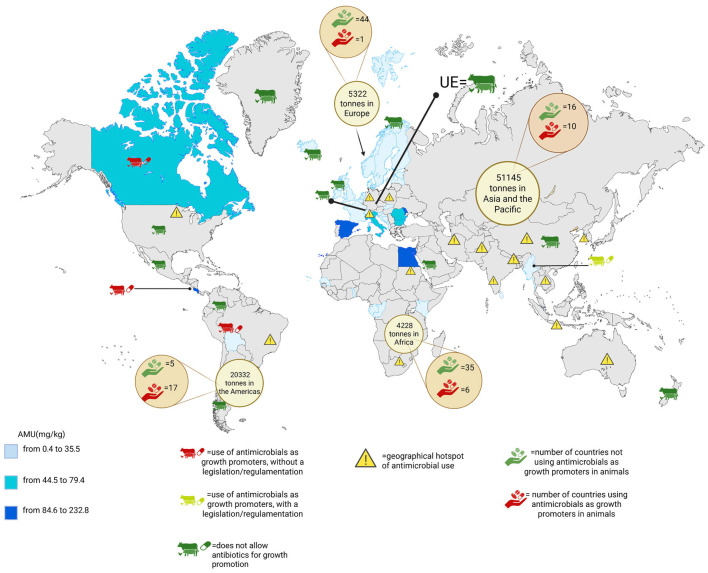
Global map integrating data on antimicrobial use (AMU) in food-producing animals. The most recent years of recorded AMU values were obtained from the WOAH AMU Data Portal. The 2022 data are available for the following countries: Finland, Ireland, Montenegro, the United Kingdom, and Senegal. The 2023 data set is from the following countries: Albania, Belgium, Bosnia and Herzegovina, Bulgaria, Croatia, Denmark, Estonia, France, Iceland, Italy, Latvia, Moldova, Norway, Romania, Slovakia, Slovenia, Spain, Sweden, Switzerland, the Netherlands, Myanmar, Sri Lanka, Bolivia, Canada, Costa Rica, Cuba, St. Vincent and the Grenadines, Cape Verde, the Republic of the Congo, Egypt, Gabon, Kenya, and Togo. Countries that use antimicrobials as growth promoters are highlighted, showing if they regulate this use (as in Myanmar—yellow icon) or not (as in Bolivia, Canada, and Costa Rica—red icon). Countries with legislation banning or restricting the use of antimicrobials as growth promoters are also indicated (e.g., Chile; China, Colombia; Greenland; Iceland; Saudi Arabia; the EU; the UK; and the USA).
Figure 3
Figure 3
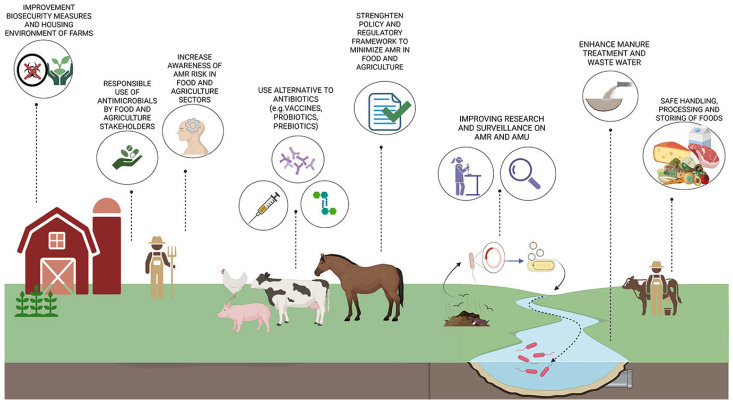
Strategies for combatting antimicrobial resistance.

References

    1. Mancuso G., De Gaetano S., Midiri A., Zummo S., Biondo C. The Challenge of Overcoming Antibiotic Resistance in Carbapenem-Resistant Gram-Negative Bacteria: “Attack on Titan”. Microorganisms. 2023;11:1912. doi: 10.3390/microorganisms11081912. - DOI - PMC - PubMed
    1. Adedeji W.A. The Treasure Called Antibiotics. Ann. Ib. Postgrad. Med. 2016;14:56–57. - PMC - PubMed
    1. Muteeb G., Rehman M.T., Shahwan M., Aatif M. Origin of Antibiotics and Antibiotic Resistance, and Their Impacts on Drug Development: A Narrative Review. Pharmaceuticals. 2023;16:1615. doi: 10.3390/ph16111615. - DOI - PMC - PubMed
    1. Selvarajan R., Obize C., Sibanda T., Abia A.L.K., Long H. Evolution and Emergence of Antibiotic Resistance in Given Ecosystems: Possible Strategies for Addressing the Challenge of Antibiotic Resistance. Antibiotics. 2022;12:28. doi: 10.3390/antibiotics12010028. - DOI - PMC - PubMed
    1. Larsson D.G.J., Flach C.F. Antibiotic resistance in the environment. Nat. Rev. Microbiol. 2022;20:257–269. doi: 10.1038/s41579-021-00649-x. - DOI - PMC - PubMed

LinkOut - more resources