


Modulating Cognition-Linked Histone Acetyltransferases (HATs) as a Therapeutic Strategy for Neurodegenerative Diseases: Recent Advances and Future Trends
- PMID: 40558500
- PMCID: PMC12190429
- DOI: 10.3390/cells14120873
Modulating Cognition-Linked Histone Acetyltransferases (HATs) as a Therapeutic Strategy for Neurodegenerative Diseases: Recent Advances and Future Trends
Abstract
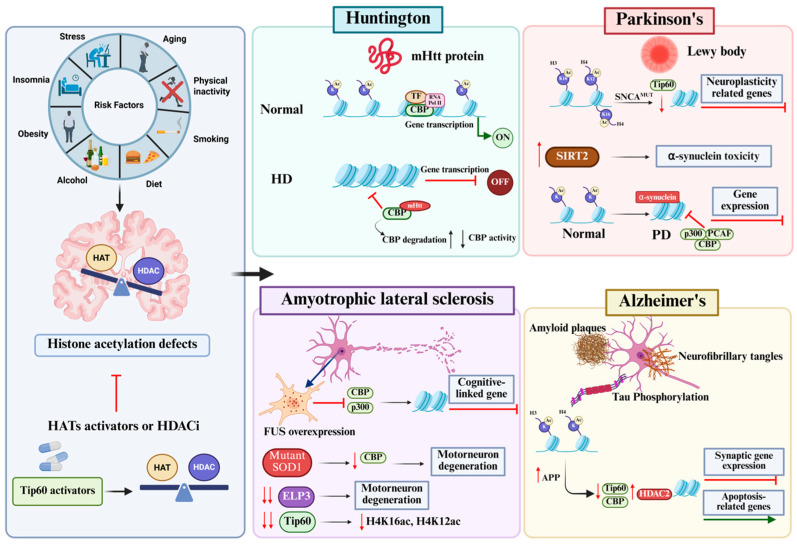
Recent investigations into the neuroepigenome of the brain are providing unparalleled understanding into the impact of post-translational modifications (PTMs) of histones in regulating dynamic gene expression patterns required for adult brain cognitive function and plasticity. Histone acetylation is one of the most well-characterized PTMs shown to be required for neuronal function and cognition. Histone acetylation initiates neural circuitry plasticity via chromatin control, enabling neurons to respond to external environmental stimuli and adapt their transcriptional responses accordingly. While interplay between histone acetylation and deacetylation is critical for these functions, dysregulation during the aging process can lead to significant alterations in the neuroepigenetic landscape. These alterations contribute to impaired cognitive functions, neuronal cell death, and brain atrophy, all hallmarks of age-related neurodegenerative disease. Significantly, while age-related generation of DNA mutations remains irreversible, most neuroepigenetic PTMs are reversible. Thus, manipulation of the neural epigenome is proving to be an effective therapeutic strategy for neuroprotection in multiple types of age-related neurodegenerative disorders (NDs) that include Alzheimer's disease (AD), Parkinson's disease (PD), Amyotrophic lateral sclerosis (ALS) and Huntington's disease (HD). Here, we highlight recent progress in research focusing on specific HAT-based neuroepigenetic mechanisms that underlie cognition and pathogenesis that is hallmarked in age-related NDs. We further discuss how these findings have potential to be translated into HAT-mediated cognitive-enhancing therapeutics to treat these debilitating disorders.
Keywords: cell death; histone acetyltransferases (HATs); histone code; histone deacetylases (HDACs); learning and memory; neurodegenerative diseases (NDs); neuroepigenetics; synaptic plasticity.
Conflict of interest statement
The authors declare no conflict of interest.
Figures

References
Publication types
MeSH terms
Substances
Grants and funding
LinkOut - more resources
Full Text Sources
Medical
Miscellaneous
