


Drivers of Lassa fever in an endemic area of southwestern Nigeria (2017-2021): An epidemiological study
- PMID: 40561161
- PMCID: PMC12193570
- DOI: 10.1371/journal.pone.0327143
Drivers of Lassa fever in an endemic area of southwestern Nigeria (2017-2021): An epidemiological study
Abstract
Background: Reporting two million human Lassa fever (LF) cases with around 10,000 associated annual mortality, the West African sub-region is endemic for Lassa fever virus (LASV). The true incidence of LF is difficult to determine because most LASV-infected individuals show no differentiating clinical signs and symptoms. We investigated the distribution of cases, post-hospitalization survival patterns, and evaluated factors contributing to infection and clinical course of the disease during an outbreak of LF in Ondo State, Nigeria, from 2017 to 2021.
Methods: We extracted LF data from the Integrated Disease Surveillance and Response weekly report of the Nigerian Centre for Disease Control for 2017-2021. Kaplan-Meier estimate was used to describe the probability of survival among the LF cases. Also, a univariable binary logistic regression was used to explore factors associated with mortality among the study participants. Key informant was interviewed and environmental assessments were also done.
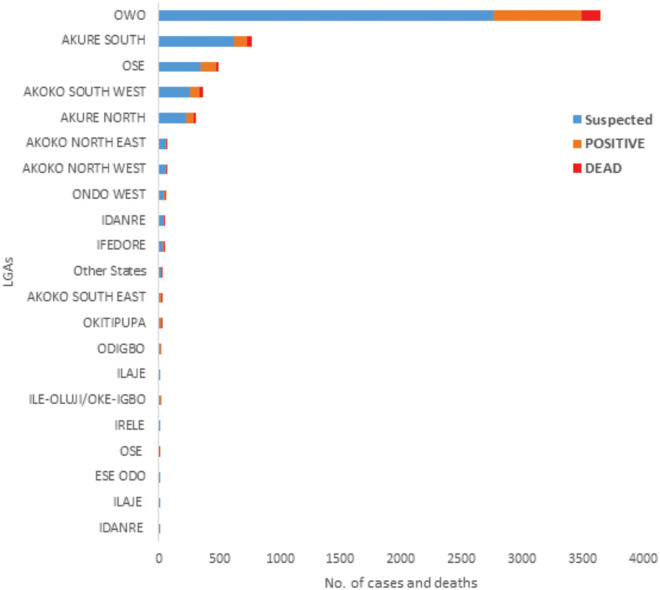
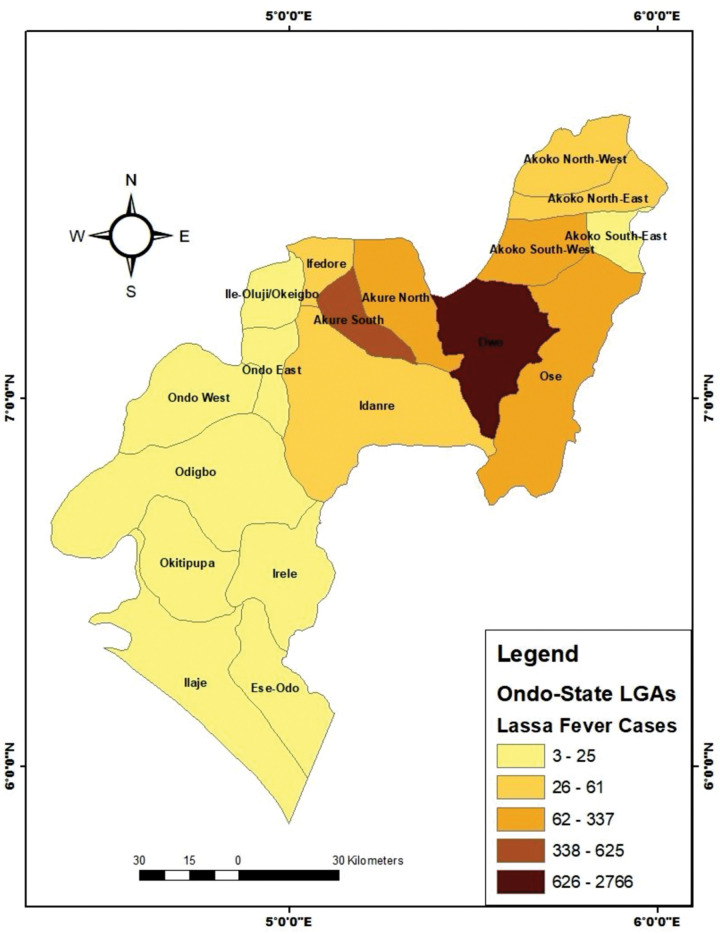
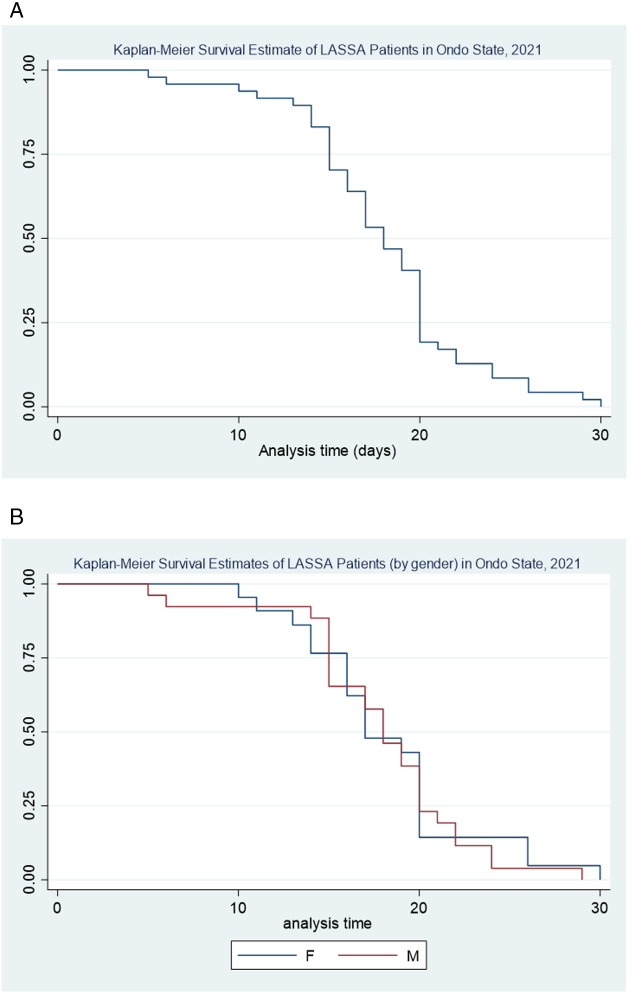
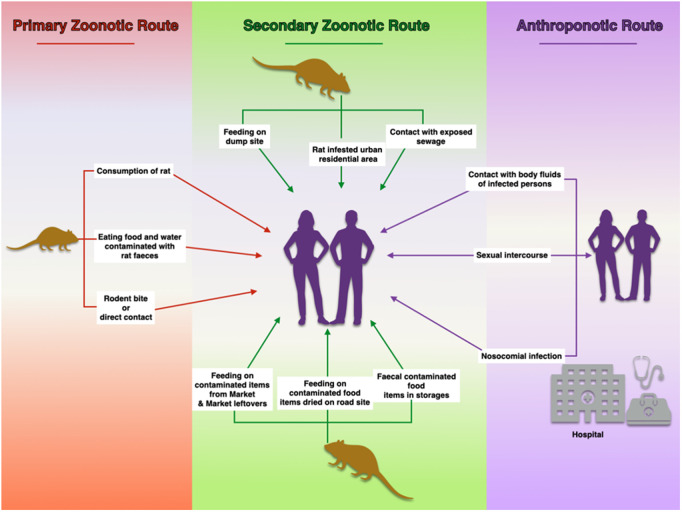
Results: LASV infection was confirmed in 1,115 (24.5%) of 4,551 cases with clinical signs suggestive of LF (age 35.24 ± 20.77) and case fatality rate of 25.5%. Hospitalized patients who did not recover within 17 days had less than 50% chance of survival. Age is a strong predictor of survival; hospitalized patients >40 years were significantly more likely than younger ones to experience mortality (Odds ratio:2.46; 95% CI = 1.67-3.62; p < 0.01). Similarly, male patients were significantly less likely than the females to survive beyond 10 days of hospitalization. Open sun drying of food items and congested urban residential settings with history of frequent rat sightings are possible factors for the increase of LF cases in the study area.
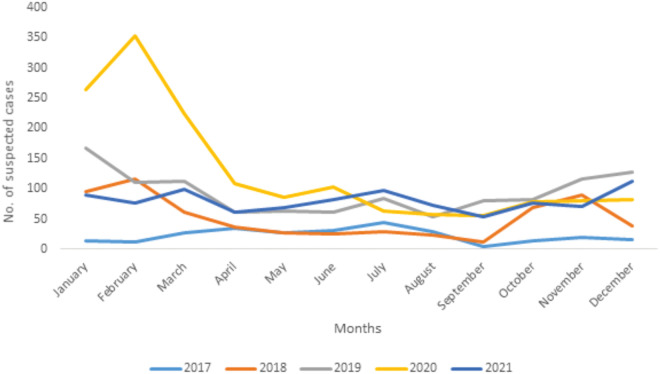
Conclusion: Current case definition in Ondo State identified close to 25% of laboratory confirmed LASV infection. Human activities during the dry season (October-March) are associated with increased LF cases. We propose a One Health disease surveillance approach that synchronizes farming activities with educational campaigns as a mitigation strategy against LASV infection and mortality in Nigeria.
Copyright: This is an open access article, free of all copyright, and may be freely reproduced, distributed, transmitted, modified, built upon, or otherwise used by anyone for any lawful purpose. The work is made available under the Creative Commons CC0 public domain dedication.
Conflict of interest statement
The authors have declared that no competing interests exist.
Figures
Similar articles
-
Epidemiological characteristics and hospital outcomes of hospitalized Lassa fever cases during the 2022-2023 outbreak in Liberia.F1000Res. 2025 Jun 10;13:661. doi: 10.12688/f1000research.150743.3. eCollection 2024. F1000Res. 2025. PMID: 40496906 Free PMC article.
-
Signs and symptoms to determine if a patient presenting in primary care or hospital outpatient settings has COVID-19.Cochrane Database Syst Rev. 2022 May 20;5(5):CD013665. doi: 10.1002/14651858.CD013665.pub3. Cochrane Database Syst Rev. 2022. PMID: 35593186 Free PMC article.
-
Estimation of Lassa fever incidence rates in West Africa: Development of a modeling framework to inform vaccine trial design.PLoS Negl Trop Dis. 2025 Jul 29;19(7):e0012751. doi: 10.1371/journal.pntd.0012751. eCollection 2025 Jul. PLoS Negl Trop Dis. 2025. PMID: 40729359 Free PMC article.
-
The epidemiology of Lassa fever in Ghana: a study on the 2023 Lassa fever outbreak in Ghana.Front Public Health. 2025 Apr 28;13:1542842. doi: 10.3389/fpubh.2025.1542842. eCollection 2025. Front Public Health. 2025. PMID: 40356840 Free PMC article.
-
Sertindole for schizophrenia.Cochrane Database Syst Rev. 2005 Jul 20;2005(3):CD001715. doi: 10.1002/14651858.CD001715.pub2. Cochrane Database Syst Rev. 2005. PMID: 16034864 Free PMC article.
References
-
- World Health Organization (WHO). Lassa Fever Fact Sheet. 2017.
MeSH terms
LinkOut - more resources
Full Text Sources
