Review
. 2025 Jun 14;14(6):731.
doi: 10.3390/antiox14060731.

Restoring Glutathione Homeostasis in Glycation-Related Eye Diseases: Mechanistic Insights and Therapeutic Interventions Beyond VEGF Inhibition

Affiliations
Review

Restoring Glutathione Homeostasis in Glycation-Related Eye Diseases: Mechanistic Insights and Therapeutic Interventions Beyond VEGF Inhibition

Yong Chool Boo. Antioxidants (Basel). .

Abstract

Advanced glycation end-products (AGEs) and oxidative stress are recognized as central contributors to the pathogenesis of age-related or diabetic cataracts, diabetic retinopathy (DR), and age-related macular degeneration (AMD). These glycation-related diseases are characterized by impaired redox balance and decreased glutathione (GSH) levels. This review aims to examine the mechanistic links between AGEs and GSH depletion across ocular tissues by integrating in vitro, ex vivo, in vivo, and clinical studies relevant to this topic. The multiple levels of evidence highlight GSH homeostasis as both a biomarker and therapeutic target in glycation-related ocular disorders. Therapeutic strategies aimed at restoring GSH homeostasis under glycation stress are categorized into four mechanistic domains: (I) promoting GSH supply and synthesis, (II) enhancing GSH recycling, (III) mitigating glycation stress, and (IV) reducing oxidative and nitrosative stress. Most of these strategies have been explored via different approaches, and experimental findings with various interventions have shown promise in restoring GSH balance and mitigating AGE-induced damage. A pathological link between GSH depletion and vascular endothelial growth factor (VEGF) overexpression is observed in DR and wet AMD. GSH-centered interventions act upstream to modulate redox homeostasis while anti-VEGF therapies target downstream angiogenesis. This study supports the rationale for a dual-targeting strategy that combines redox-based interventions with VEGF inhibition in glycation-related ocular diseases.

Keywords: advanced glycation end-products; age-related macular degeneration; aldose reductase inhibitors; cataracts; diabetic retinopathy; glutathione; glyoxalase; oxidative stress; redox homeostasis.


Conflict of interest statement

The authors declare no conflicts of interest.

Figures
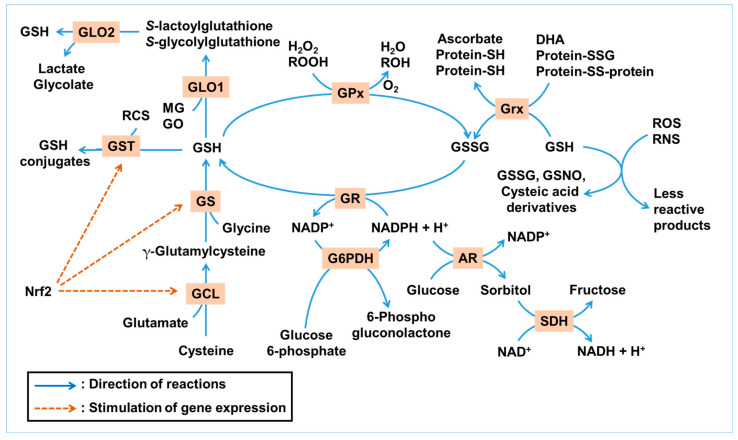
Figure 1
Figure 1
Glutathione (GSH)-centered antioxidant and antiglycation network. This illustration summarizes the antioxidant and antiglycation roles of GSH under metabolic stress. GSH can directly react non-enzymatically with a range of reactive oxygen species (ROS) and reactive nitrogen species (RNS), such as hydroxyl radicals (OH), nitric oxide (NO), and peroxynitrite (ONOO), resulting in its conversion into GSSG, GSNO, or cysteic acid derivatives, while neutralizing ROS/RNS into less reactive products. Enzymatically, GSH serves as a substrate for glutathione peroxidase (GPx) to reduce hydrogen peroxide (H2O2) and lipid hydroperoxides (ROOH), and for glutaredoxin (Grx) to reduce protein disulfides and dehydroascorbate (DHA). GSH is regenerated from its oxidized form, GSSG, by glutathione reductase (GR) using NADPH. NADPH is mainly regenerated through glucose 6-phosphate dehydrogenase (G6PDH), with contributions from other NADPH-generating enzymes. The GLO system utilizes GSH to detoxify methylglyoxal (MG) and glyoxal (GO). Glutathione S-transferase (GST) conjugates GSH to various electrophilic xenobiotics and reactive carbonyl species (RCS). GSH is synthesized de novo via glutamate–cysteine ligase (GCL) and glutathione synthetase (GS) in two ATP-dependent steps. These enzymes are transcriptionally regulated by nuclear factor erythroid 2-related factor 2 (Nrf2), a master antioxidant response factor. The polyol pathway, initiated by aldose reductase (AR) and followed by sorbitol dehydrogenase (SDH), consumes NADPH during glucose-to-sorbitol conversion, reducing NADPH availability for GSH regeneration. Collectively, this network demonstrates how redox and carbonyl homeostasis in ocular tissues are maintained through a tightly regulated, NADPH-dependent enzymatic system centered on GSH. Blue arrows indicate the directionality of reactions, whereas brown dashed arrows denote the activation of gene expression.
Figure 2
Figure 2
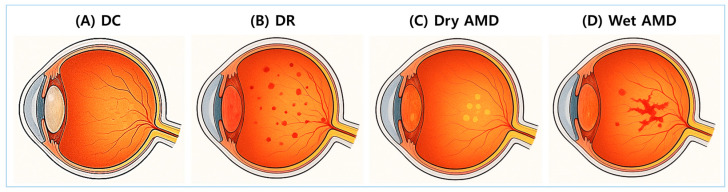
Anatomical illustrations of major glycation-related eye diseases. Cross-sectional images of the eye illustrate four major ocular complications associated with glycation and oxidative stress. (A) Diabetic cataracts (DCs): A condition characterized by opacification of the lens. (B) Diabetic retinopathy (DR): A diabetes-related complication involving progressive retinal vascular damage. (C) Dry age-related macular degeneration (AMD): A condition characterized by the accumulation of drusen and atrophy of the retinal pigment epithelium (RPE). (D) Wet AMD: A condition marked by abnormal neovascularization beneath the retina and within the subretinal space.
Figure 3
Figure 3
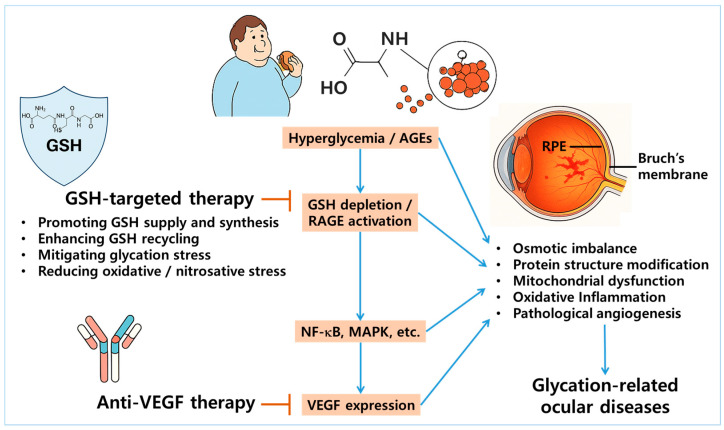
Rationale for dual targeting of GSH homeostasis and VEGF pathways in glycation-related ocular diseases. Chronic hyperglycemia and accumulation of AGEs promote GSH depletion and activate the receptor for AGEs (RAGE), leading to the downstream stimulation of nuclear factor kappa B (NF-κB) and mitogen-activated protein kinase (MAPK) signaling pathways. This cascade ultimately results in the overexpression of vascular endothelial growth factor (VEGF), driving pathological angiogenesis in ocular tissues—particularly within the RPE and Bruch’s membrane. The illustration highlights this mechanistic interplay as a therapeutic rationale for dual targeting: restoring GSH homeostasis to mitigate oxidative and glycation-induced stress, while concurrently inhibiting VEGF to suppress neovascularization. Arrows represent stimulation, whereas blunted bars indicate prevention or inhibition.

References

    1. Lam N.V. Adult Eye Conditions: Diabetic Retinopathy and Age-Related Macular Degeneration. FP Essent. 2022;519:24–28. - PubMed
    1. Cvekl A., Vijg J. Aging of the eye: Lessons from cataracts and age-related macular degeneration. Ageing Res. Rev. 2024;99:102407. doi: 10.1016/j.arr.2024.102407. - DOI - PMC - PubMed
    1. Castro-Castaneda C.R., Altamirano-Lamarque F., Ortega-Macias A.G., Santa Cruz-Pavlovich F.J., Gonzalez-De la Rosa A., Armendariz-Borunda J., Santos A., Navarro-Partida J. Nutraceuticals: A Promising Therapeutic Approach in Ophthalmology. Nutrients. 2022;14:5014. doi: 10.3390/nu14235014. - DOI - PMC - PubMed
    1. Bejarano E., Taylor A. Too sweet: Problems of protein glycation in the eye. Exp. Eye Res. 2019;178:255–262. doi: 10.1016/j.exer.2018.08.017. - DOI - PMC - PubMed
    1. Yamagishi S., Maeda S., Matsui T., Ueda S., Fukami K., Okuda S. Role of advanced glycation end products (AGEs) and oxidative stress in vascular complications in diabetes. Biochim. et Biophys. Acta. 2012;1820:663–671. doi: 10.1016/j.bbagen.2011.03.014. - DOI - PubMed

LinkOut - more resources