


Heart Failure and Wide QRS: Clinical and Pharmacological Perspectives
- PMID: 40564182
- PMCID: PMC12190266
- DOI: 10.3390/biomedicines13061462
Heart Failure and Wide QRS: Clinical and Pharmacological Perspectives
Abstract
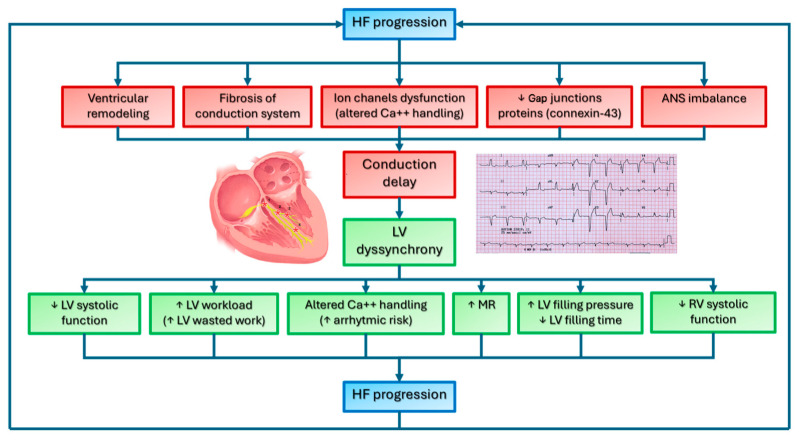
Heart failure (HF) is a highly prevalent cardiovascular clinical syndrome. Health care spending on HF treatment is high. Therefore, its treatment has generated a great deal of interest in pharmacological research in recent years. Recent guidelines have introduced several molecules for the treatment of HF that have demonstrated safety, and above all, efficacy. One of the worst aspects of HF is ventricular dyssynchrony (VD) with a wide QRS interval. Currently, the cornerstone of VD therapy is cardiac resynchronization therapy (CRT). Our comprehensive review aims to analyze the effects of new molecules on QRS width and understand whether these molecules can provide benefits.
Keywords: QRS widening; cardiac remodeling; dapagliflozin; empagliflozin; heart failure; sacubitril/valsartan; ventricular dyssynchrony; vericiguat.
Conflict of interest statement
The authors declare no conflicts of interest.
Figures

References
-
- McDonagh T.A., Metra M., Adamo M., Gardner R.S., Baumbach A., Böhm M., Burri H., Butler J., Čelutkienė J., Chioncel O., et al. 2021 ESC Guidelines for the Diagnosis and Treatment of Acute and Chronic Heart Failure: Developed by the Task Force for the Diagnosis and Treatment of Acute and Chronic Heart Failure of the European Society of Cardiology (ESC) with the Special Contribution of the Heart Failure Association (HFA) of the ESC. Eur. Heart J. 2021;42:3599–3726. doi: 10.1093/eurheartj/ehab368. Erratum in Eur. Heart J. 2021, 42, 4901. - DOI - PubMed
-
- Kass D.A. Ventricular Dyssynchrony and Mechanisms of Resynchronization Therapy. Eur. Heart J. Suppl. 2002;4:D23–D30. doi: 10.1093/ehjsupp/4.suppl_D.D23. - DOI
Publication types
LinkOut - more resources
Full Text Sources
Research Materials
Miscellaneous
