


Valorization of Carob and Brewer's Spent Grain as Growth-Substrate Supplements in Tenebrio molitor Rearing
- PMID: 40564249
- PMCID: PMC12189906
- DOI: 10.3390/ani15121697
Valorization of Carob and Brewer's Spent Grain as Growth-Substrate Supplements in Tenebrio molitor Rearing
Abstract
Background: Agro-industrial by-products, such as carob and brewer's spent grain (BSG), have gained increasing attention as sustainable feed ingredients capable of enhancing the nutritional and functional value of Tenebrio molitor larvae. This study aimed to evaluate the effects of carob and BSG supplementation of growth substrates on larval performance and the functional properties of the resulting insect meals.
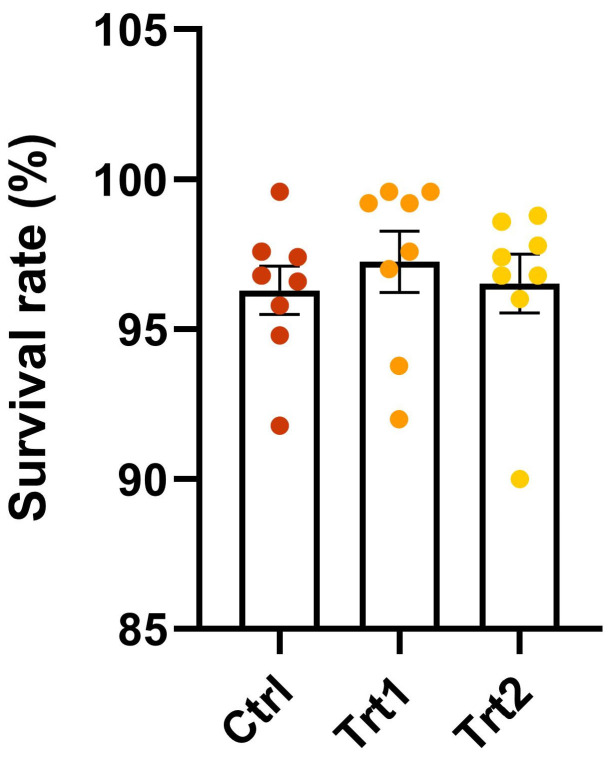
Methods: Seven-week-old larvae were reared for 14 days on the following three diets: control (wheat bran), wheat bran + carob (Trt1), and wheat bran + BSG (Trt2). Larval weight, substrate consumption, and survival were recorded. After processing, insect meals were analyzed for chemical composition, total phenolic content (TPC), and antioxidant activity in both water- and lipid-soluble extracted fractions.
Results: Both treatment groups showed significantly higher final weights than the control (Ctrl: 104.9 ± 2.69 g; Trt1: 114.8 ± 1.26 g; Trt2: 116.9 ± 1.07 g; p < 0.05). TPC was highest in the control for both fractions, and the antioxidant activity was similar between the Ctrl and Trt1 groups in the water-soluble fraction but significantly lower in the Trt2 group (p < 0.05).
Conclusions: These findings highlight the potential of carob and BSG for sustainable insect farming, though their functional benefits may depend on the inclusion levels and their interaction with insect metabolism.
Keywords: Tenebrio molitor; agro-industrial by-products; antioxidant activity; brewer’s spent grain; carob; circular economy; functional feed; insect meals; sustainable protein source; total phenolic content.
Conflict of interest statement
The authors declare no conflicts of interest.
Figures


References
-
- Food and Agriculture Organization (FAO) World Livestock: Transforming the Livestock Sector Through the Sustainable Development Goals. FAO; Rome, Italy: 2019.
-
- Hefferon K.L., De Steur H., Perez-Cueto F.J.A., Herring R. Alternative Protein Innovations and Challenges for Industry and Consumer: An Initial Overview. Front. Sustain. Food Syst. 2023;7:1038286. doi: 10.3389/fsufs.2023.1038286. - DOI
-
- European Parliament Regulation (EU) 2015/2283 of the European Parliament and of the Council of 25 November 2015 on Novel Foods, Amending Regulation (EU) No 1169/2011 of the European Parliament and of the Council and Repealing Regulation (EC) No 258/97 of the European Parliament and of the Council and Commission Regulation (EC) No 1852/2001 (Text with EEA Relevance) [(accessed on 20 April 2025)];Off. J. Eur. Union. 2015 Available online: http://data.europa.eu/eli/reg/2015/2283/oj.
-
- European Parliament Regulation (EU) No 1169/2011 of the European Parliament and of the Council of 25 October 2011 on the Provision of Food Information to Consumers, Amending Reg (EC) No 1924/2006 and (EC) No 1925/2006 of the European Parliament and of the Council, and Repealing Commission Dir 87/250/EEC, Council Directive 90/496/EEC, Commission Directive 1999/10/EC, Directive 2000/13/EC of the European Parliament and of the Council, Commission Dir 2002/67/EC and 2008/5/EC and Commission Reg (EC) No 608/2004. [(accessed on 20 April 2025)];Off. J. Eur. Union. 2011 Available online: http://data.europa.eu/eli/reg/2011/1169/oj.
Grants and funding
LinkOut - more resources
Full Text Sources
Miscellaneous
