


Genome-Wide Association Study for Individual Primal Cut Quality Traits in Canadian Commercial Crossbred Pigs
- PMID: 40564306
- PMCID: PMC12189728
- DOI: 10.3390/ani15121754
Genome-Wide Association Study for Individual Primal Cut Quality Traits in Canadian Commercial Crossbred Pigs
Abstract
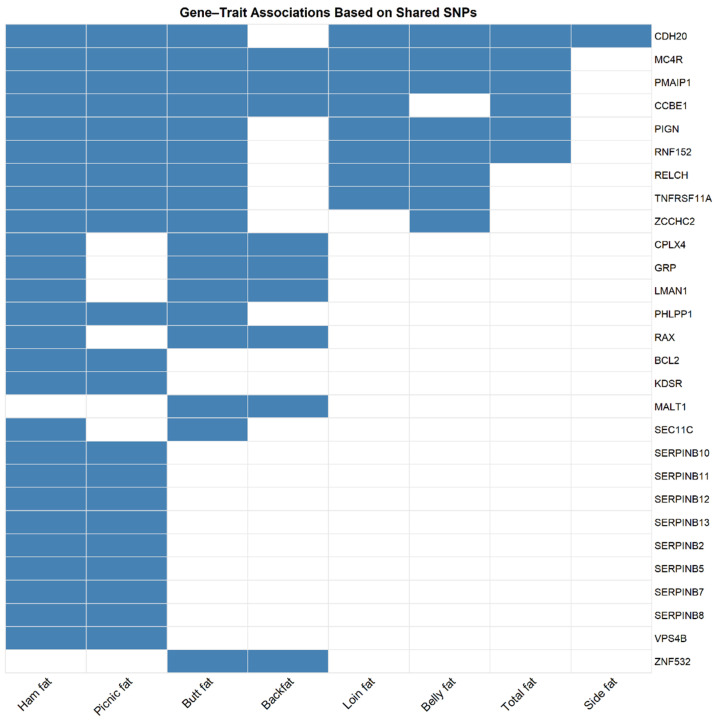
This study identified genomic variants and potential candidate genes associated with 11 primal cut traits (back fat, belly fat, total fat, loin fat, ham fat, picnic fat, butt fat, loin intramuscular fat content, ham side fat, shoulder dorsal fat, and belly side fat thicknesses) in Canadian commercial crossbred pigs. Genome-wide association studies using whole genome sequencing data were conducted using genotyping data from 1118 commercial crossbred pigs. This analysis revealed multiple QTLs across chromosomes SSC1, 2, 3, 6, 7, 9, 14, 15, and 17, associated with fat traits. Notably, an SNP at position 160,230,075 bp on SSC1 was significantly associated with multiple fat traits, including belly fat, butt fat, ham fat, loin fat, picnic fat, and side fat. Common genes in windows associated with multiple traits, such as MC4R, RNF152, and CDH20 were shared across these traits, suggesting pleiotropic effects. Some of the QTLs were near previously identified QTLs or candidate genes that have been reported to be linked to meat quality traits associated with backfat and intramuscular fat. Other candidate genes identified in the study include TNFRSF11A, LEPR, and genes from the SERPINB family, highlighting their roles in fat deposition and composition. Additional candidate genes were also implicated in regulation of fat metabolism, adipogenesis, and adiposity. These findings offer valuable insights into the genetic architecture of fat traits in pigs, which could inform breeding strategies aimed at improving the pork quality.
Keywords: SNPs; fat metabolism; pork quality; primal fat; whole genome sequencing.
Conflict of interest statement
Kerry Houlahan and Robert Kemp were employees of Genesus Genetic Technology Inc. at the time of the study. The remaining authors declare that the research was conducted in the absence of any commercial or financial relationships that could be construed as a potential conflict of interest.
Figures



References
-
- Li J., Wu J., Jian Y., Zhuang Z., Qiu Y., Huang R., Lu P., Guan X., Huang X., Li S., et al. Genome-Wide Association Studies Revealed Significant QTLs and Candidate Genes Associated with Backfat and Loin Muscle Area in Pigs Using Imputation-Based Whole Genome Sequencing Data. Animals. 2022;12:2911. doi: 10.3390/ani12212911. - DOI - PMC - PubMed
-
- Miar Y., Plastow G.S., Moore S.S., Manafiazar G., Charagu P., Kemp R.A., van Haandel B., Huisman A.E., Zhang C.Y., Mckay R.M., et al. Genetic and Phenotypic Parameters for Carcass and Meat Quality Traits in Commercial Crossbred Pigs. J. Anim. Sci. 2014;92:2869–2884. doi: 10.2527/jas.2014-7685. - DOI - PubMed
-
- Ciobanu D.C., Lonergan S.M., Huff-Lonergan E.J. The Genetics of the Pig. CABI; Wallingford, UK: 2011. Genetics of Meat Quality and Carcass Traits; pp. 355–389.
Grants and funding
LinkOut - more resources
Full Text Sources
Miscellaneous
