


Age and Gender Differences in Emotional and Behavioral Functioning Among Youth Referred to a Psychiatric Outpatient Clinic at a Public Hospital
- PMID: 40564641
- PMCID: PMC12191876
- DOI: 10.3390/children12060683
Age and Gender Differences in Emotional and Behavioral Functioning Among Youth Referred to a Psychiatric Outpatient Clinic at a Public Hospital
Abstract
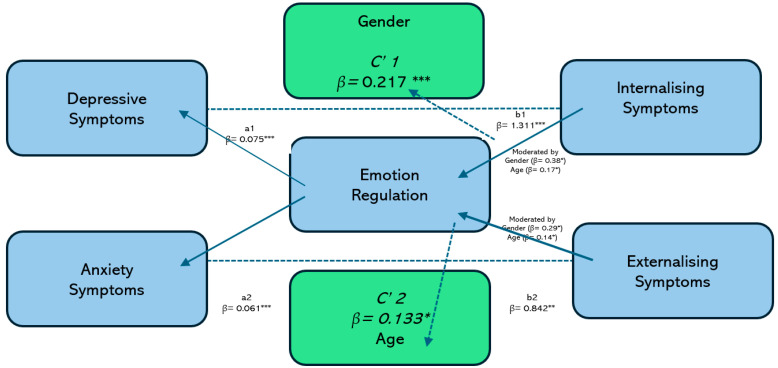
Background: Emotional and behavioral difficulties are prevalent among children and adolescents referred for psychiatric care. This study examined how these challenges vary across age and gender, including regulatory functioning. It also explored whether emotion regulation mediates the relationship between depressive symptoms and internalizing problems and whether this mediating effect is moderated by gender and age.
Methods: A cross-sectional study was conducted among 661 children and adolescents (aged 9-17 years) referred to a psychiatric outpatient clinic. Participants completed self-report questionnaires assessing depressive symptoms (MFQ-C), anxiety (SCARED-C), emotion regulation (DERS), and emotional/behavioral problems (SDQ). Statistical analyses included group comparisons and moderated mediation modeling using SPSS 27.
Results: Adolescents aged 15-17 years reported significantly higher levels of depressive symptoms, emotion regulation difficulties, and anxiety-related symptoms compared to younger participants. Girls exhibited higher levels of internalizing symptoms and greater emotion regulation difficulties than boys, whereas boys showed more conduct problems. A significant gender × age interaction was found for depressive symptoms. Depressive symptoms indirectly affected internalizing problems through emotion regulation, with the strongest effect among adolescent girls.
Conclusions: The findings emphasize the need for developmentally tailored assessment and intervention strategies in youth psychiatric care. Emotion regulation emerged as a central mechanism linking depressive symptoms to internalizing difficulties, particularly in older adolescent girls, supporting the design of targeted interventions to reduce emotional distress.
Keywords: adolescents; anxiety; children; depression; developmental psychopathology; emotion regulation; gender differences; mental health; psychiatric care.
Conflict of interest statement
The authors declare no conflicts of interest.
Figures

References
-
- Solmi M., Radua J., Olivola M., Croce E., Soardo L., Salazar de Pablo G., Il Shin J., Kirkbride J.B., Jones P., Kim J.H. Age at onset of mental disorders worldwide: Large-scale meta-analysis of 192 epidemiological studies. Mol. Psychiatry. 2022;27:281–295. doi: 10.1038/s41380-021-01161-7. - DOI - PMC - PubMed
-
- Gross J.J. Emotion regulation: Current status and future prospects. Psychol. Inq. 2015;26:1–26. doi: 10.1080/1047840X.2014.940781. - DOI
LinkOut - more resources
Full Text Sources
