


The Impact of Early Cranial Doppler Ultrasonography on Prognosis in Neonates with Perinatal Asphyxia
- PMID: 40564703
- PMCID: PMC12191212
- DOI: 10.3390/children12060745
The Impact of Early Cranial Doppler Ultrasonography on Prognosis in Neonates with Perinatal Asphyxia
Abstract
Background: Cranial Doppler ultrasonography (DS) is a non-invasive method for evaluating cerebral hemodynamics in neonates with perinatal asphyxia (PA). This study aimed to assess whether cerebral vascular resistance indices (RIs) measured within the first 24 h of life can predict the severity of brain injury.
Methods: DS was performed on the anterior cerebral artery (ACA) and middle cerebral artery (MCA) between 6 and 24 h after birth in newborns diagnosed with PA. Prognostic value was evaluated by comparing RI values with cranial magnetic resonance imaging (MRI) results.
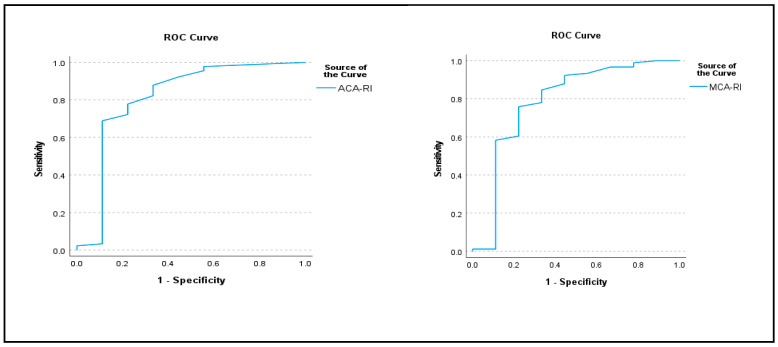
Results: Of the 107 infants included in the study, 11 (10.3%) had severe brain damage, 27 (25.2%) had mild and 20 (18.7%) had moderate changes. The mean ACA RI was 0.61 ± 0.15 in the severe group and 0.70 ± 0.12 in the mild-moderate group (p = 0.023). MCA RI was 0.63 ± 0.20 and 0.71 ± 0.13, respectively. ROC analysis showed an area under the curve (AUC) of 0.901 for ACA RI with a cut-off of 0.58 (84% sensitivity and 84% specificity), and 0.874 for MCA RI with a cut-off of 0.59 (83% sensitivity and 84% specificity).
Conclusions: Early ACA and MCA RI measurements via Doppler ultrasonography may serve as valuable predictors of brain injury severity in neonates with PA and should be considered alongside other clinical and imaging findings.
Keywords: Doppler USG; neonatal; perinatal asphyxia; resistive index.
Conflict of interest statement
The authors declare no conflicts of interest.
References
-
- Lee A.C., Kozuki N., Blencowe H., Vos T., Bahalim A., Darmstadt G.L., Niermeyer S., Ellis M., Robertson N.J., Cousens S., et al. Intrapartum-related neonatal encephalopathy incidence and impairment at regional and global levels for 2010 with trends from 1990. Pediatr. Res. 2013;74((Suppl. S1)):50–72. - PMC - PubMed
LinkOut - more resources
Full Text Sources
