. 2025 Jun 13;26(12):5681.
doi: 10.3390/ijms26125681.

Uropathogenic Escherichia coli Associated with Risk of Urosepsis-Genetic, Proteomic, and Metabolomic Studies

Affiliations

Uropathogenic Escherichia coli Associated with Risk of Urosepsis-Genetic, Proteomic, and Metabolomic Studies

Beata Krawczyk et al. Int J Mol Sci. .

Abstract

In the absence of fully effective therapies and preventive strategies against the development of urosepsis, a deeper understanding of the virulence mechanisms of Uropathogenic Escherichia coli (UPEC) strains is needed. UPEC strains employ a wide range of virulence factors (VFs) to persist in the urinary tract and bloodstream. UPEC strains were isolated from patients with sepsis and a control group without sepsis. PCR was used to detect 36 genes encoding various groups of virulence and fitness factors. Profiling of both intracellular and extracellular bacterial proteins was also included in our approach. Bacterial metabolites were identified and quantified using GC-MS and LC-MS techniques. The UpaG autotransporter, a trimeric E. coli AT adhesin, was significantly more prevalent in urosepsis strains (p = 0.00001). Iron uptake via aerobactin and the Iha protein also appeared to be predictive of urosepsis (p = 0.03 and p = 0.002, respectively). While some studies suggest an association between S fimbriae and the risk of urosepsis, we observed no such correlation (p = 0.0001). Proteomic and metabolomic analyses indicated that elevated levels of bacterial citrate, malate, coenzyme Q10, pectinesterase (YbhC), and glutamate transport proteins, as well as the regulators PhoP two-component system, CpxR two-component system, Nitrate/nitrite response regulator protein NarL, and the Ferrienterobactin receptor FepA, may play a role in sepsis. These genetic biomarkers, proteins, and metabolites derived from UPEC could potentially serve as indicators for assessing the risk of developing sepsis.

Keywords: Escherichia coli; OMICS technology; UPEC; markers; pathogenesis; sepsis; virulence.


Conflict of interest statement

The authors declare no conflicts of interest. The funders had no role in the design of the study; in the collection, analyses, or interpretation of data; in the writing of the manuscript; or in the decision to publish the results.

Figures
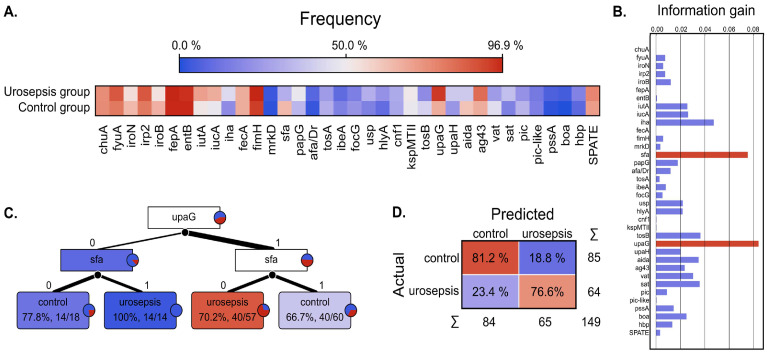
Figure 1
Figure 1
Binary classification results for urosepsis diagnostics. (A) the heatmap of the frequency of different virulence factors in the control and urosepsis groups. (B) Information gain analysis for feature selection; sfa adhesin encoding fimbriae S type and upaG gene encoding autotransporter; we paid special attention to autotransporters providing the highest score. (C) The classification tree for diagnostics of urosepsis. (D) Confusion matrix of the cross-validated classification model based on tree classifiers with a total classification accuracy of 79.2%; the percentage values represents the proportion of the actual target class. The heatmaps, feature ranking based on the information gain, and decision tree algorithm were performed using Orange Data Mining (v 3.36.1) [41]. Information gain provides information on data entropy reduction while splitting the data set into two target classes [42,43]. For the sake of analysis, those classes were the ‘control group’ and ‘urosepsis group’, respectively. The binary prediction model was validated using stratified 10-fold cross-validation. UpSet plots were generated using an R script with the UpSetR package (v 1.4.0).
Figure 2
Figure 2
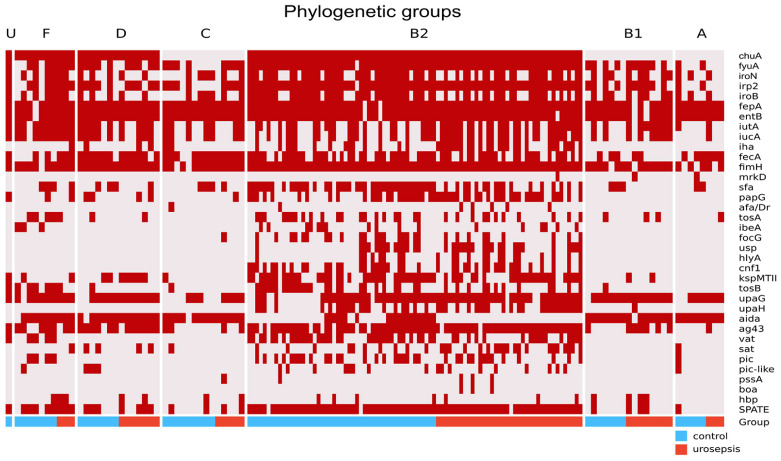
Heatmap of virulence factors detection in each phylogenetic group; red indicates detected virulence genes and the colored labels depict control (blue) and urosepsis (red) groups.
Figure 3
Figure 3
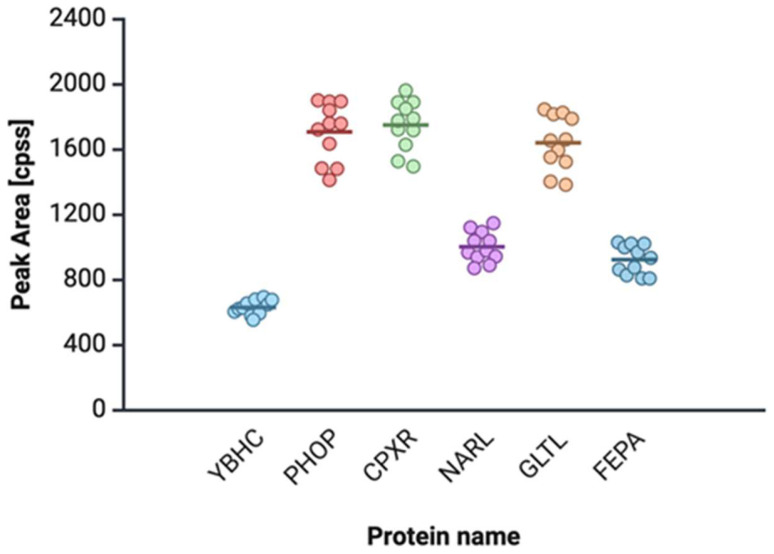
Proteins exclusively detected (presented as peak areas of respective peptides) in the proteomic profile of urosepsis-derived E. coli strains through untargeted LC-MS/MS analysis, absent in strains associated with uncomplicated urinary tract infections (UTIs). YBHC—pectinesterase; PHOP—phoP two-component system, OmpR family; CPXR—cpxR two-component system, OmpR family; NARL—key component of the nitrate respiration regulatory; GLTL—glutamate-aspartate transport system ATP-binding protein; FEPA—outer membrane receptor for ferric enterobactin.
Figure 4
Figure 4
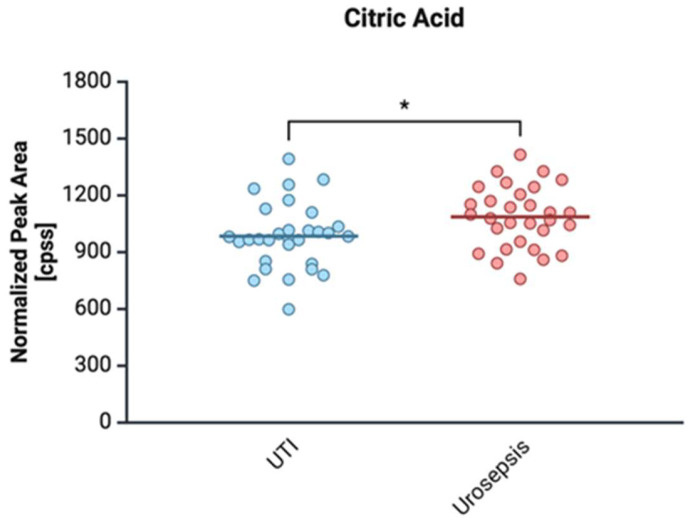
Comparison of citric acid levels in clinical E. coli isolates from patients with urinary tract infection (UTI) and urosepsis. Data are presented as mean ± standard deviation: UTI (984.6 ± 173.7) vs. urosepsis (1086.5 ± 162.5). * statistically significant levels p ≤ 0.05.
Figure 5
Figure 5
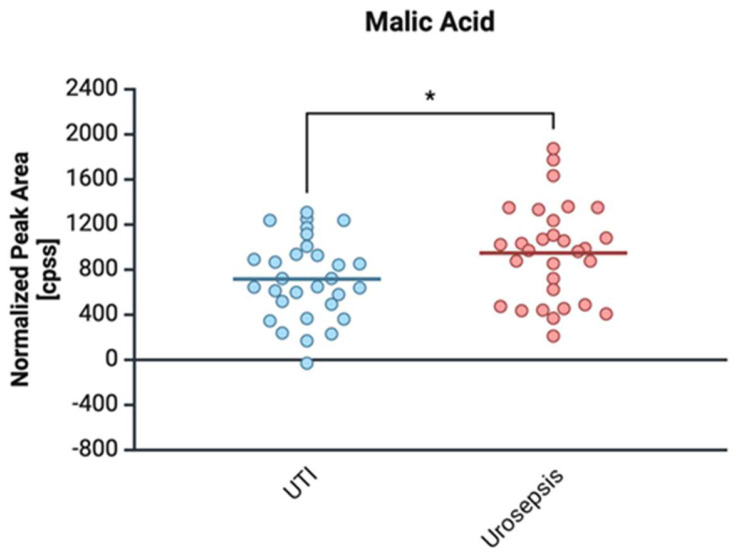
Comparison of malic acid levels in clinical E. coli isolates from patients with urinary tract infection (UTI) and urosepsis. Data are presented as mean ± standard deviation: UTI (716.67 ± 355.46) vs. urosepsis (947.75 ± 429.95); * statistically significant levels p ≤ 0.05.
Figure 6
Figure 6
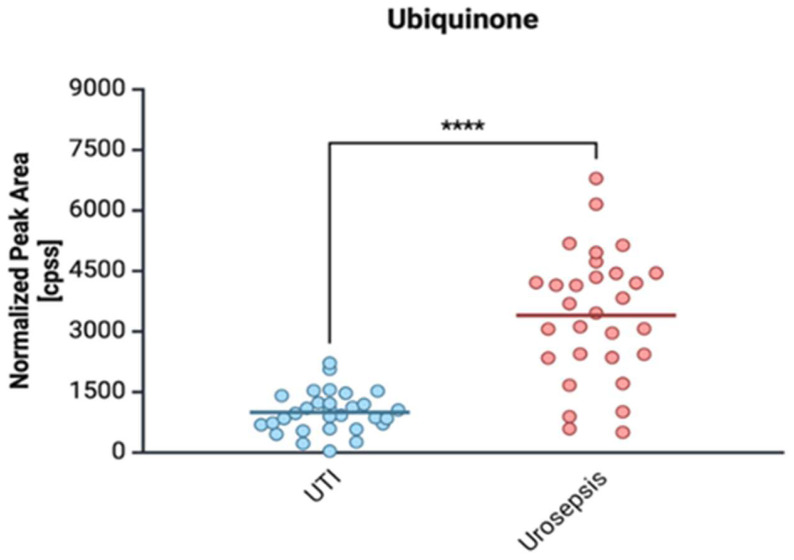
Comparison of ubiquinone levels in clinical E. coli isolates from patients with urinary tract infection (UTI) and urosepsis. Data are presented as mean ± standard deviation: UTI (998.18 ± 502.72) vs. urosepsis (3400.54 ± 1596.71); **** statistically significant levels p < 0.0001.

References

    1. He Y., Zhao J., Wang L., Han C., Yan R., Zhu P. Epidemiological Trends and Predictions of Urinary Tract Infections in the Global Burden of Disease Study 2021. Sci. Rep. 2025;15:4702. doi: 10.1038/s41598-025-89240-5. - DOI - PMC - PubMed
    1. Yang X., Chen H., Zheng Y., Qu S., Wang H., Yi F. Disease Burden and Long-Term Trends of Urinary Tract Infections: A Worldwide Report. Front. Public Health. 2022;10:888205. doi: 10.3389/fpubh.2022.888205. - DOI - PMC - PubMed
    1. Kaper J.B., Nataro J.P., Mobley H.L.T. Pathogenic Escherichia coli. Nat. Rev. Microbiol. 2004;2:123–140. doi: 10.1038/nrmicro818. - DOI - PubMed
    1. Manges A.R., Geum H.M., Guo A., Edens T.J., Fibke C.D., Pitout J.D.D. Global Extraintestinal Pathogenic Escherichia coli (ExPEC) Lineages. Clin. Microbiol. Rev. 2019;32:10-1128. doi: 10.1128/CMR.00135-18. - DOI - PMC - PubMed
    1. Kim B., Kim J.-H., Lee Y. Virulence Factors Associated with Escherichia coli Bacteremia and Urinary Tract Infection. Ann. Lab. Med. 2022;42:203–212. doi: 10.3343/alm.2022.42.2.203. - DOI - PMC - PubMed

MeSH terms

Substances

LinkOut - more resources