


Multilevel Interventions Demonstrate Mixed Effectiveness for Improving Blood Pressure Outcomes: A Rapid Review
- PMID: 40565425
- PMCID: PMC12192770
- DOI: 10.3390/healthcare13121397
Multilevel Interventions Demonstrate Mixed Effectiveness for Improving Blood Pressure Outcomes: A Rapid Review
Abstract
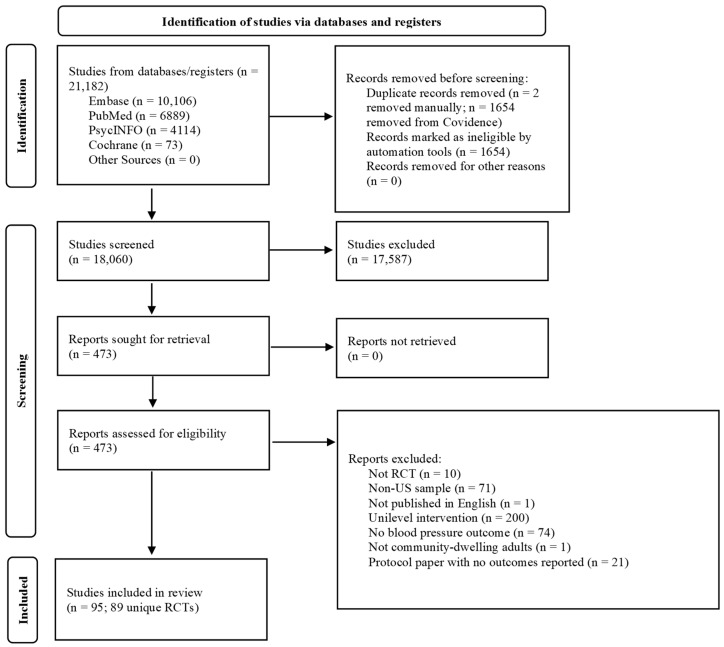
Objective: What types of multilevel interventions exist to improve blood pressure among community-dwelling adults aged 18+ in the United States? What is the treatment efficacy?
Data source: Peer-reviewed articles from Cochrane Library, EMBASE, PsycINFO, and PubMed. The search strategy was pre-registered on Open Science Framework.
Study inclusion and exclusion criteria: Inclusion criteria were community-dwelling adults in the United States aged 18 or older; interventions involving at least two levels; at least one blood pressure outcome measured; and published in a peer-reviewed journal.
Data extraction: Intervention activities, blood pressure outcomes, and moderation/subgroup analyses, when available, were extracted.
Data synthesis: Qualitative synthesis and summary statistics.
Results: Ninety-five papers covering 89 RCTs were included. Multilevel interventions involving the individual and healthcare team (without health policies = 49 studies; with health policies = 15 studies) tended to show the most consistent saltatory effects on blood pressure (systolic: 46% of studies showed statistical improvement; diastolic: 47% of studies showed statistical improvement). Interventions involving families or communities outside of healthcare settings were promising but were less frequently reported (19% of studies).
Conclusions: There was mixed evidence that multilevel interventions targeting cardiovascular health improved blood pressure among U.S.-based adults. Future research should continue evaluating interventions that improve the individual as well as the environments in which individuals work and play, especially those levels outside of traditional healthcare settings.
Keywords: adults; blood pressure; cardiovascular health; health promotion; multilevel intervention; randomized controlled trial.
Conflict of interest statement
The authors declare no conflicts of interest.
References
-
- Sallis J.F., Owen N., Fisher E.B. Ecological models of health behavior. In: Glanz K., Rimer B.K., Viswanath K., editors. Health Behavior and Health Education: Theory, Research, and Practice. Jossey-Bass; San Francisco, CA, USA: 2008. pp. 465–486.
Publication types
LinkOut - more resources
Full Text Sources
