


Production of Protein Hydrolysates with Antioxidant and Antihypertensive Activity from Edible Larvae of Aegiale hesperiaris and Comadia redtenbacheri
- PMID: 40565733
- PMCID: PMC12191756
- DOI: 10.3390/foods14122124
Production of Protein Hydrolysates with Antioxidant and Antihypertensive Activity from Edible Larvae of Aegiale hesperiaris and Comadia redtenbacheri
Abstract
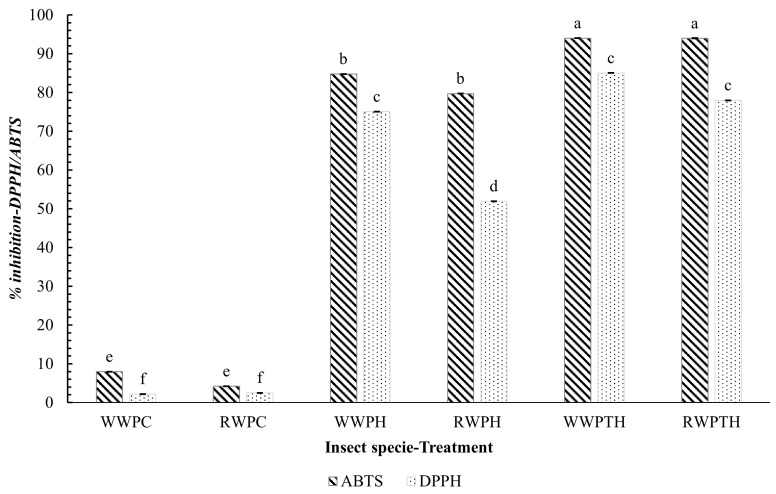
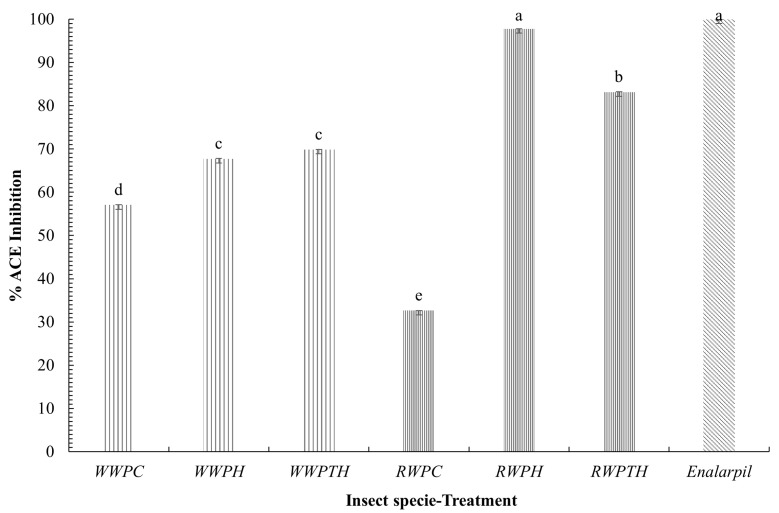
The search for sustainable and health-promoting food sources has increased interest in edible insects, which are rich in proteins and bioactive compounds with potential nutraceutical applications. In this study, we evaluated the bioactive properties of protein hydrolysates derived from Aegiale hesperiaris (maguey white worm, WW) and Comadia redtenbacheri (maguey red worm, RW), two culturally and economically significant insect species in Mexico. Hydrolysates were obtained via enzymatic treatments: either single hydrolysis with pepsin (PH) or sequential hydrolysis with pepsin followed by trypsin (PTH). The PTH hydrolysates exhibited strong antioxidant activity, with 2,2-azino-bis (3-ethylbenzothiazoline-6-sulfonic acid) (ABTS) radical inhibition above 90% and 2,2-diphenyl-1-picrylhydrazyl (DPPH) radical scavenging capacity between 75-85%. Additionally, they showed significant angiotensin-converting enzyme (ACE) inhibitory activity, reaching IC50 values of 0.35 and 0.017 μg/mL for WWPH and RWPH, respectively-the latter outperforming the commercial drug Enalapril (IC50 = 0.11 μg/mL). SDS-PAGE analysis revealed low molecular weight peptides (<10 kDa), especially between 5-9 kDa, associated with enhanced bioactivity. Peptides from RW also showed low Hill coefficients, suggesting a gradual and sustained interaction with ACE. These findings support the use of insect-derived hydrolysates as promising multifunctional ingredients for the development of functional foods targeting cardiovascular health.
Keywords: Aegiale hesperiaris; Comadia redtenbacheri; angiotensin- converting enzyme (ACE) inhibitory activity; antioxidant activity; bioactive peptides; bioactive properties; edible insects; enzymatic hydrolysis.
Conflict of interest statement
The authors declare no conflicts of interest.
Figures


References
-
- Food and Agriculture Organization of the United Nations (FAO) The Contribution of Insects to Food Security, Livelihoods and the Environment. 2013. [(accessed on 14 January 2025)]. Available online: https://www.fao.org/4/i3264e/i3264e00.pdf.
-
- Rumpold B.A., Schlüter O.K. Potential and Challenges of Insects as an Innovative Source for Food and Feed Production. Innov. Food Sci. Emerg. Technol. 2013;17:1–11. doi: 10.1016/j.ifset.2012.11.005. - DOI
LinkOut - more resources
Full Text Sources
Miscellaneous
