


Cardiopulmonary Recovery After Maximal Exercise in Individuals with Neuromuscular Disease and Limited Mobility
- PMID: 40565934
- PMCID: PMC12194694
- DOI: 10.3390/jcm14124190
Cardiopulmonary Recovery After Maximal Exercise in Individuals with Neuromuscular Disease and Limited Mobility
Abstract
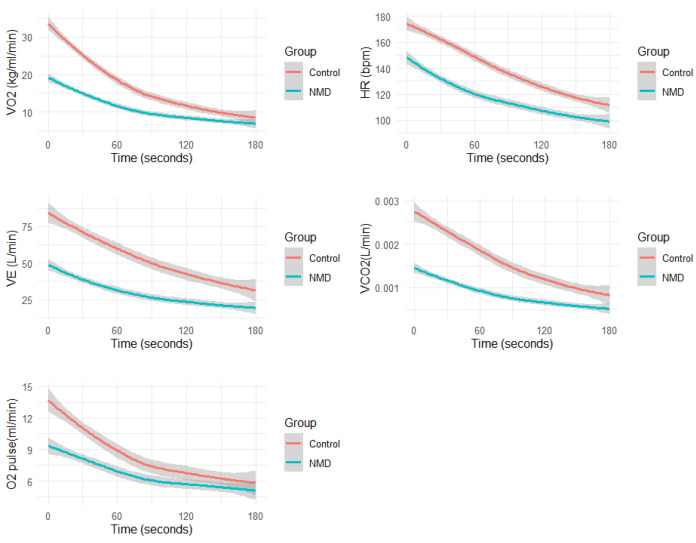
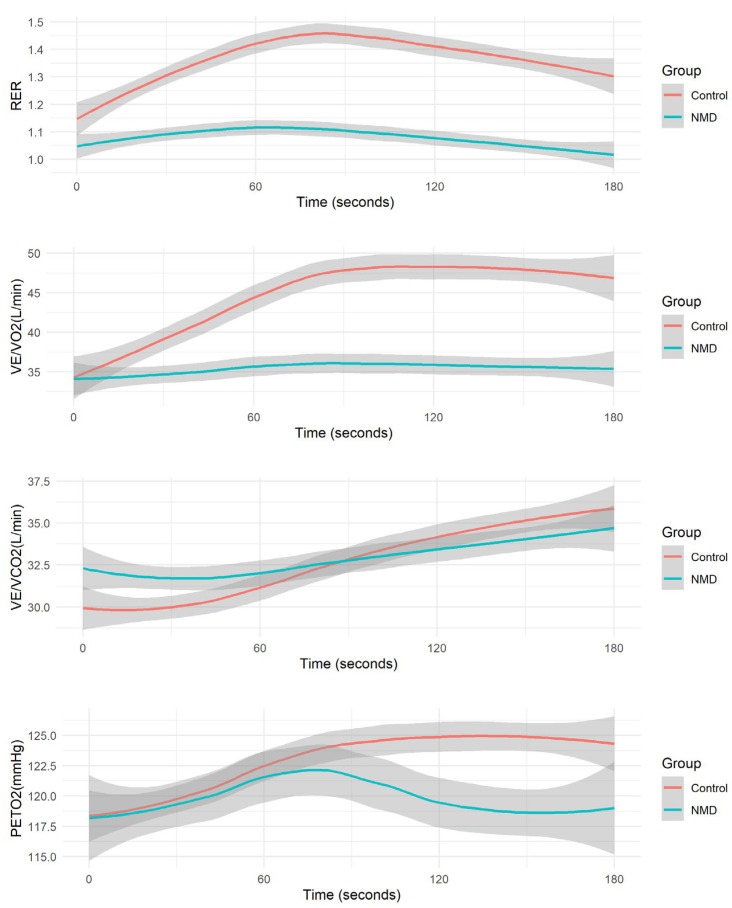
Background: Individuals with neuromuscular diseases (NMDs) have low physical activity levels and an increased risk of cardiovascular and pulmonary diseases. Respiratory gas kinetics obtained during cardiopulmonary exercise testing (CPET) may provide valuable insights into disease mechanisms and cardiorespiratory fitness in individuals with NMD. Recovery from exercise is an important marker of exercise performance and overall physical health, and impaired recovery is strongly associated with poor health outcomes. This study evaluates recovery metrics in individuals with NMD after performing maximal exertion during CPET. Methods: A total of 34 individuals with NMD and 15 healthy volunteers were recruited for the study. CPET was performed using a wearable metabolic system and a wheelchair-accessible total body trainer to peak exertion. Recovery metrics assessed were (i) the time to reach 50% O2 recovery compared with peak exercise and (ii) the ratios of ventilation and respiratory gases between peak exercise and the highest values observed during recovery (overshoot). Results: The NMD group had a significantly longer time to reach 50% O2 recovery (T1/2 VO2: 105 ± 43.4 vs. 76 ± 36.4 s, p = 0.02), lower respiratory overshoot (17.1 ± 13.0% vs. 28.8 ± 9.03%), and lower ventilation/VO2 (31.9 ± 28.3 vs. 52.2 ± 23.5) compared to the control group. Conclusions: This study observes significantly impaired recovery metrics following peak exercise in individuals with NMD compared to controls. These insights may improve the understanding of exercise recovery and mechanics, thus improving prognostication and optimizing exercise prescriptions for individuals with NMD.
Keywords: 50% recovery; cardiopulmonary exercise testing; exercise recovery; neuromuscular disease; overshoot.
Conflict of interest statement
The authors declare no conflict of interest.
Figures
References
-
- Rodriguez-Torres R.S., Uher D., Gay E.L., Coratti G., Dunaway Young S., Rohwer A., Muni Lofra R., De Vivo D.C., Hirano M., Glynn N.W., et al. Measuring Fatigue and Fatigability in Spinal Muscular Atrophy (SMA): Challenges and Opportunities. J. Clin. Med. 2023;12:3458. doi: 10.3390/jcm12103458. - DOI - PMC - PubMed
LinkOut - more resources
Full Text Sources
