


Hand Hygiene Roles, Challenges, and Intervention Feedback from School Staff: A Qualitative Analysis, Belize, 2022-2023
- PMID: 40566263
- PMCID: PMC12193699
- DOI: 10.3390/ijerph22060835
Hand Hygiene Roles, Challenges, and Intervention Feedback from School Staff: A Qualitative Analysis, Belize, 2022-2023
Abstract
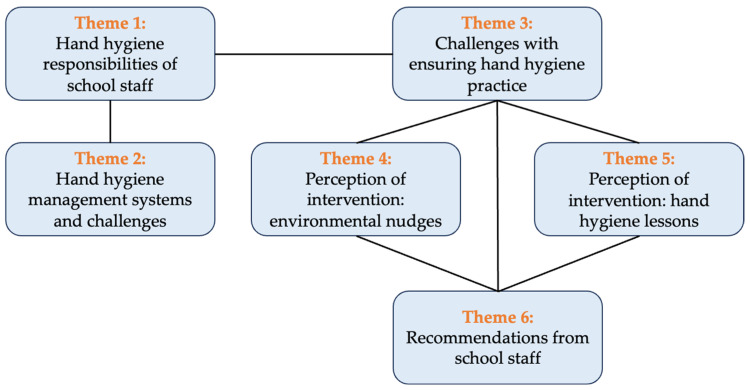
Hand hygiene (HH) in school settings can reduce the spread of infectious diseases and student absenteeism due to illness. During the COVID-19 pandemic, the World Health Organization recommended HH as a public health measure to prevent disease transmission. Understanding school staff's experiences with school-based programs is important for future program development and improvement. As part of a mixed-methods study, we conducted in-depth interviews in March 2022 with school administrators and teachers at 12 primary schools in Belize, selected based on high gaps in HH resources, to understand HH responsibilities, supplies, and challenges. An intervention was implemented to increase HH knowledge and practices among students, which included environmental nudges, supplemental provision of soap, and HH lesson implementation. Follow-up interviews were conducted in June 2023 among school administrators to garner feedback on the intervention. School staff described roles in teaching and managing HH supplies at both timepoints. The environmental nudges and HH lessons were perceived as helpful, but there were gaps remaining in HH practices, which may be partially influenced by practices and beliefs outside of school. Procurement of HH supplies remained a challenge at some schools due to financial constraints. The feedback from school staff will be valuable for the implementation of future hand hygiene programs in schools.
Keywords: Belize; COVID-19; Central America; WASH in schools; behavior change; hand hygiene.
Conflict of interest statement
The authors declare no conflicts of interest. The funders had no role in the design of the study; in the collection, analyses, or interpretation of data; in the writing of the manuscript; or in the decision to publish the results.
Figures
References
-
- Wolf J., Johnston R.B., Ambelu A., Arnold B.F., Bain R., Brauer M., Brown J., Caruso B.A., Clasen T., Colford J.M., et al. Burden of Disease Attributable to Unsafe Drinking Water, Sanitation, and Hygiene in Domestic Settings: A Global Analysis for Selected Adverse Health Outcomes. Lancet. 2023;401:2060–2071. doi: 10.1016/S0140-6736(23)00458-0. - DOI - PMC - PubMed
-
- Willmott M., Nicholson A., Busse H., MacArthur G.J., Brookes S., Campbell R. Effectiveness of Hand Hygiene Interventions in Reducing Illness Absence among Children in Educational Settings: A Systematic Review and Meta-Analysis. Arch. Dis. Child. 2016;101:42–50. doi: 10.1136/archdischild-2015-308875. - DOI - PMC - PubMed
-
- McGuinness S.L., Barker S.F., O’Toole J., Cheng A.C., Forbes A.B., Sinclair M., Leder K. Effect of Hygiene Interventions on Acute Respiratory Infections in Childcare, School and Domestic Settings in Low- and Middle-Income Countries: A Systematic Review. Trop. Med. Int. Health. 2018;23:816–833. doi: 10.1111/tmi.13080. - DOI - PubMed
MeSH terms
Grants and funding
LinkOut - more resources
Full Text Sources
Medical
Research Materials
