


Bone Mineral Density in Children and Adolescents of the Abay Region, Kazakhstan: Prevalence and Associated Risk Factors
- PMID: 40566375
- PMCID: PMC12192759
- DOI: 10.3390/ijerph22060949
Bone Mineral Density in Children and Adolescents of the Abay Region, Kazakhstan: Prevalence and Associated Risk Factors
Abstract
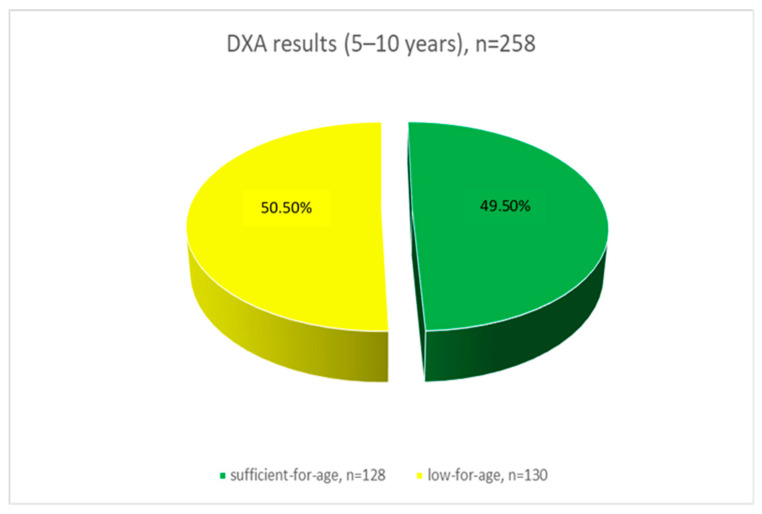
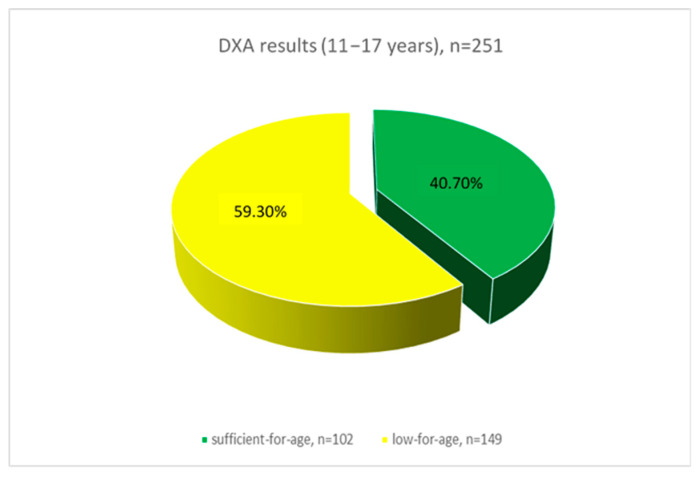
Approximately 95% of skeletal size, bone, and muscle mass is achieved by the age of 18, with a rapid acceleration in bone mineral accumulation and muscle growth during the adolescent growth spurt. Bone mineral status in children and adolescents in Kazakhstan is a relevant subject for both clinical and fundamental research. The aim of this study was to investigate the prevalence of low bone mineral density (BMD) and the factors associated with it in children and adolescents living in the Abay region of Kazakhstan. The target group consisted of children and adolescents aged 5 to 17 years (n = 509) who had been residing in the Abay region of Kazakhstan since birth. Based on physiological age, participants were divided into two groups: 5-10 years (preschool and early school age) and 11-17 years (adolescence). All participants completed a questionnaire and underwent bone mineral density assessment using dual-energy X-ray absorptiometry (DXA). Comparisons were made between two age groups (5-10 and 11-17 years) and based on the presence or absence of reduced bone mineralization. Regression analysis identified four factors independently associated with reduced bone mineralization: ionized calcium (AOR 2099.9; p = 0.007), age (AOR 1.21; p = 0.013), body weight (AOR 0.97; p = 0.047), and green vegetables (AOR 0.46; p = 0.017). Conclusions: Our study demonstrated that 50.5% of children aged 5-10 years and 57.4% of adolescents aged 11-17 years had BMD below the age-specific norm. The study identified several risk factors that are associated with a decrease in BMD. These include blood ionized calcium, age, inadequate consumption of fruits and vegetables and dairy products, low physical activity, and insufficient sun exposure. These findings highlight the importance of early prevention of osteopenic conditions beginning in childhood and adolescence.
Keywords: adolescents; blood ionized calcium; bone mineral density; children; dual-energy X-ray absorptiometry; osteopenia.
Conflict of interest statement
The authors declare no conflicts of interest.
Figures
Similar articles
-
Effectiveness and safety of vitamin D in relation to bone health.Evid Rep Technol Assess (Full Rep). 2007 Aug;(158):1-235. Evid Rep Technol Assess (Full Rep). 2007. PMID: 18088161 Free PMC article.
-
Nutritional interventions for survivors of childhood cancer.Cochrane Database Syst Rev. 2016 Aug 22;2016(8):CD009678. doi: 10.1002/14651858.CD009678.pub2. Cochrane Database Syst Rev. 2016. PMID: 27545902 Free PMC article.
-
Physical exercise training interventions for children and young adults during and after treatment for childhood cancer.Cochrane Database Syst Rev. 2016 Mar 31;3(3):CD008796. doi: 10.1002/14651858.CD008796.pub3. Cochrane Database Syst Rev. 2016. PMID: 27030386 Free PMC article.
-
Dairy product consumption, eating habits, sedentary behaviour and physical activity association with bone mineral density among adolescent boys: a cross-sectional observational study.BMC Pediatr. 2024 Jan 17;24(1):53. doi: 10.1186/s12887-024-04539-y. BMC Pediatr. 2024. PMID: 38233826 Free PMC article.
-
Incentives for preventing smoking in children and adolescents.Cochrane Database Syst Rev. 2017 Jun 6;6(6):CD008645. doi: 10.1002/14651858.CD008645.pub3. Cochrane Database Syst Rev. 2017. PMID: 28585288 Free PMC article.
References
-
- Galindo-Zavala R., Bou-Torrent R., Magallares-López B., Mir-Perelló C., Palmou-Fontana N., Sevilla-Pérez B., Medrano-San Ildefonso M., González-Fernández M.I., Román-Pascual A., Alcañiz-Rodríguez P., et al. Expert panel consensus recommendations for diagnosis and treatment of secondary osteoporosis in children. Pediatr. Rheumatol. Online J. 2020;24:20. doi: 10.1186/s12969-020-0411-9. - DOI - PMC - PubMed
MeSH terms
Grants and funding
LinkOut - more resources
Full Text Sources
Medical
