


Exploring Disorders of Gut-Brain Interaction in Schoolchildren and Adolescents with Autism
- PMID: 40566564
- PMCID: PMC12194783
- DOI: 10.3390/life15060912
Exploring Disorders of Gut-Brain Interaction in Schoolchildren and Adolescents with Autism
Abstract
Background: Disorders of Gut-Brain Interaction (DGBIs) are present in 23.0% of the paediatric population, according to Rome IV. Latin American (LA) prevalence of DGBIs in children with Autism Spectrum Disorder (ASD) is unknown. The aim of this study was to determine the prevalence of DGBIs and possible associations in schoolchildren and adolescents with ASD from LA.
Methods: An observational analytical study was conducted in LA cities. Caregivers of children with ASD completed the Rome IV Questionnaire for Pediatric Gastrointestinal Symptoms to identify DGBIs. Sociodemographic, clinical, and family variables were included. Statistical analysis involved central tendency measures, univariate and bivariate analysis, calculation odds ratios (ORs), and 95% confidence intervals (95%CIs), with p < 0.05 significance.
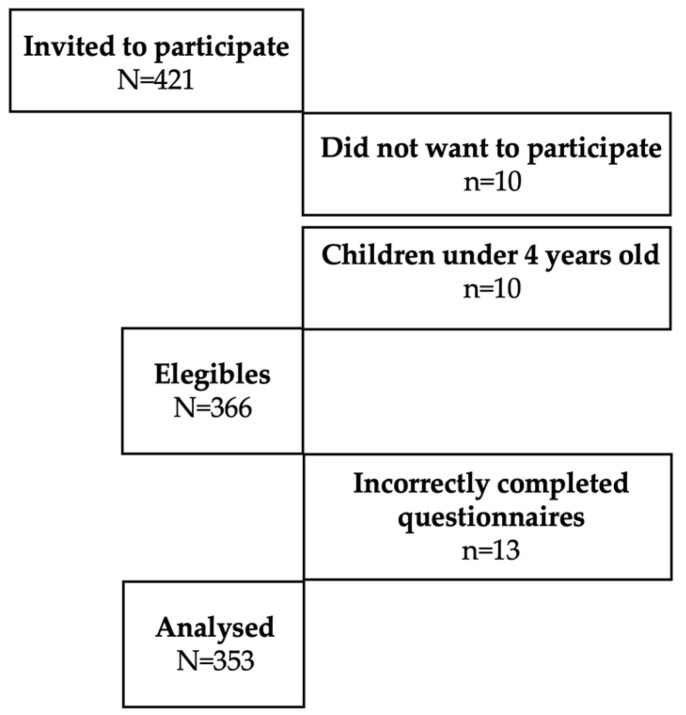
Results: The study included 353 children with ASD. Predominantly male (78.8%), white (56.1%), attending private schools (79.3%), altered nutritional status (43.9%), born by c-section (57.5%), firstborn (54.7%), level of autism not classified at the time of the study (49.0%). A total of 58.9% presented DGBI. Functional constipation (FC) was the most frequent (27.2%). Those from Central America (CA) had a higher likelihood of presenting a DGBI (OR = 1.98, 95% CI = 1.25-3.12, p = 0.0018).
Conclusions: Over half of LA schoolchildren and adolescents with ASD presented DGBI, FC being the most common, and higher likelihood of DGBI in CA.
Keywords: Latin America; Rome IV; adolescents; autism spectrum disorder; disorders of gut–brain interaction; functional constipation; prevalence; schoolchildren.
Conflict of interest statement
The authors declare no conflicts of interest.
References
-
- Dargenio V.N., Dargenio C., Castellaneta S., De Giacomo A., Laguardia M., Schettini F., Francavilla R., Cristofori F. Intestinal barrier dysfunction and microbiota-gut-brain axis: Possible implications in the pathogenesis and treatment of autism spectrum disorder. Nutrients. 2023;15:1620. doi: 10.3390/nu15071620. - DOI - PMC - PubMed
-
- American Psychiatric Association . Diagnostic and Statistical Manual of Mental Disorders. 5th ed. American Psychiatric Publishing; Washington, DC, USA: 2014.
LinkOut - more resources
Full Text Sources
