


Healthcare-Seeking Behaviour for Obstetric Complications in Ethiopia: A Multilevel Mixed-Effect Analysis
- PMID: 40567355
- PMCID: PMC12188065
- DOI: 10.1177/11786329251347353
Healthcare-Seeking Behaviour for Obstetric Complications in Ethiopia: A Multilevel Mixed-Effect Analysis
Abstract
Background: Healthcare-seeking behaviour, and its associated factors, for obstetric complications are an important determinant of maternal deaths and adverse foetal outcomes. However, there is limited evidence on healthcare-seeking behaviours from health facilities in response to obstetric complications among Ethiopian women.
Objective: To investigate women's healthcare-seeking behaviour in response to obstetric complications, and its associated factors, in Ethiopia.
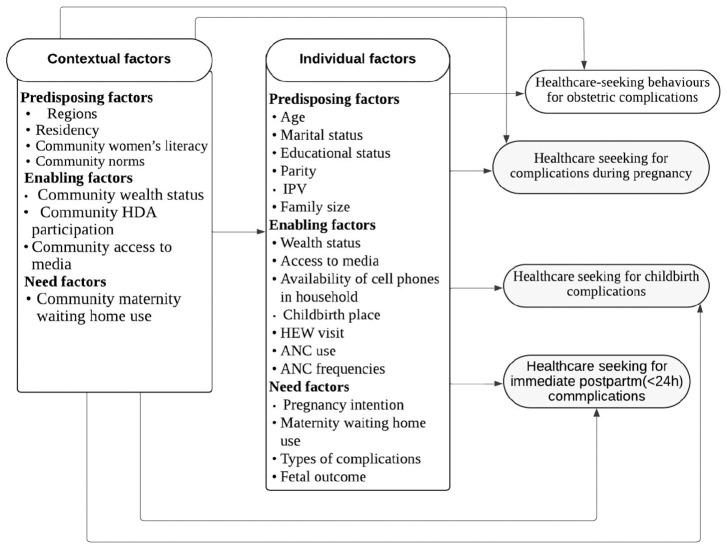
Methods: Data were sourced from the Performance Monitoring for Action (PMA-E) longitudinal survey national database. Andersen's health service use model was utilised to group individual and contextual factors. A multilevel mixed-effect logistic regression model was employed, with adjusted Odds Ratio (aOR) and 95% confidence intervals reported.
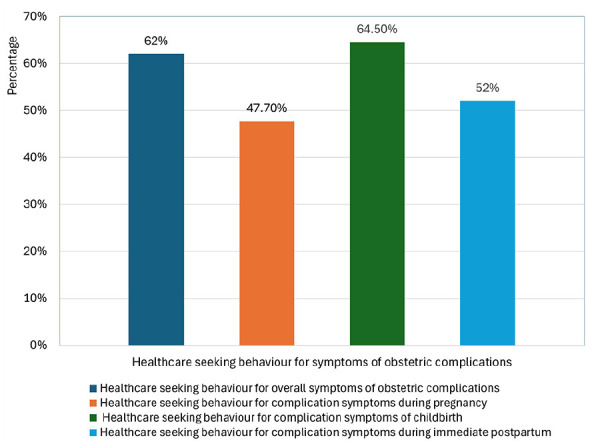
Results: Data were derived from a weighted sample of 1750 women who experienced obstetric complications during pregnancy, childbirth, and immediately postpartum. Overall healthcare-seeking at health facilities for obstetric complication symptoms during the maternity continuum was 62% (95%CI: 59.6-64.3), with 47.8% (95%CI: 45.0-50.5), 64.5% (95%CI: 61.3-67.5), and 52% (95%CI: 48.3-55.6) seeking healthcare from health facilities during pregnancy, childbirth, and the immediate post-partum period, respectively. Antenatal care attendance (aOR = 3.43, 95%CI: 2.4-5.0), nulliparity (aOR = 2.1; 95%CI: 1.0-4.4), household access to media (aOR = 1.5, 95%CI: 1.0-2.1), no intimate partner violence (IPV) during pregnancy (aOR = 1.8, 95%CI: 1.1-3.1), high community wealth status (aOR = 1.2, 95%CI: 1.1-2.4), community encouragement of facility childbirth (aOR = 2.2, 95%CI: 1.1-4.3), community non-acceptance of the traditional birth attendant (TBA; aOR = 2.4, 95%CI: 1.6-3.7), and high community participation in health developmental army (HDA; aOR = 2.1, 95%CI: 1.1-3.9) were significantly associated with healthcare seeking behaviour.
Conclusions: The healthcare-seeking behaviour of women from health facilities in response to obstetric complication symptoms was low and varied across the different stages of the maternity continuum. Key programme priority interventions should focus on reducing community reliance on TBA care, enhancing community encouragement of facility childbirth, and strengthening the HDA.
Keywords: childbirth; complications; healthcare seeking; obstetrics; pregnancy.
© The Author(s) 2025.
Conflict of interest statement
The author(s) declared no potential conflicts of interest with respect to the research, authorship, and/or publication of this article.
Figures
References
-
- Trends in maternal mortality 2000 to 2020: estimates by WHO, UNICEF, UNFPA, World Bank Group and UNDESA/Population Division. Executive summary . Geneva: World Health Organization; 2023. Licence: CC BY-NC-SA 3.0 IGO.
-
- Trends in maternal mortality 2000 to 2017: estimates by WHO, UNICEF, UNFPA, World Bank Group and the United Nations Population Division . Geneva: World Health Organization; 2019. Licence: CC BY-NC-SA 3.0 IGO.
-
- Holmer H, Oyerinde K, Meara JG, et al. The global met need for emergency obstetric care: a systematic review. BJOG: Int J Obstet Gynaecol. 2015;122(2):183-189. - PubMed
-
- Souza JP, Day LT, Rezende-Gomes AC, et al. A global analysis of the determinants of maternal health and transitions in maternal mortality. Lancet Glob Health. 2024;12(2):e306-e16. - PubMed
LinkOut - more resources
Full Text Sources
