


Prevalence and Factors Associated With Cesarean Section Delivery among Pregnant Women Attending Rwamagana Level Two Teaching Hospital, Rwanda
- PMID: 40567462
- PMCID: PMC12110475
- DOI: 10.4314/rjmhs.v7i3.5
Prevalence and Factors Associated With Cesarean Section Delivery among Pregnant Women Attending Rwamagana Level Two Teaching Hospital, Rwanda
Abstract
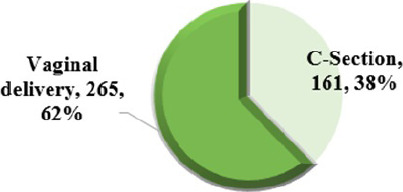
Background: Cesarean section (CS) is an essential, life-saving procedure when clinically justified. However, exceeding the World Health Organization's recommended prevalence (10-15%) may lead to adverse outcomes. This study aimed to determine the prevalence of CS at Rwamagana Hospital and to assess the associated factors.
Methods: This cross-sectional study was conducted among 426 postpartum women at Rwamagana Hospital. Data were analysed using the Statistical Package for the Social Sciences (SPSS). Descriptive statistics and multivariable logistic regression were employed. Statistical significance was set at a 5% level.
Results: The results showed a 38% prevalence of CS. Women younger than 25 years were 9.51 times more likely to undergo CS compared to those aged 36-45 years (AO:9.51, 95% CI: 3.37-26.83, p < 0.001), Fetal malposition (AOR:106.8, 95% CI: 29.89-382.25, p < 0.001), experiencing no labour (AOR: 4.64, 95%CI: 1.71 - 12.63, p = 0.003), and first-time mothers (Parity=1) (AOR: 19.65, 95%CI: 8.91-43.33, p<0.001) were positively associated with CS. However, Previous vaginal birth reduced the odds of CS by 89% (AOR:0.11, 95% CI: 0.06-0.21, p < 0.001).
Conclusion: The prevalence of CS at Rwamagana Hospital exceeds the WHO recommendation. There is a need for enhanced community education to support safe vaginal deliveries.
Keywords: Cesarean section; Maternal health; Postpartum women; Rwanda.
Conflict of interest statement
The study's authors state that they had no relationships or affiliations that would have created a conflict of interest. The authors jointly agreed to submit the study to the current journal.
Figures
References
-
- WHO, author. Maternal health. WHO; 2024. [17 April 2024]. https://www.who.int/health-topics/maternal-health.
-
- WHO, author. Trends in maternal mortality: 2000 to 2017: estimates by WHO, UNICEF, UNFPA, World Bank Group and the United Nations Population Division. WHO; 2019. [15 April 2024]. https://www.unfpa.org/featured-publication/trends-maternal-mortality-200....
-
- WHO, author. Acceleration towards the Sustainable Development Goal targets for maternal health and child mortality Report by the Director-General. WHO; 2023. [12 May 2024]. pp. 1–6. https://apps.who.int/gb/ebwha/pdf_files/EB154/B154_12-en.pdf.
LinkOut - more resources
Full Text Sources