


Variational quantum classifier-based early identification and classification of chronic kidney disease using sparse autoencoder and LASSO shrinkage
- PMID: 40567645
- PMCID: PMC12190610
- DOI: 10.7717/peerj-cs.2789
Variational quantum classifier-based early identification and classification of chronic kidney disease using sparse autoencoder and LASSO shrinkage
Abstract
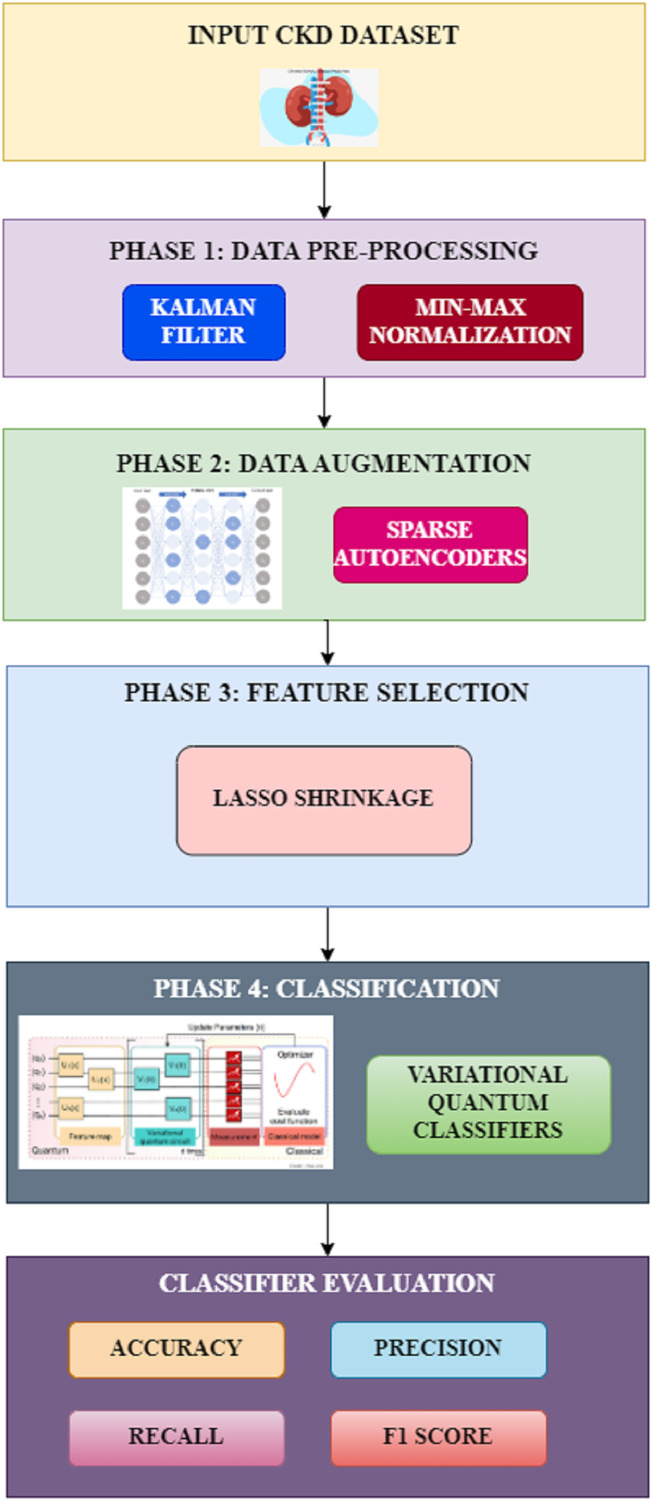
The two leading causes of chronic kidney disease (CKD) are excessive blood pressure and diabetes. Researchers worldwide utilize the rate of globular filtration and kidney inflammation biomarkers to identify chronic kidney disease that gradually reduces renal function. The mortality rate for CKD is high, and thus, a person with this illness is more likely to pass away at a younger age. Healthcare professionals must diagnose the various illnesses connected to this deadly disease as promptly as possible to lighten the impact of CKD. A quantum machine learning (QML) based technique is presented in this research to help with the early diagnosis and prognosis of CKD. The proposed research comprises four phases: data pre-processing, data augmentation, feature selection, and classification. In the first phase, Kalman filter and data normalization techniques are applied to handle the missing and noisy data. In the second phase, data augmentation uses sparse autoencoders to balance the data for smaller classes. In the third phase, LASSO shrinkage is used to select the significant features in the dataset. Variational Quantum classifiers, a supervised QML technique, are employed in the classification phase to classify chronic kidney diseases. The proposed system has been evaluated on the UCI dataset, which comprises 400 CKD patients in the early stages with 25 attributes. The suggested system was assessed using F1-score, precision, recall, and accuracy as evaluation metrics. With a 99.2% classification accuracy, it was found that this model performed better than the other traditional classifiers used for chronic kidney disease classification.
Keywords: Autoencoder; Chronic kidney disease; Deep learning; LASSO shrinkage; Quantum classifier.
© 2025 Parthasarathi et al.
Conflict of interest statement
The authors declare that they have no competing interests.
Figures


References
-
- Belur Nagaraj S, Pena MJ, Ju W, Heerspink HL, BEAt-DKD Consortium Machine-learning-based early prediction of end-stage renal disease in patients with diabetic kidney disease using clinical trials data. Diabetes, Obesity and Metabolism. 2020;22(12):2479–2486. doi: 10.1111/dom.14178. - DOI - PMC - PubMed
-
- De Almeida KL, Lessa L, Peixoto AB, Gomes RL, Celestino J. Kidney failure detection using machine learning techniques. 8th International Workshop on Advances in ICT Infrastructures and Services (ADVANCE 2020); January 27th–29th 2020; Cancún, Mexico. 2020. pp. 1–8.
-
- Deepika B, Rao V, Rampure DN, Prajwal P, Gowda D. Early prediction of chronic kidney disease by using machine learning techniques. American Journal of Computer Science and Engineering Survey. 2020;8(2):7.
-
- Dovgan E, Gradišek A, Luštrek M, Uddin M, Nursetyo AA, Annavarajula SK, Li Y-C, Syed-Abdul S. Using machine learning models to predict the initiation of renal replacement therapy among chronic kidney disease patients. PLOS ONE. 2020;15(6):e0233976. doi: 10.1371/journal.pone.0233976. - DOI - PMC - PubMed
LinkOut - more resources
Full Text Sources