Review
. 2025 Jun 11:15:1593445.
doi: 10.3389/fcimb.2025.1593445. eCollection 2025.

The emerging roles of ubiquitin-like modifications in regulating HIV replication and host defense

Affiliations
Review

The emerging roles of ubiquitin-like modifications in regulating HIV replication and host defense

Jinsong Yuan et al. Front Cell Infect Microbiol. .

Abstract

As a post-translational modification (PTM) mechanism analogous to ubiquitination, ubiquitin-like (UBL) modification plays a crucial regulatory role in virus-host interactions. With the increasing discovery of UBL modification types, their roles in diverse biological process, including HIV infection, have gained growing attention. Rather than merely serving as anti-HIV defenses or being exploited by the virus, UBLs often exert dual roles by modulating both host restriction factors and viral proteins, thereby impacting key steps of HIV life cycle, immune evasion, and intracellular signaling. This article summarizes recent advances on the contribution of UBLs in regulating HIV replication and host defense, highlighting their indispensable roles in arms races between HIV and host, aiming to provide a theoretical framework for developing novel therapeutic strategies against HIV-1 targeting virus-host interactions.

Keywords: ATG8ylation; FAT10ylation; HIV-1; ISGylation; NEDDylation; SUMOylation; UBLs.


Conflict of interest statement

The authors declare that the research was conducted in the absence of any commercial or financial relationships that could be construed as a potential conflict of interest.

Figures
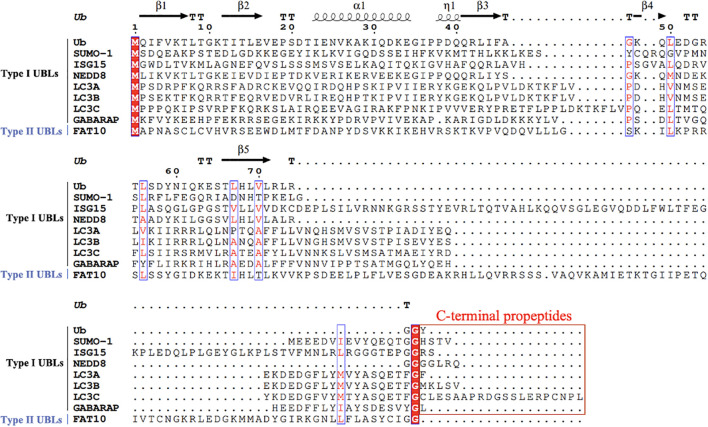
Figure 1
Figure 1
Multiple sequence alignment of Ub and UBLs. A multiple sequence alignment of Ub and various UBLs was performed using ClustalW. The residue numbering is based on Ub’s first methionine (M1). UBLs are classified into two types: Type I UBLs (e.g., SUMO-1, ISG15, NEDD8, LC3A, LC3B, LC3C, GABARAP), which require the removal of C-terminal propeptides prior to functional activation, and Type II UBLs (e.g., FAT10), which do not require such processing. Conserved residues are shown in red font and enclosed in blue boxes. Functionally important C-terminal glycine residues are also indicated. C-terminal propeptides regions in Type I UBLs are enclosed in red boxes to highlight their required removal before activation. Gaps introduced for optimal alignment are represented by dots. Ub residues are numbered every 10 amino acids along the alignment to assist in identifying conserved and functionally relevant regions. Secondary structure elements of Ub (β-strands, α-helix, and the η-helix) are annotated above the alignment, based on the crystal structure of ubiquitin.
Figure 2
Figure 2
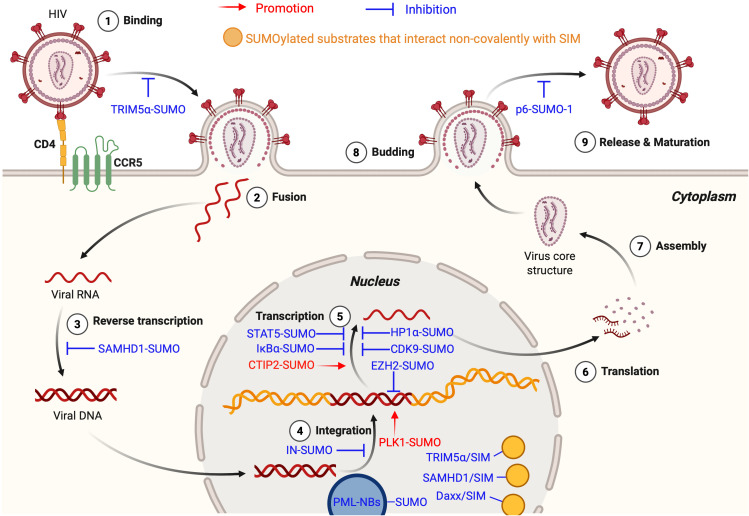
SUMOylation in the HIV life cycle. The figure illustrates the dual roles of SUMOylation in the HIV-1 life cycle, encompassing both HIV-promoting (shown in red text and arrows) and anti-HIV (shown in blue text and inhibitory symbols) effects. Yellow circles denote SUMOylated substrates that interact non-covalently with SIM. During the Binding Stage, SUMOylated TRIM5α recognizes the CA, preventing cross-species transmission. In the Reverse Transcription Stage, SUMOylated SAMHD1 inhibits replication by depleting the intracellular dNTP pool. At the Integration Stage, SUMOylated IN impairs integration, SUMOylated PLK1 supports latency maintenance, and SUMOylated EZH2 promotes epigenetic silencing. At the Transcription Stage, SUMOylated STAT5, IκBα, HP1α, and CDK9 suppress HIV-1 transcription, whereas SUMOylated CTIP2 enhances it. During Budding Stage, SUMOylated p6 reduces viral infectivity. In the nucleus, hyper-SUMOylated PML NBs facilitate the establishment and maintenance of viral latency. Additionally, SUMOylated substrates interact non-covalently with SIMs on TRIM5α, SAMHD1, and Daxx, contributing to inhibition of HIV-1 replication. This figure is generated using BioRender (http://biorender.com/).
Figure 3
Figure 3
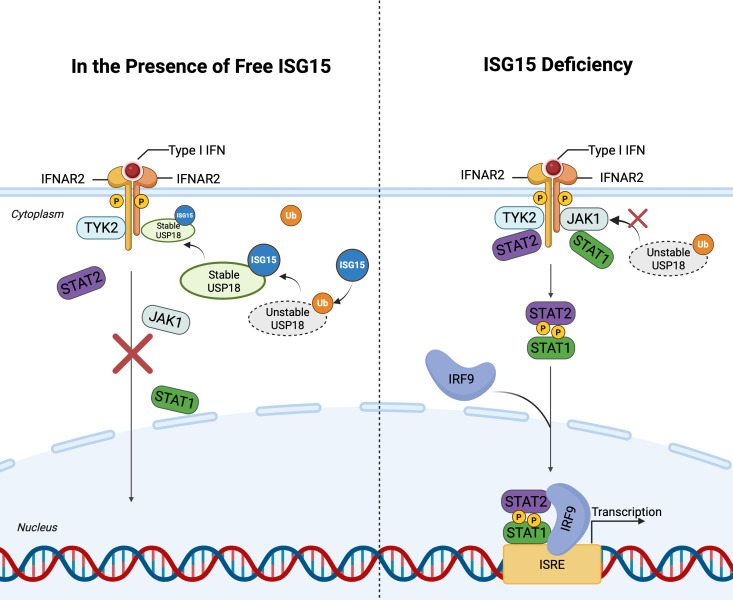
ISG15-Mediated stabilization of USP18 and negative regulation of IFN-I signaling. This figure illustrates the the interplay between ISG15 and USP18 in regulating the IFN-I signaling. Left panel: In the presence of free ISG15, USP18 is stabilized by competing with ubiquitin, thereby enhancing its association with IFNAR2 and preventing JAK1 binding. This inhibits activation of the JAK-STAT pathway and downregulating ISG expression. Right panel: In the absence of ISG15, USP18 becomes unstable, leading to sustained IFN-I signaling. Upon IFN-I binding to its receptor complex, JAK1 and TYK2 are activated, resulting in the formation of the ISGF3 complex (STAT1, STAT2, and IRF9). ISGF3 translocates into the nucleus and binds to ISREs in the promoters of ISGs. This figure is generated using BioRender (http://biorender.com/).
Figure 4
Figure 4
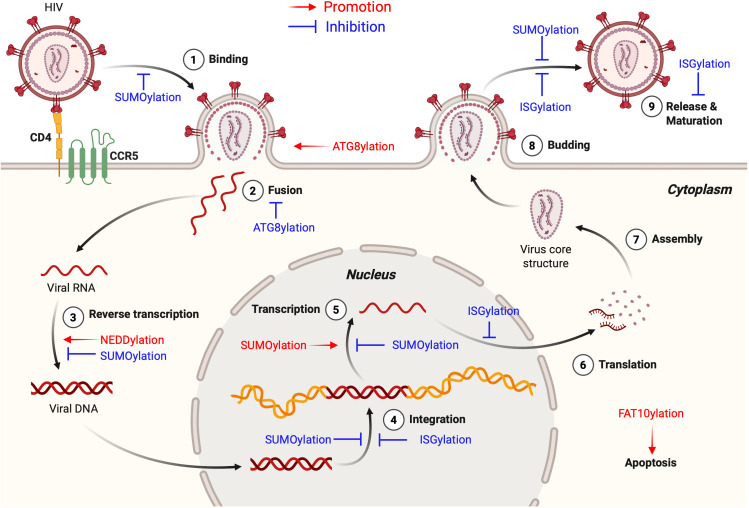
Roles of UBL modifications in the HIV-1 life cycle. This figure highlights the roles of various UBL modifications in the HIV-1 life cycle, demonstrating both HIV-promoting (shown in red text and arrows) and anti-HIV (shown in blue text and inhibitory symbols) functions. SUMOylation related regulatory mechanisms are described in detail in Figure 2 . ISGylation stabilizes the tumor suppressor protein p53 to limit HIV-1 replication, inhibits early post-entry steps including viral DNA integration, and interferes with viral budding and release. NEDDylation promotes viral replication by facilitating the formation of CRL complexes that target host restriction factors such as A3G, SAMHD1, and UNG2 for degradation. ATG8ylation contributes to viral entry through LC3 lipidation at the plasma membrane, which drives membrane remodeling, and also mediates selective autophagic degradation of HIV-1 virions via TRIM5-GABARAP interactions. FAT10ylation plays a HIV-promoting role as the HIV-1 accessory protein Vpr induces FAT10 expression in RTECs, activating intrinsic apoptotic pathways and promoting cell death. This Figure is drawn using the BioRender website. This figure is generated using BioRender (http://biorender.com/).

References

    1. Abounouh K., Kayesh M. E. H., Altawalah H., Kitab B., Murakami S., Ogawa S., et al. (2022). Blocking neddylation elicits antiviral effect against hepatitis B virus replication. Mol. Biol. Rep. 49, 403–412. doi: 10.1007/s11033-021-06886-w - DOI - PubMed
    1. Aichem A., Catone N., Groettrup M. (2014). Investigations into the auto-FAT10ylation of the bispecific E2 conjugating enzyme UBA6-specific E2 enzyme 1. FEBS J. 281, 1848–1859. doi: 10.1111/febs.12745 - DOI - PubMed
    1. Aichem A., Pelzer C., Lukasiak S., Kalveram B., Sheppard P. W., Rani N., et al. (2010). USE1 is a bispecific conjugating enzyme for ubiquitin and FAT10, which FAT10ylates itself in cis. Nat. Commun. 1, 13. doi: 10.1038/ncomms1012 - DOI - PubMed
    1. Akbari M., Otterlei M., Peña-Diaz J., Aas P. A., Kavli B., Liabakk N. B., et al. (2004). Repair of U/G and U/A in DNA by UNG2-associated repair complexes takes place predominantly by short-patch repair both in proliferating and growth-arrested cells. Nucleic Acids Res. 32, 5486–5498. doi: 10.1093/nar/gkh872 - DOI - PMC - PubMed
    1. Albin J. S., Harris R. S. (2010). Interactions of host APOBEC3 restriction factors with HIV-1 in vivo: implications for therapeutics. Expert Rev. Mol. Med. 12, e4. doi: 10.1017/s1462399409001343 - DOI - PMC - PubMed