


Selective Conservatism in the Management of Spinal Stab Wounds Remains Applicable-A Critical Review of 169 Patients Managed at a Major Trauma Center in South Africa
- PMID: 40569704
- PMCID: PMC12338429
- DOI: 10.1002/wjs.12685
Selective Conservatism in the Management of Spinal Stab Wounds Remains Applicable-A Critical Review of 169 Patients Managed at a Major Trauma Center in South Africa
Abstract
Background: Spinal stab wounds (SW) are relatively uncommon and can be both morbid and fatal. The exact role of surgery remains somewhat unclear. This study reviews our institutional experience of spinal SW management and examines the clinical outcome of these patients in a developing world setting.
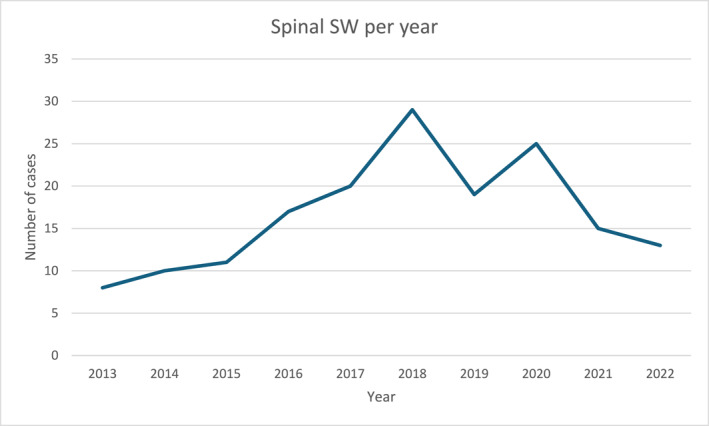
Methods: A retrospective study was conducted over a 10-year study period from December 2012-December 2022 at a major trauma center in South Africa. All patients who sustained spinal SW were included.
Results: One hundred sixty-nine patients with spinal SW were included (male: 87%, mean age: 28 years, median Injury Severity Score [ISS]: 9). AIS classifications: E (51%), C (18%), A (14%), D (12%), B (4%). Nearly all patients (95%) underwent CT scan and 81% had an MRI. 72% had bony injury and 60% had spinal cord injury. Five percent of all patients underwent surgical intervention. Overall, 5% of patients required intensive care unit (ICU) admission and 9% had one or more complications. Common complications were hospital acquired pneumonia and pressure sores. The overall in hospital mortality rate was 1% (2/169). Of the 167 patients who survived to hospital discharge, 88% were discharged to spinal rehabilitation centers and the remaining patients were discharged home.
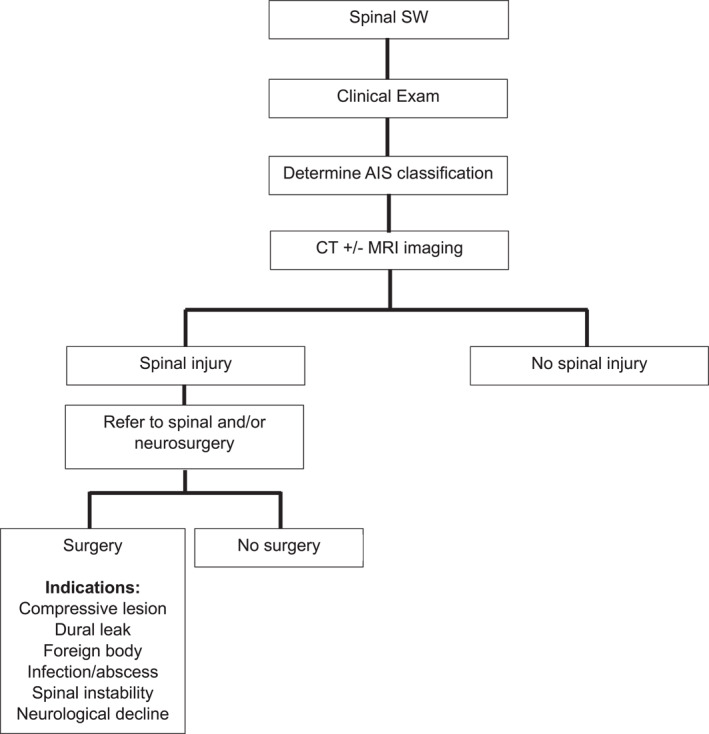
Conclusions: Our study supports a conservative management in select SW patients, especially in the absence of progressive neurological deficits or spinal instability. Non-operative management aligns well with resource-constrained public healthcare facilities in our environment. Further research should aim to develop context-specific guidelines to refine surgical decision-making and improve outcomes across varied healthcare settings.
Keywords: orthopedic surgery; spine; trauma surgery.
© 2025 The Author(s). World Journal of Surgery published by John Wiley & Sons Ltd on behalf of International Society of Surgery/Société Internationale de Chirurgie (ISS/SIC).
Conflict of interest statement
The authors declare no conflicts of interest.
Figures
References
-
- Smith C. and White J. B., “Penetrating Knife Injuries to the Spine: Management Considerations and Literature Review,” Interdisciplinary Neurosurgery 1, no. 1 (2014): 3–4, 10.1016/j.inat.2014.01.001. - DOI
MeSH terms
LinkOut - more resources
Full Text Sources
Medical
