


Developing and evaluating a community-driven intervention to promote uptake of HIV and contraception services among students enrolled in colleges and universities in Zimbabwe
- PMID: 40569896
- PMCID: PMC12231659
- DOI: 10.1002/jia2.26461
Developing and evaluating a community-driven intervention to promote uptake of HIV and contraception services among students enrolled in colleges and universities in Zimbabwe
Abstract
Introduction: There is a growing appreciation that community-led interventions are key to sustaining the HIV response and achieving HIV prevention and treatment targets. Together with young people in colleges/universities and Ministry of Health (MOH), we developed and evaluated a student-led intervention for promoting the uptake of HIV self-testing (HIVST), post-exposure prophylaxis (PEP) and emergency contraception (EC) among college/university students.
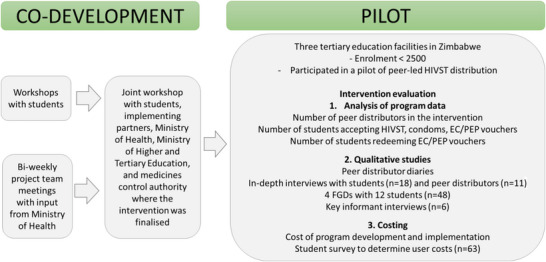
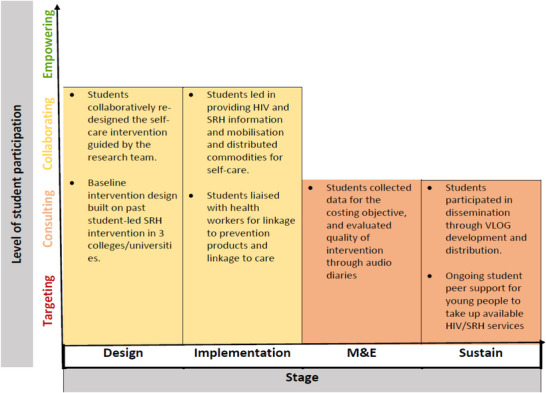
Methods: Over 3 months, in biweekly study team meetings, two workshops with students, two meetings with MOH, and a joint workshop with students, MOH and relevant stakeholders, we co-developed an intervention for peer-led promotion/distribution of HIVST, PEP, EC and condoms. The agreed intervention was piloted in three Zimbabwean colleges/universities from December 2023 to February 2024. Student peers distributed HIVST and condoms directly, and vouchers for PEP and EC that were redeemed at college/nearby clinics. During co-development, students strongly preferred peer distribution of all commodities but this was restricted by regulatory requirements for PEP and EC. Peer distributors (n = 14) kept daily audio diaries of their experiences. In-depth interviews were held with students (n = 18), peer distributors (n = 11) and key informants (n = 12) to explore views/preferences, with participant observations and four focus group discussions to provide additional insights. We determined the intervention development and implementation costs.
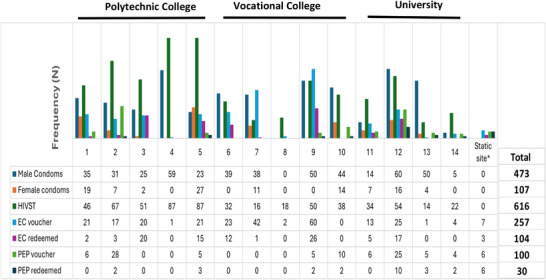
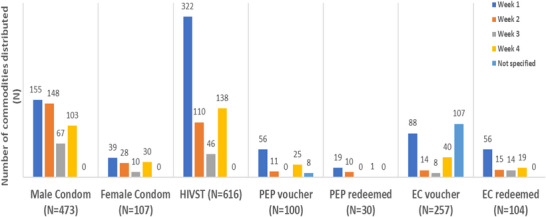
Results: Peer-led distribution of HIVST, PEP and EC to college/university students was acceptable, feasible, appropriate and generally implemented as intended. PEP and EC acceptability was driven by high HIV and pregnancy risk among students, who had no easy access to services. Of 100 PEP and 257 EC vouchers distributed, 30% and 40% were redeemed, respectively. The main barrier to PEP and EC uptake was moral judgement against premarital sex, which affected female students more. Judgemental health worker attitudes also limited uptake of PEP and EC. EC voucher redemption among female students was lower versus males, aOR = 0.4 (95% CI = 0.2-0.8), p = 0.019. Redemption was also higher at the college where the nearby clinic could be accessed discreetly. Total cost of the intervention per student was $14.57 (cross-institution range: $7.26-$35.52).
Conclusions: Student-led distribution of HIVST, PEP and EC was feasible, acceptable and affordable. Making the intervention more community-driven according to the 2024 WHO PEP guidelines will likely achieve great impact.
Keywords: HIV prevention; PEP; community‐driven; self‐care; sexual and reproductive health; young people.
© 2025 The Author(s). Journal of the International AIDS Society published by John Wiley & Sons Ltd on behalf of International AIDS Society.
Conflict of interest statement
The authors declared no competing interests.
Figures
References
-
- UNAIDS . Community‐led AIDS responses: final report based on the recommendations of the multistakeholder task team. 2022.
-
- UNAIDS . Global AIDS strategy 2021–2026. End inequalities. End AIDS. 2021.
-
- Joint United Nations Programme on HIV/AIDS (UNAIDS) . IN DANGER: UNAIDS Global AIDS Update 2022. Geneva: UNAIDS; 2022.
-
- UNAIDS . 2020 Global AIDS Update. 2020.
MeSH terms
Grants and funding
LinkOut - more resources
Full Text Sources
Medical
Miscellaneous
