


AlphaMissense for Identifying Pathogenic Missense Mutations in DNA Damage Repair Genes in Cancer
- PMID: 40570257
- PMCID: PMC12203982
- DOI: 10.1200/PO-24-00908
AlphaMissense for Identifying Pathogenic Missense Mutations in DNA Damage Repair Genes in Cancer
Abstract
Purpose: AlphaMissense is a new artificial intelligence-based approach to predicting the pathogenicity of missense variants. However, whether its predictions can be directly applied to clinical decision making remains unclear. This study aimed to evaluate the accuracy of AlphaMissense predictions for DNA damage repair (DDR) genes using genomic and clinical characteristics.
Methods: Sequencing data from 56,965 patients with cancer who underwent Memorial Sloan Kettering-Integrated Mutation Profiling of Actionable Cancer Targets (MSK-IMPACT) testing between April 2015 and March 2023 and data from The Cancer Genome Atlas (TCGA)/Pan-Cancer Analysis of Whole Genomes (PCAWG) were analyzed. AlphaMissense pathogenicity was evaluated in six commonly mutated DDR genes. Missense mutations were classified into three categories on the basis of AlphaMissense and OncoKB: known pathogenic, newly identified pathogenic by AlphaMissense, or benign.
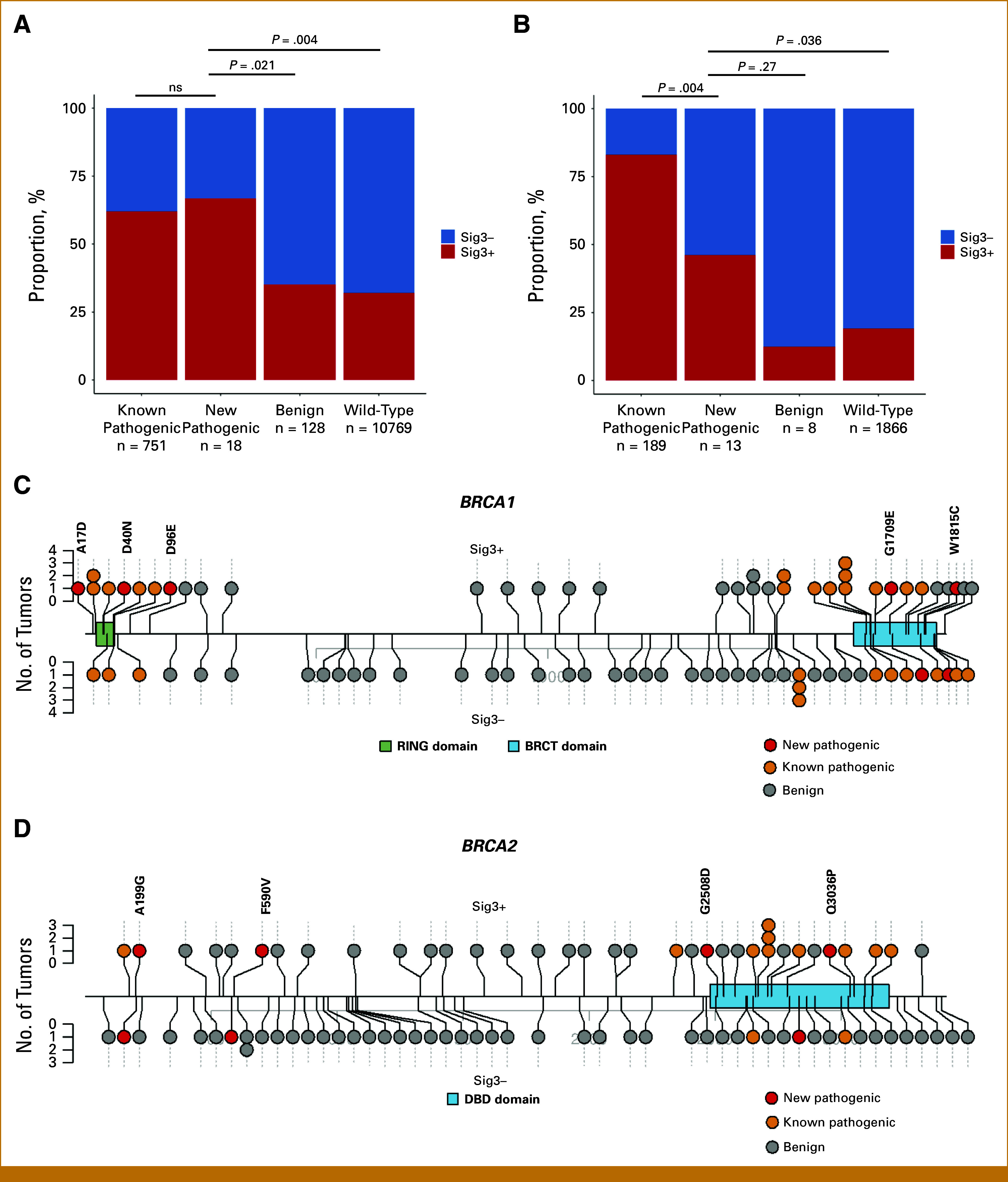
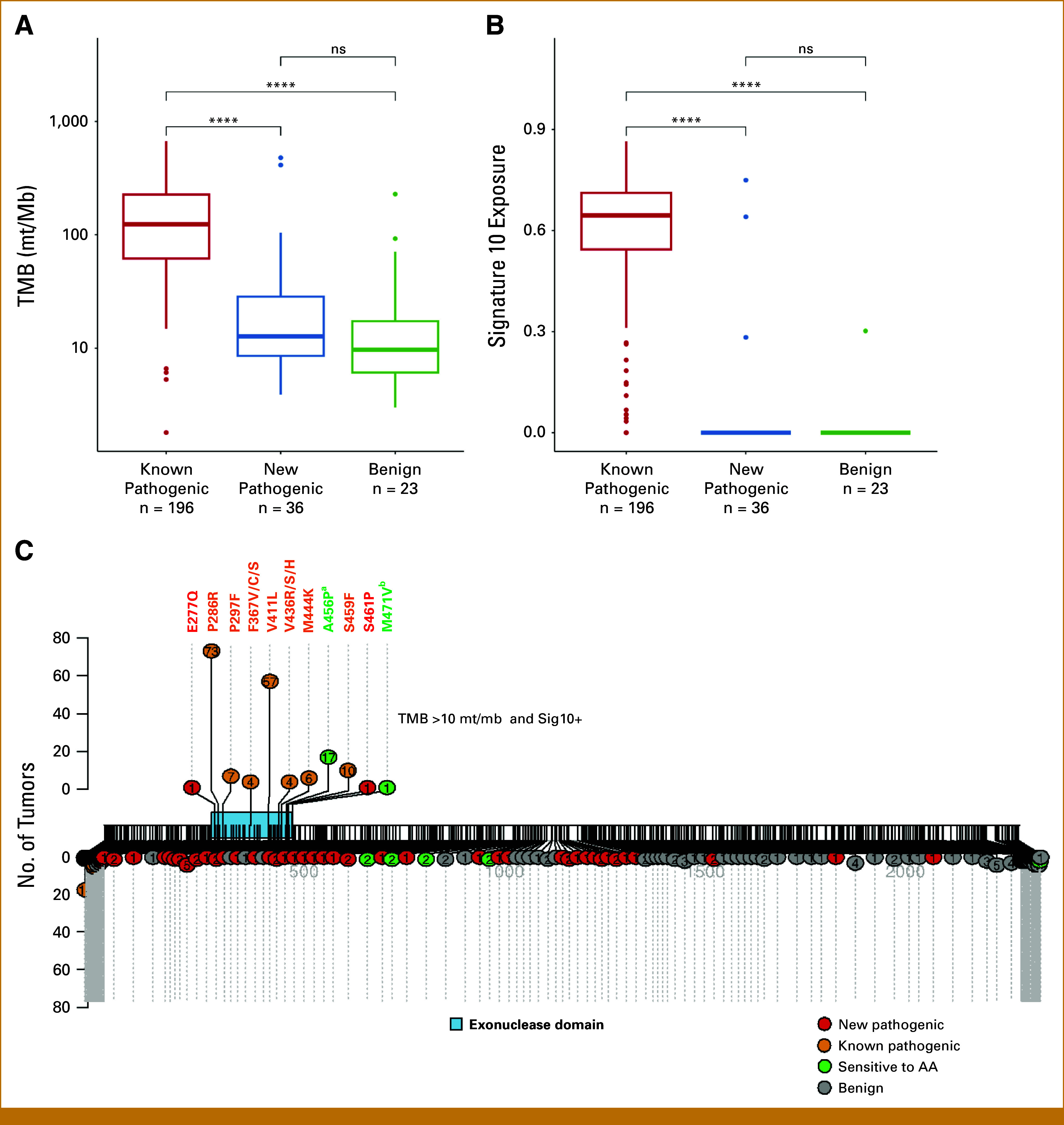
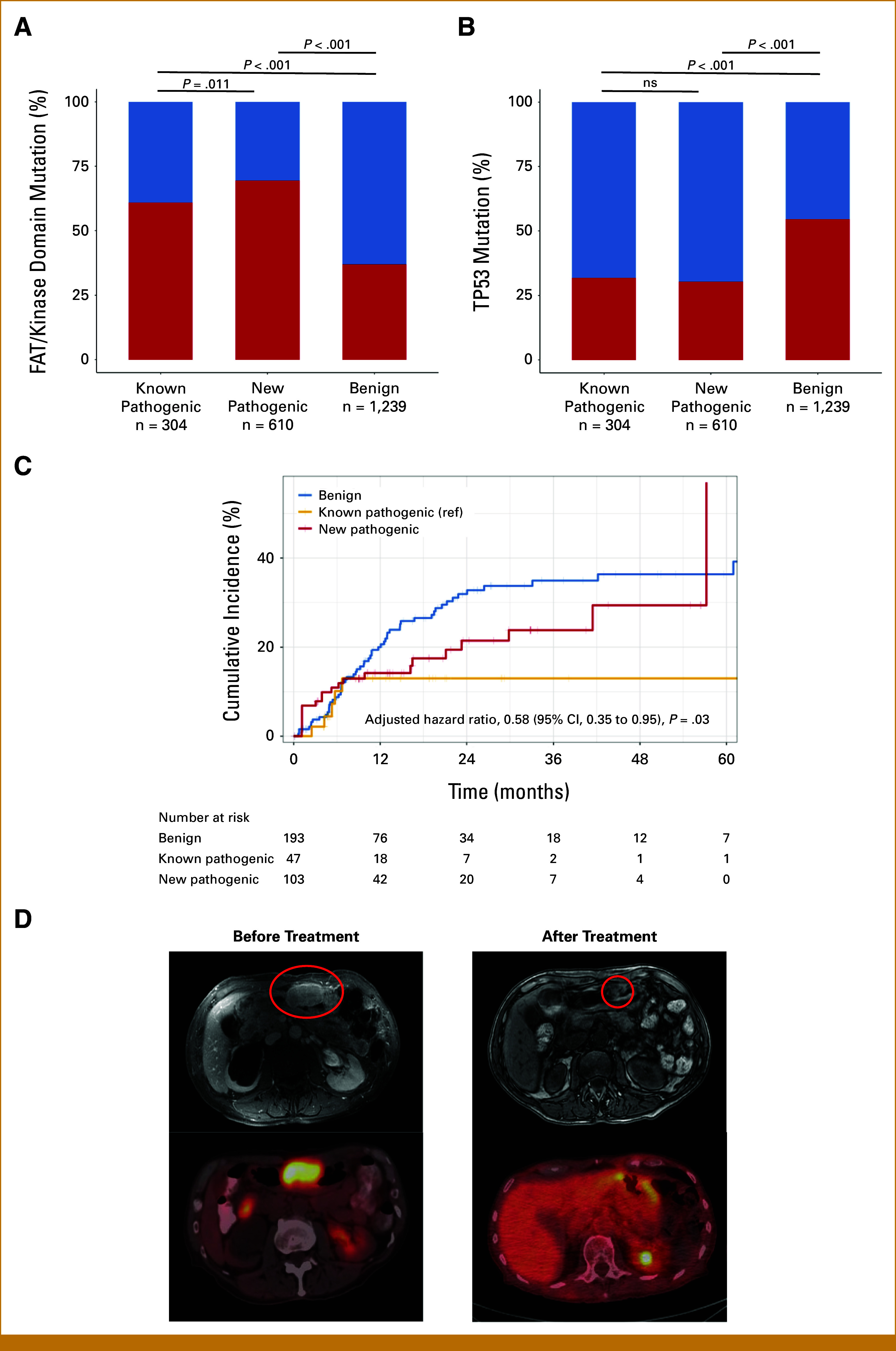
Results: In the MSK-IMPACT cohort, 1,182 (17.5%) of 6,743 unique DDR gene missense mutations were newly identified as pathogenic. In breast, ovarian, pancreatic, and prostate cancers, homologous recombination (HR)-deficiency signatures were more common in tumors with new pathogenic missense mutations in BRCA1/2, PALB2, and RAD51C than in benign missense mutations (66.7% v 35.2%, P = .021). In the TCGA/PCAWG data set, HR-deficiency signatures were also more frequent in tumors with new pathogenic mutations than in wild-type (46.2% v 19.2%, P = .036). For tumors with POLE missense mutations, there were no significant differences in tumor mutation burden and POLE-associated signatures between new pathogenic and benign mutations. Patients with new pathogenic ATM missense mutations had fewer TP53 mutations (30.5% v 54.6%, P < .001) and showed improved irradiated tumor control (hazard ratio, 0.58 [95% CI, 0.35 to 0.95]; P = .03) compared with those with benign missense mutations.
Conclusion: Our findings suggest that AlphaMissense can help identify previously unknown pathogenic DDR gene mutations, but its accuracy is gene-dependent. AlphaMissense prediction still requires additional confirmation with clinical and functional validation.
Conflict of interest statement
The following represents disclosure information provided by authors of this manuscript. All relationships are considered compensated unless otherwise noted. Relationships are self-held unless noted. I = Immediate Family Member, Inst = My Institution. Relationships may not relate to the subject matter of this manuscript. For more information about ASCO's conflict of interest policy, please refer to
Open Payments is a public database containing information reported by companies about payments made to US-licensed physicians (
No other potential conflicts of interest were reported.
Figures

Similar articles
-
Molecular feature-based classification of retroperitoneal liposarcoma: a prospective cohort study.Elife. 2025 May 23;14:RP100887. doi: 10.7554/eLife.100887. Elife. 2025. PMID: 40407808 Free PMC article.
-
Impact of residual disease as a prognostic factor for survival in women with advanced epithelial ovarian cancer after primary surgery.Cochrane Database Syst Rev. 2022 Sep 26;9(9):CD015048. doi: 10.1002/14651858.CD015048.pub2. Cochrane Database Syst Rev. 2022. PMID: 36161421 Free PMC article.
-
The effectiveness and cost-effectiveness of carmustine implants and temozolomide for the treatment of newly diagnosed high-grade glioma: a systematic review and economic evaluation.Health Technol Assess. 2007 Nov;11(45):iii-iv, ix-221. doi: 10.3310/hta11450. Health Technol Assess. 2007. PMID: 17999840
-
Does Augmenting Irradiated Autografts With Free Vascularized Fibula Graft in Patients With Bone Loss From a Malignant Tumor Achieve Union, Function, and Complication Rate Comparably to Patients Without Bone Loss and Augmentation When Reconstructing Intercalary Resections in the Lower Extremity?Clin Orthop Relat Res. 2025 Jun 26. doi: 10.1097/CORR.0000000000003599. Online ahead of print. Clin Orthop Relat Res. 2025. PMID: 40569278
-
Cost-effectiveness of using prognostic information to select women with breast cancer for adjuvant systemic therapy.Health Technol Assess. 2006 Sep;10(34):iii-iv, ix-xi, 1-204. doi: 10.3310/hta10340. Health Technol Assess. 2006. PMID: 16959170
References
MeSH terms
Grants and funding
LinkOut - more resources
Full Text Sources
Medical
Research Materials
Miscellaneous
