


Hydrolytic Enzymes in the Secretome of the Mushrooms P. eryngii and P. ostreatus: A Comparison Between the Two Species
- PMID: 40572471
- PMCID: PMC12196154
- DOI: 10.3390/molecules30122505
Hydrolytic Enzymes in the Secretome of the Mushrooms P. eryngii and P. ostreatus: A Comparison Between the Two Species
Abstract
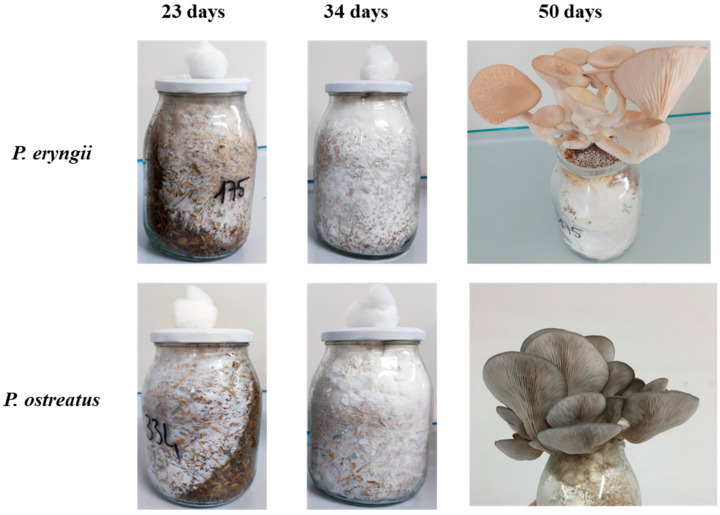
The fungi belonging to the genus Pleurotus can be cultivated in different substrates and represent excellent producers of several extracellular enzymes. In this study, we analyzed eleven hydrolytic enzymes of the P. eryngii and P. ostreatus secretomes, which were collected at three different growth stages after 23 days (mycelial colonization of about 50% of the substrate), 34 days (100% colonization of the substrate) and 50 days (after the first flush). Mushrooms were axenically cultivated on the same substrate. The results demonstrate that proteases, lipases, amylases, α-glucosidase, cellulases (endoglucanase, β-cellobiohydrolase and β-glucosidase) and hemicellulase (xylosidase, glucuronidase, arabinosidase and mannosidase) activities were higher in the secretomes from P. eryngii than those from P. ostreatus. Time course analysis revealed for both species a similar enzymatic activity profile, in which in the early stages of mycelium development, both species use starch as the main carbon source. Protease and lipase activities increased and remained constant during the subsequent formation of fruiting bodies, whereas cellulase and hemicellulase activities decreased after the complete mycelial colonization of the substrate. The zymographic analysis suggested the presence in the secretomes of proteolytic activities belonging to different classes. In conclusion, both mushroom species released into the secretomes a broad spectrum of hydrolytic enzymes potentially useful in various biotechnological fields.
Keywords: cellulases; hemicellulases; hydrolytic enzymes; lipases; mushroom cultivation; mushroom substrate; proteases; secretome.
Conflict of interest statement
The authors declare no conflicts of interest.
Figures


References
-
- Ball A.S., Jackson A.M. The recovery of lignocellulose-degrading enzymes from spent mushroom compost. Bioresour. Technol. 1995;54:311–314. doi: 10.1016/0960-8524(95)00153-0. - DOI
-
- Grujic M., Dojnov B., Potocnik I., Duduk B., Vujcic Z. Spent mushroom compost as substrate for the production of industrially important hydrolytic enzymes by fungi Trichoderma spp. and Aspergillus niger in solid state fermentation. Int. Biodeterior. Biodegrad. 2015;104:290–298. doi: 10.1016/j.ibiod.2015.04.029. - DOI
-
- Ariff I.N.M., Bahrin E.K., Ramli N., Abd-Aziz S. Direct use of spent mushroom substrate from Pleurotus pulmonarius as a readily delignified feedstock for cellulase production. Waste Biomass Valorization. 2019;10:839–850. doi: 10.1007/s12649-017-0106-8. - DOI
Publication types
MeSH terms
Substances
Supplementary concepts
LinkOut - more resources
Full Text Sources
