


Surface Evaluation of a Novel Acid-Etching Solution for Zirconia and Lithium Disilicate
- PMID: 40573041
- PMCID: PMC12195062
- DOI: 10.3390/ma18122912
Surface Evaluation of a Novel Acid-Etching Solution for Zirconia and Lithium Disilicate
Abstract
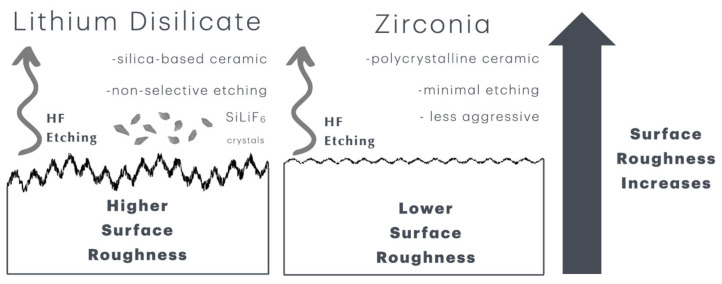
The current investigation evaluated a novel acid-etching solution containing hydrochloric acid (HCl), hydrofluoric acid (HF), nitric acid (HNO3), orthophosphoric acid (H3PO4), and sulfuric acid (H2SO4) designed for etching zirconia ceramics. Achieving reliable bonding to zirconia is challenging due to its chemical inertia, unlike lithium disilicate, which can be effectively conditioned with HF etching. One hundred and twenty specimens of zirconia and lithium disilicate underwent etching with the experimental solution for six different durations: control, 20 s, 60 s, 5 min, 30 min, and 1 h. Surface roughness was assessed using 3D optical profilometry and scanning electron microscopy (SEM). The roughness of both materials increased with etching time; however, lithium disilicate demonstrated a significantly greater response, with Ra values rising from 0.18 µm (control) to 1.26 µm (1 h), while zirconia increased from 0.21 µm to 0.60 µm. ANOVA revealed significant effects depending on the ceramic type, time, and their interaction (p < 0.001). SEM images revealed non-selective etching of lithium disilicate, suggesting potential over-etching. The novel acid-etching solution improved surface roughness, especially in lithium disilicate ceramics. An application duration of one hour appears optimal for zirconia, improving surface characteristics while reducing damage; however, further research is required to assess its clinical safety and long-term effects on the mechanical properties of this dental ceramic.
Keywords: acid etching; lithium disilicate; roughness; surface evaluation; zirconia.
Conflict of interest statement
The authors declare no conflicts of interest.
Figures


References
-
- Streit G., Sykes L.M. Overview of lithium disilicate as a restorative material in dentistry. S. Afr. Dent. J. 2022;77:495–499. doi: 10.17159/2519-0105/2022/v77no8a7. - DOI
LinkOut - more resources
Full Text Sources
Research Materials
Miscellaneous
