


Spin in the Titles and Abstracts of Allergy and Immunology Randomized Controlled Trials With Nonsignificant Outcomes
- PMID: 40575232
- PMCID: PMC12198706
- DOI: 10.7759/cureus.84840
Spin in the Titles and Abstracts of Allergy and Immunology Randomized Controlled Trials With Nonsignificant Outcomes
Abstract
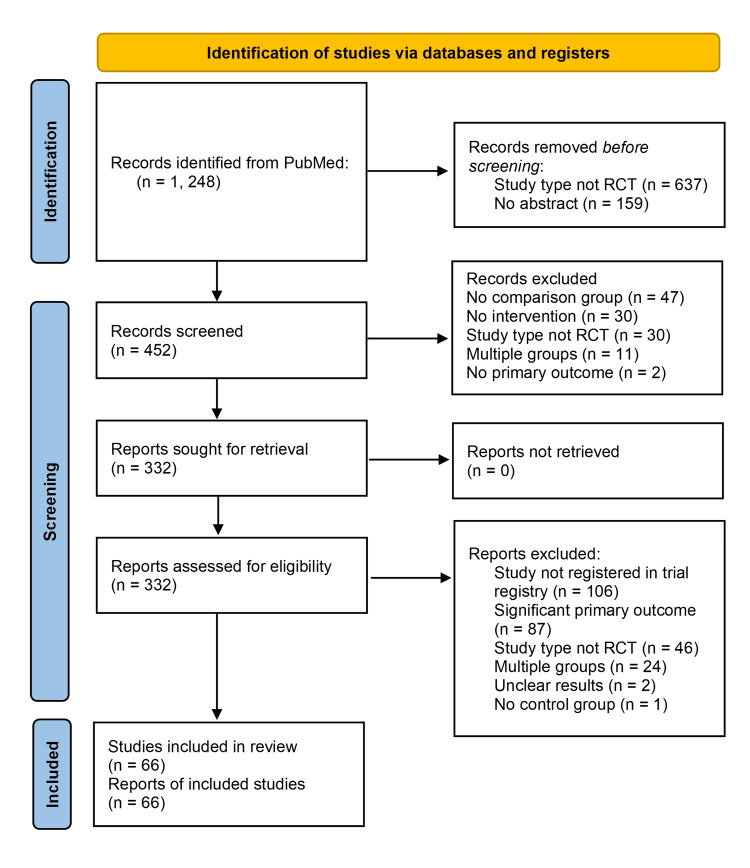
In scientific reporting, 'spin' refers to presenting neutral or negative outcomes in a manner that infers favorable results. Spin can be especially problematic in the abstracts of randomized control trials, leading to an incorrect interpretation of trial outcomes, and potentially impacting subsequent studies, patient care, and policy decisions. The present study aims to evaluate the presence of spin in the abstracts of registered randomized control trials published in allergy and immunology journals. A systematic search of the PubMed database was performed to identify randomized controlled trials of human subjects registered in a clinical trial registry with a test and control group and a nonsignificant primary endpoint. A total of 1,248 articles were screened and 66 abstracts met full inclusion criteria. Thirty-five of the 66 (53%) abstracts were found to contain one or more elements of spin, among which 11 (31.4%) had spin in the title, 29 (82.9%) in the abstract results, and 30 (85.7%) in the abstract conclusion. Industry-sponsored trials did not contain more spin compared to other funding sources (p=0.62). High rates of spin may adversely affect the interpretation and integration of new research. Careful evaluation is recommended when reviewing abstracts lacking statistically significant primary outcomes.
Keywords: allergy; immunology; outcome reporting bias; randomized control trials; rct; spin.
Copyright © 2025, Hamdan et al.
Conflict of interest statement
Conflicts of interest: In compliance with the ICMJE uniform disclosure form, all authors declare the following: Payment/services info: All authors have declared that no financial support was received from any organization for the submitted work. Financial relationships: All authors have declared that they have no financial relationships at present or within the previous three years with any organizations that might have an interest in the submitted work. Other relationships: All authors have declared that there are no other relationships or activities that could appear to have influenced the submitted work.
Figures
References
-
- Reporting and interpretation of randomized controlled trials with statistically nonsignificant results for primary outcomes. Boutron I, Dutton S, Ravaud P, Altman DG. JAMA. 2010;303:2058–2064. - PubMed
-
- Clinical trial registration: a statement from the International Committee of Medical Journal Editors. De Angelis C, Drazen JM, Frizelle FA, et al. Stroke. 2005;36:924–925. - PubMed
-
- Some superiority trials with nonsignificant results published in high impact factor journals correspond to noninferiority situations: a research-on-research study. Rajendrabose D, Collet L, Reinaud C, et al. J Clin Epidemiol. 2025;177:111613. - PubMed
-
- Relationship between research outcomes and risk of bias, study sponsorship, and author financial conflicts of interest in reviews of the effects of artificially sweetened beverages on weight outcomes: a systematic review of reviews. Mandrioli D, Kearns CE, Bero LA. PLoS One. 2016;11:0. - PMC - PubMed
Publication types
LinkOut - more resources
Full Text Sources
Miscellaneous