


Improving predictability, reliability, and generalizability of brain-wide associations for cognitive abilities via multimodal stacking
- PMID: 40575708
- PMCID: PMC12199782
- DOI: 10.1093/pnasnexus/pgaf175
Improving predictability, reliability, and generalizability of brain-wide associations for cognitive abilities via multimodal stacking
Abstract
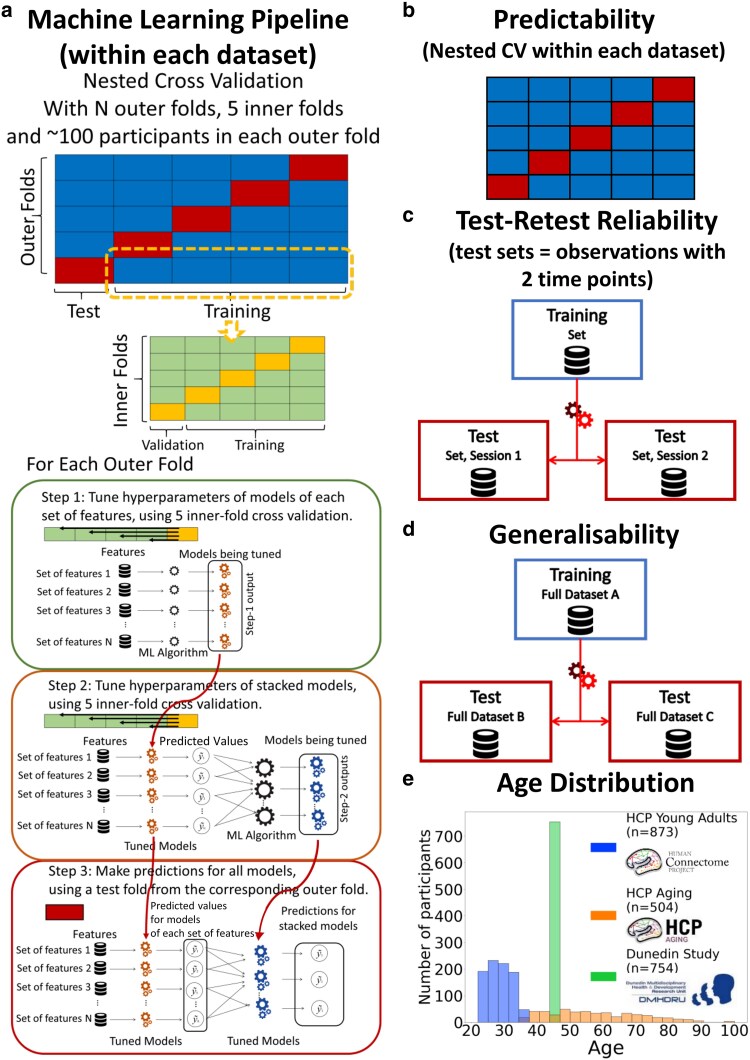
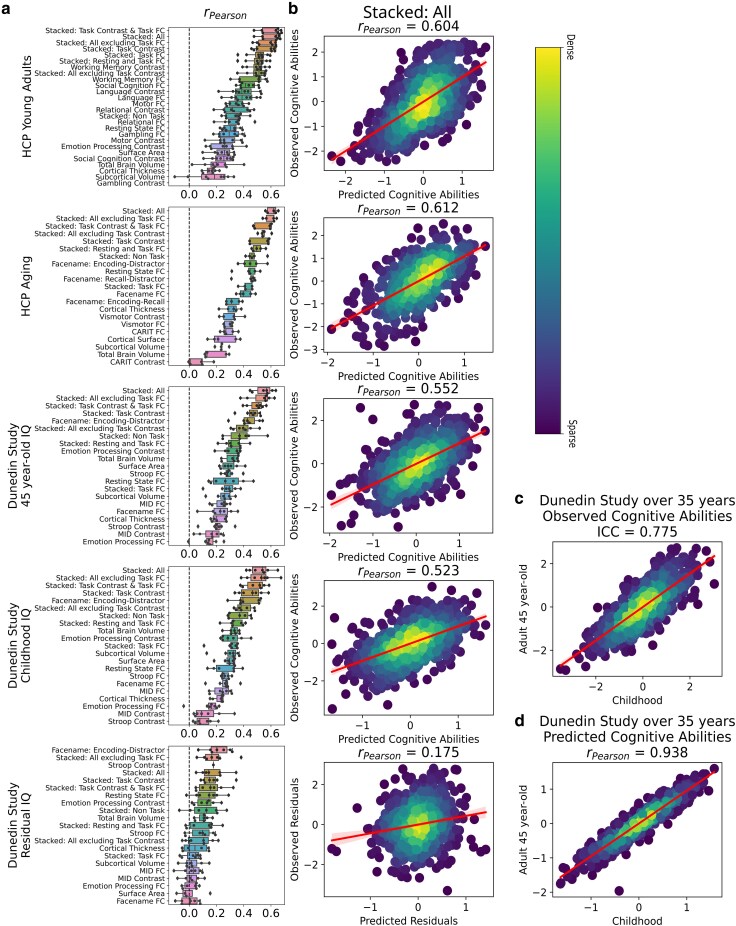
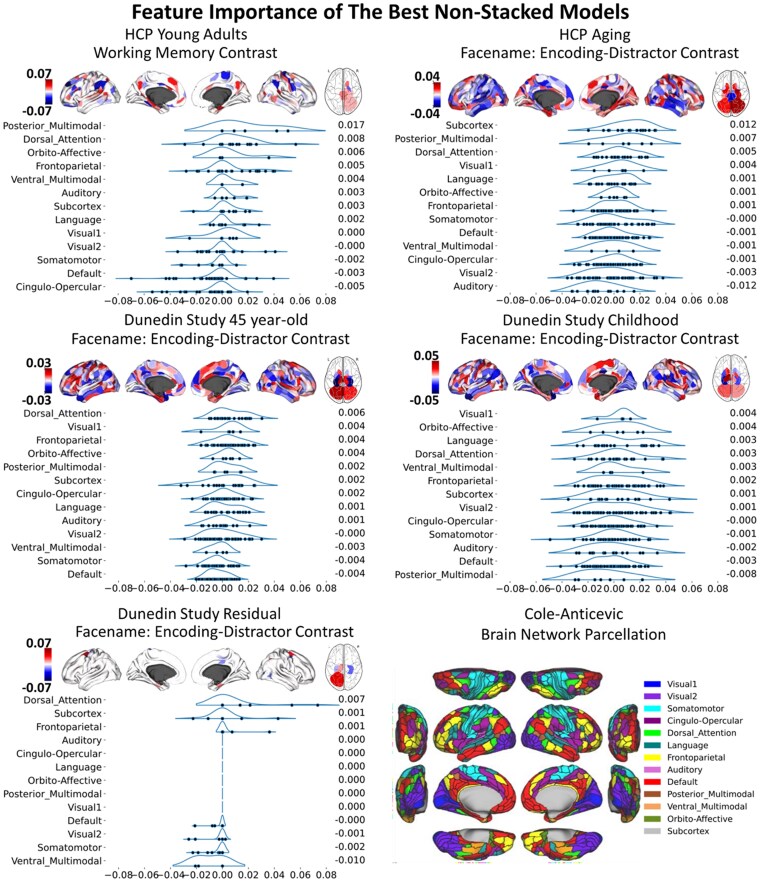
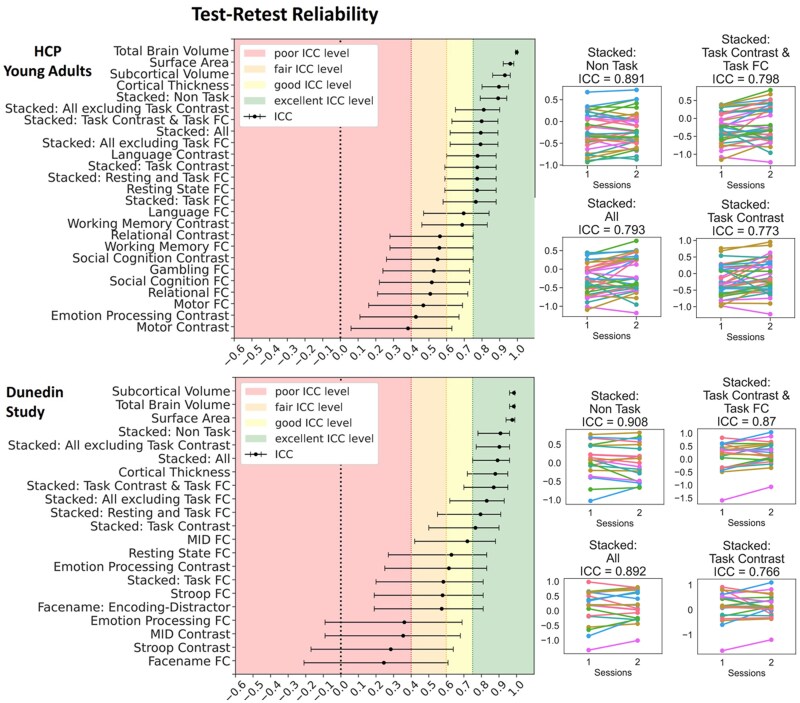
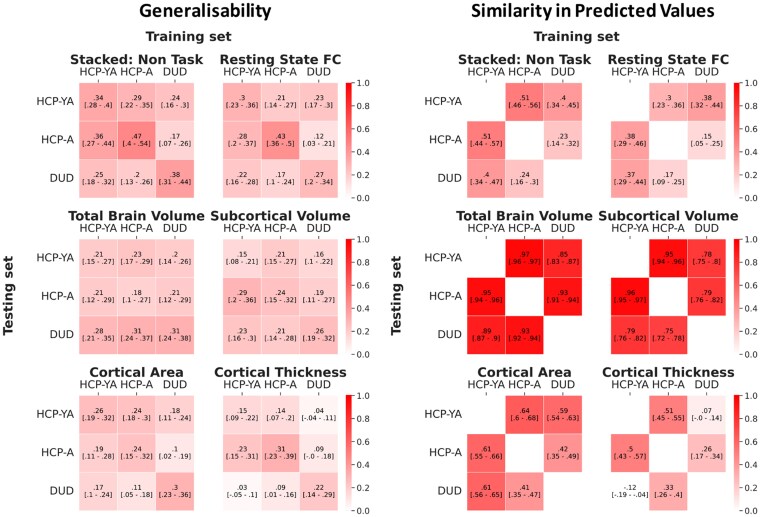
Brain-wide association studies (BWASs) have attempted to relate cognitive abilities with brain phenotypes, but have been challenged by issues such as predictability, test-retest reliability, and cross-cohort generalizability. To tackle these challenges, we proposed a machine learning "stacking" approach that draws information from whole-brain MRI across different modalities, from task-functional MRI (fMRI) contrasts and functional connectivity during tasks and rest to structural measures, into one prediction model. We benchmarked the benefits of stacking using the Human Connectome Projects: Young Adults (n = 873, 22-35 years old) and Human Connectome Projects-Aging (n = 504, 35-100 years old) and the Dunedin Multidisciplinary Health and Development Study (Dunedin Study, n = 754, 45 years old). For predictability, stacked models led to out-of-sample r∼0.5-0.6 when predicting cognitive abilities at the time of scanning, primarily driven by task-fMRI contrasts. Notably, using the Dunedin Study, we were able to predict participants' cognitive abilities at ages 7, 9, and 11 years using their multimodal MRI at age 45 years, with an out-of-sample r of 0.52. For test-retest reliability, stacked models reached an excellent level of reliability (interclass correlation > 0.75), even when we stacked only task-fMRI contrasts together. For generalizability, a stacked model with nontask MRI built from one dataset significantly predicted cognitive abilities in other datasets. Altogether, stacking is a viable approach to undertake the three challenges of BWAS for cognitive abilities.
Keywords: cognitive abilities; generalizability; reliability; stacking; task fMRI.
© The Author(s) 2025. Published by Oxford University Press on behalf of National Academy of Sciences.
Figures
Update of
-
Improving Predictability, Reliability and Generalisability of Brain-Wide Associations for Cognitive Abilities via Multimodal Stacking.bioRxiv [Preprint]. 2025 Mar 5:2024.05.03.589404. doi: 10.1101/2024.05.03.589404. bioRxiv. 2025. Update in: PNAS Nexus. 2025 Jun 24;4(6):pgaf175. doi: 10.1093/pnasnexus/pgaf175. PMID: 38746222 Free PMC article. Updated. Preprint.
References
-
- Deary IJ, Pattie A, Starr JM. 2013. The stability of intelligence from age 11 to age 90 years: the Lothian Birth Cohort of 1921. Psychol Sci. 24:2361–2368. - PubMed
-
- Deary IJ, Strand S, Smith P, Fernandes C. 2007. Intelligence and educational achievement. Intelligence. 35:13–21.
-
- Schmidt FL, Hunter J. 2004. General mental ability in the world of work: occupational attainment and job performance. J Pers Soc Psychol. 86:162–173. - PubMed
Grants and funding
LinkOut - more resources
Full Text Sources
