. 2025 Jun;122(6):e70300.
doi: 10.1111/tpj.70300.

Genome-wide association analysis and linkage mapping decipher the genetic control of primary metabolites and quality traits in Capsicum

Affiliations

Genome-wide association analysis and linkage mapping decipher the genetic control of primary metabolites and quality traits in Capsicum

Julia von Steimker et al. Plant J. 2025 Jun.

Abstract

Pepper (Capsicum spp.) is a rich source of natural compounds, including primary metabolites essential for plants and influencing human nutrition and taste perception. Although pepper represents an important horticultural crop, the genetic bases underlying the primary metabolism remain largely unclear. Here, we performed a complementary approach for mapping primary metabolites via quantitative trait loci analysis (mQTL) and genome-wide association studies (mGWAS). Using gas chromatography coupled with mass spectrometry we quantified and mapped 80 metabolites, including amino acids, sugars, and organic acids in an interspecific backcross inbred line population and a GWAS panel over three independent trials. We identified 263 candidate genes implicated in 91 robust QTL across studies. Additionally, 28 QTL containing 84 candidate genes were identified with various pleiotropic effects. We further combined agro-physiological characteristics determining their relationships with metabolites, both underlying the quality of pepper fruits. We implemented plasticity analysis to investigate candidate genes causal for metabolic dispersion. Eighty-six genes were identified; among these, a previously reported UDP-glycosyltransferase responsible for capsianosides biosynthesis was found to be associated with a cluster of sugars, organic, and amino acids, which are the main precursors of sensory taste in vegetables. This study provides the first attempt to comprehend the genetic basis of Capsicum primary metabolism, which will further support assisted breeding for fruit quality.

Keywords: GWAS; QTL mapping; candidate gene; genotype by environment; morpho‐agronomic traits; pepper; primary metabolites; quality.


Conflict of interest statement

The authors declare no conflict of interest.

Figures
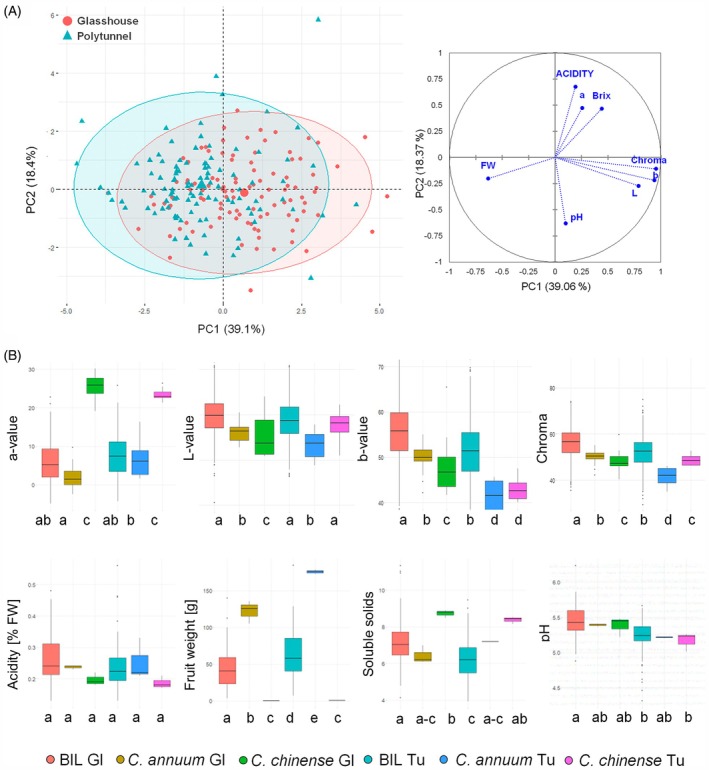
Figure 1
Figure 1
Morphological descriptors of the backcross inbred line (BIL) population. (A) Loading plot of the first two principal components showing the variation in the glasshouse (red ellipse) and polytunnel (blue ellipse). Variables that contributed to group separation are indicated by the arrows. (B) Box plots for phenotypic measures performed on parental lines and BIL populations grown in two environments (Gl, greenhouse; Tu, polytunnel); Color‐related measures (L, lightness/darkness; a, green‐redness; b, blue‐yellowness, Chroma). Letters indicate significance P < 0.05 (ANOVA, post‐hoc Fisher's LSD).
Figure 2
Figure 2
Agro‐qualitative traits of the genome‐wide association study (GWAS) population. (A) Loading plot of the first (PC1) and second (PC2) principal components showing the variation in the first season (Y1–2018; blue ellipse) and second (Y2–2019/20; red ellipse) growing seasons. (B) Box plots for phenotypic measures performed in two seasons (left group year 1, right group year 2); accessions were assigned to green, kapia, pumpkin, and pungent. Letters indicate significance P < 0.05 (ANOVA, post‐hoc Fisher's LSD).
Figure 3
Figure 3
Primary metabolic features are conserved among species. (A) Principal component analysis (PCA) and heatmap of 77 primary metabolic features of the backcross inbred line and their parental lines Capsicum annuum and Capsicum chinense grown in the glasshouse (Gl) and the polytunnel (Tu). (B) PCA and heatmap of the GWAS population grouped as green, kapia, pumpkin‐shaped, and pungent varieties.
Figure 4
Figure 4
Phenotypic variation and heritability estimates of the backcross inbred line (BIL) population and genome‐wide association study (GWAS) panel. (A) Analysis of genotype‐by‐environment and heritability of BIL population of morphological descriptors includes fruit weight (FW), brix, acidity, pH, and color‐related measures (L, lightness/darkness; a, green‐redness; b, blue‐yellowness). (B) Genotype‐by‐environment analysis of morphological descriptors of the GWAS panel including vitamin C and Brix from 2018 and 2020, productivity per plant, locule number, fruit length/width/weight, usable part, wall thickness, embranchment, stem height, wall thickness, and plant height from 2018 to 2019. Phenotypic variation in % is given for genotype (green), environment (light blue), genotype:environment interaction (orange), and residuals (pink). Heritability estimate in % is given for narrow‐sense heritability (gray) and broad‐sense heritability (blue). Bar plots as mean ± standard error, ***P < 0.001, two‐way ANOVA.
Figure 5
Figure 5
Phenotypic variation and heritability estimate of primary metabolites of the backcross inbred line (BIL) population. (A–C) (A) Amino acids are sorted by polarity (orange = polar, blue = hydrophobic), (B) sugars, and (C) organic acids. Heritability estimates in % are given for narrow‐sense heritability (gray) and broad‐sense heritability (blue). Phenotypic variation in % is given for genotype (green), environment (light blue), genotype: environment interaction (orange), and residuals (pink). Bar plots as mean ± standard error, ***P < 0.001, **P < 0.01, *P < 0.05; two‐way ANOVA.
Figure 6
Figure 6
Pleiotropic map of QTL mapping of color‐related traits and primary metabolites from the BIL panel and GWAS. Backcross inbred line population grown in the polytunnel (Tu; gray), in the glasshouse (Gl; yellow) and GWAS panel (blue). QTL shown in blue color were found in both GWAS and BIL populations. (A) Color‐related traits include Chroma, L as the lightness/darkness measure, a describes green‐redness, and b describes blue‐yellowness, acidity, pH, fruit weight, and brix. (B–D) Primary metabolic compounds were separated into (B) amino acids (nTu = 32, nGl = 25, nGWAS = 9), (C) organic acids (nTu = 21, nGl = 22, nGWAS = 17), and (D) sugars (nTu = 14, nGl = 17, nGWAS = 8). Each dot represents a significant SNP, while the outer circle indicates the number of chromosomes and the inner circle the sum of lead SNPs.
Figure 7
Figure 7
Identification of candidate genes associated with plasticity. (A–C) Overlayed Manhattan plots of selected (A) amino acids, (B) organic acids, and (C) sugars from the BIL panel. The logarithm of the odds (LOD) is plotted against the chromosome position. The coefficient of variation was computed for each individual between the glasshouse and polytunnel. UGT, UDP‐glycosyltransferase.

References

    1. Aiello, A. , Pepe, E. , De Luca, L. , Pizzolongo, F. & Romano, R. (2022) Preliminary study on kinetics of pyroglutamic acid formation in fermented milk. International Dairy Journal, 126, 105233.
    1. Alfosea‐Simón, M. , Simón‐Grao, S. , Zavala‐Gonzalez, E.A. , Cámara‐Zapata, J.M. , Simón, I. , Martínez‐Nicolás, J.J. et al. (2021) Physiological, nutritional and metabolomic responses of tomato plants after the foliar application of amino acids aspartic acid, glutamic acid and alanine. Frontiers in Plant Science, 11, 1–16. - PMC - PubMed
    1. Alseekh, S. , Scossa, F. , Wen, W. , Luo, J. , Yan, J. , Beleggia, R. et al. (2021) Domestication of crop metabolomes: desired and unintended consequences. Trends in Plant Science, 26, 650–661. - PubMed
    1. Antonio, A.S. , Wiedemann, L.S.M. & Veiga Junior, V.F. (2018) The genus Capsicum: a phytochemical review of bioactive secondary metabolites. RSC Advances, 8, 25767–25784. - PMC - PubMed
    1. Araújo, W.L. , Nunes‐Nesi, A. , Trenkamp, S. , Bunik, V.I. & Fernie, A.R. (2008) Inhibition of 2‐oxoglutarate dehydrogenase in potato tuber suggests the enzyme is limiting for respiration and confirms its importance in nitrogen assimilation. Plant Physiology, 148, 1782–1796. - PMC - PubMed

LinkOut - more resources
