


Development and validation of a hierarchical machine learning method using MALDI-TOF mass spectrometry for rapid SCCmec typing and PVL detection in MRSA: a multi-centre study
- PMID: 40576568
- PMCID: PMC12272661
- DOI: 10.1080/22221751.2025.2525264
Development and validation of a hierarchical machine learning method using MALDI-TOF mass spectrometry for rapid SCCmec typing and PVL detection in MRSA: a multi-centre study
Abstract
Objectives: Methicillin-resistant Staphylococcus aureus (MRSA) is a major public health concern because of its genotypic diversity and association with severe infections, particularly those caused by strains carrying Panton-Valentine leukocidin (PVL). This study aimed to develop an artificial intelligence-clinical decision support system (AI-CDSS) to streamline MRSA genotyping and PVL detection, providing a more efficient alternative to complex PCR-based workflows.
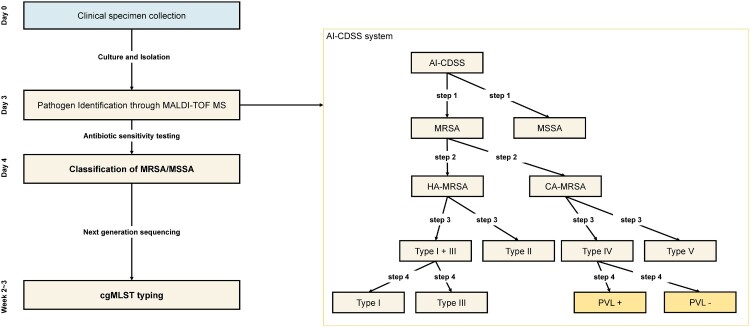
Methods: We retrospectively analysed 345,748 bacterial specimens collected from five healthcare institutions between 2010 and 2024. Matrix-assisted laser desorption/ionization time-of-flight mass spectrometry data were analysed using a hierarchical classification framework enhanced by machine learning models to identify the MRSA status, staphylococcal cassette chromosome mec subtypes, and PVL presence. Area under the curve (AUC), sensitivity, and specificity were used for model evaluation.
Results: AI-CDSS was highly accurate for MRSA genotyping (AUCs > 0.9) and PVL detection (AUC = 0.85). Automating hierarchical classifications effectively replaced labour-intensive PCR processes, reducing diagnostic complexity and resource use.
Conclusions: AI-CDSS is a scalable and efficient method for MRSA genotyping and PVL detection. By streamlining diagnostics and supporting timely clinical interventions, this system can improve infection management and patient care, which will reduce mortality associated with MRSA infections.
Keywords: AI-CDSS; MRSA; PVL; artificial intelligence; artificial intelligence-clinical decision support systems.
Conflict of interest statement
No potential conflict of interest was reported by the author(s).
Figures
References
-
- World Health Organization . WHO’s first global report on antibiotic resistance reveals serious, worldwide threat to public health 2014 [updated 2014 April 30–2025 Jan 2]. https://www.who.int/news/item/30-04-2014-who-s-first-global-report-on-an....
Publication types
MeSH terms
Substances
LinkOut - more resources
Full Text Sources
Other Literature Sources
Medical
