


The relationship between the Geriatric Nutritional Risk Index and all-cause mortality in patients with peripheral artery disease
- PMID: 40577338
- PMCID: PMC12204543
- DOI: 10.1371/journal.pone.0325938
The relationship between the Geriatric Nutritional Risk Index and all-cause mortality in patients with peripheral artery disease
Abstract
Background: Peripheral artery disease (PAD) is a common atherosclerotic condition that leads to limb dysfunction and increases mortality risk. Malnutrition is closely related to the long-term mortality of PAD patients. Therefore, studying the relationship between the Geriatric Nutritional Risk Index (GNRI) and long-term mortality in patients with PAD is crucial for identifying high-risk populations and developing targeted interventions.
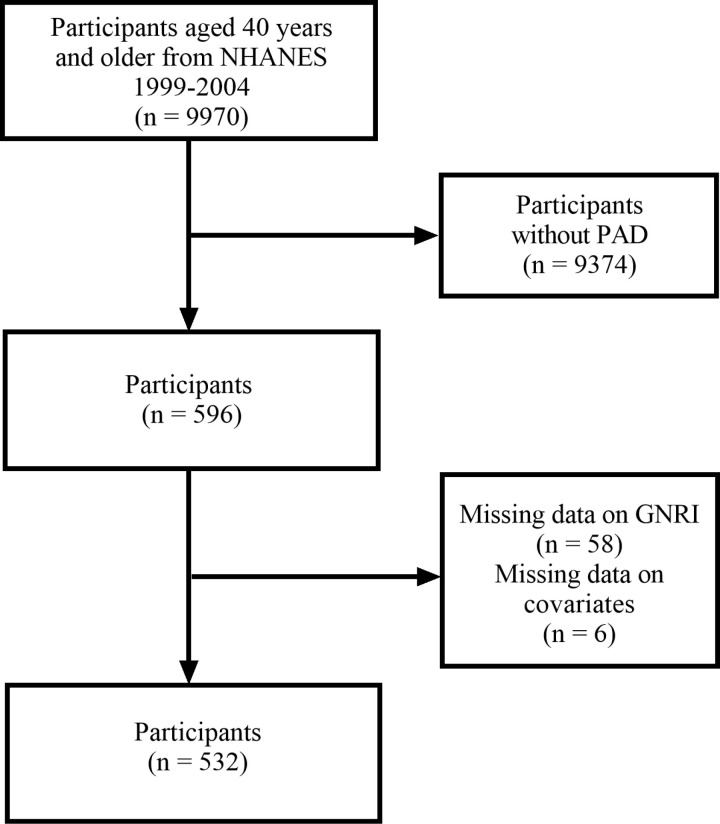
Methods: Data were sourced from the National Health and Nutrition Examination Survey (NHANES) conducted between 1999-2004, including 532 PAD patients. Kaplan-Meier survival analysis and multivariate Cox regression models assessed the relationship between GNRI and all-cause mortality in PAD patients. Subgroup analyses were conducted to explore differences based on demographic and disease backgrounds.
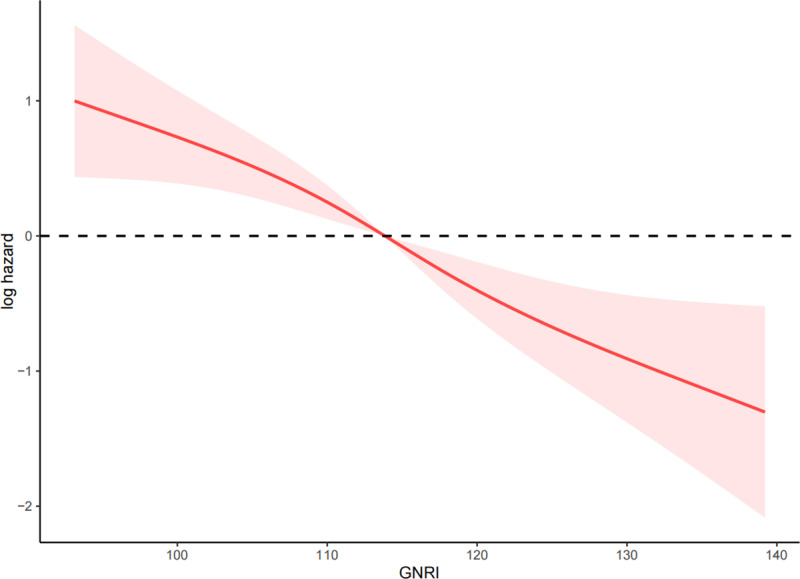
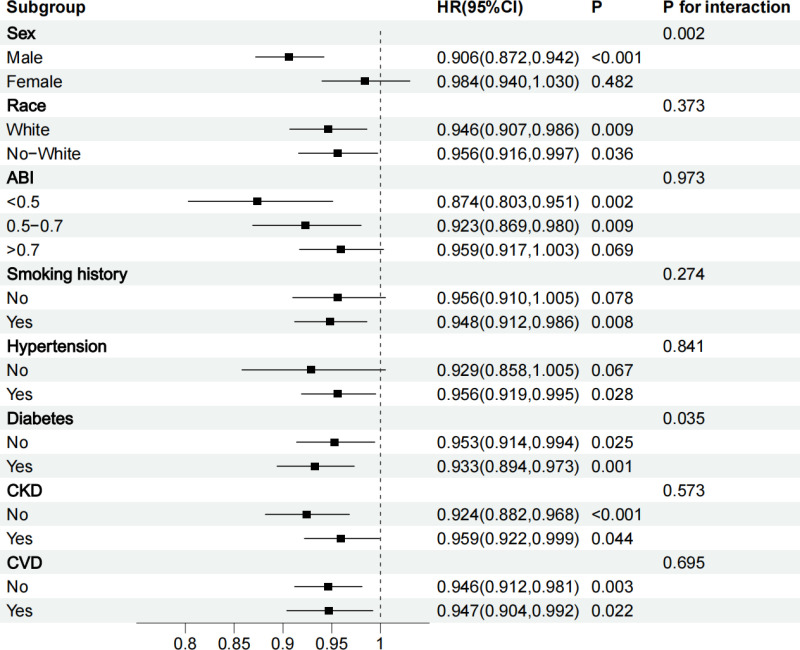
Results: During the follow-up period, a total of 415 all-cause deaths were recorded. The Kaplan-Meier survival curve showed significant differences in mortality rates between the different GNRI quartile groups. Multivariate Cox regression analysis showed a significant negative correlation between GNRI and the long-term mortality risk of PAD patients (HR: 0.950, 95%CI: 0.918, 0.983). Compared to the first GNRI quartile, PAD patients in the third (HR: 0.569, 95%CI: 0.357, 0.909) and fourth (HR: 0.396, 95%CI: 0.208, 0.751) quartiles had a significantly reduced risk of long-term mortality. Restrictive cubic spline analysis showed a significant linear negative correlation between GNRI and all-cause mortality in PAD patients. The subgroup analysis results showed that the negative correlation between GNRI and all-cause mortality in PAD patients was significant in all subgroups except for the female subgroup, subgroup with ABI > 0.7, subgroup without smoking history, and subgroup without hypertension.
Conclusion: There is a significant negative association between GNRI and all-cause mortality in PAD patients, suggesting that malnutrition may be a key factor affecting the prognosis of PAD patients. Early identification and intervention for malnutrition could reduce long-term mortality risks. Future research should further explore the role of nutritional interventions in the management of PAD and validate the findings of this study.
Copyright: © 2025 Wu et al. This is an open access article distributed under the terms of the Creative Commons Attribution License, which permits unrestricted use, distribution, and reproduction in any medium, provided the original author and source are credited.
Conflict of interest statement
The authors have declared that no competing interests exist.
Figures

References
-
- Firnhaber JM, Powell CS. Lower extremity peripheral artery disease: diagnosis and treatment. Am Fam Physician. 2019;99(6):362–9. - PubMed
-
- Criqui MH, Matsushita K, Aboyans V, Hess CN, Hicks CW, Kwan TW, et al. Lower extremity peripheral artery disease: contemporary epidemiology, management gaps, and future directions: a scientific statement from the American heart association. Circulation. 2021;144(9):e171–91. doi: 10.1161/CIR.0000000000001005 - DOI - PMC - PubMed
MeSH terms
LinkOut - more resources
Full Text Sources
Medical
