


Application of enhanced recovery after surgery in perioperative care of infants and children with Hirschsprung disease
- PMID: 40584501
- PMCID: PMC12188570
- DOI: 10.4240/wjgs.v17.i6.105739
Application of enhanced recovery after surgery in perioperative care of infants and children with Hirschsprung disease
Abstract
Background: Enhanced recovery after surgery (ERAS) represents an innovative, protocol-driven perioperative care program designed to optimize patient outcomes. However, its application and efficacy in infants and children with Hirschsprung disease (HD) remain underexplored.
Aim: To delve into the impact of ERAS on perioperative recovery and the overall medical experience in HD infants and children.
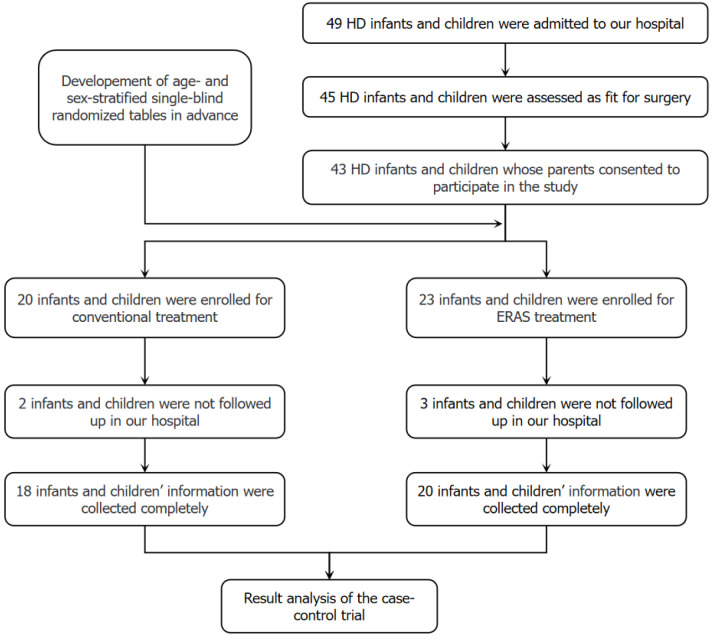
Methods: Thirty-eight infants and children with HD who received the Soave surgical procedure were enrolled in this case-control study. According to age- and sex-stratified single-blind randomized tables, 20 cases received ERAS treatment (ERAS group) and 18 cases received conventional treatment (control group). The two treatments were then compared in terms of perioperative recovery and medical experience.
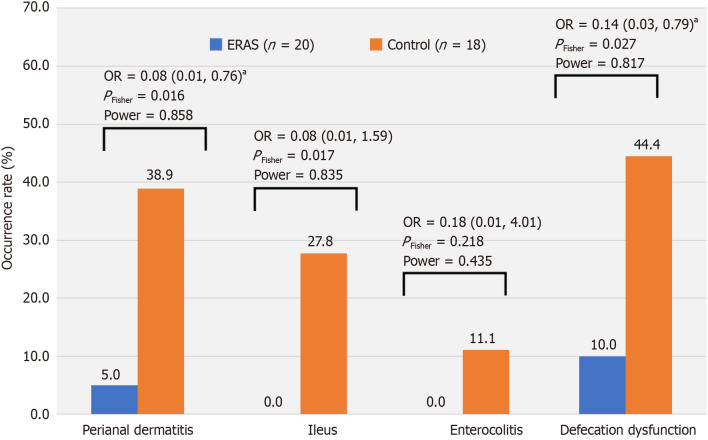
Results: Significant differences were observed in pain scores at awakening (4.2 ± 1.3 vs 5.2 ± 1.2, t = 2.516, P = 0.017) and pain duration (85.69 ± 7.46 hours vs 67.00 ± 8.56 hours, t = 7.139, P < 0.001) between the ERAS and control group. The recovery of bowel movement was earlier in the ERAS group than in the control group (borborygmus time: 33.63 ± 9.83 hours vs 44.69 ± 16.85 hours, t = 2.501, P = 0.017; feeding time: 36.63 ± 9.55 hours vs 49.36 ± 16.99 hours, t = 2.884, P = 0.007; anal catheter indwelling time: 75.83 ± 13.80 hours vs 93.36 ± 20.65 hours, t = 3.104, P = 0.004), and fever duration (40.73 ± 14.42 hours vs 52.63 ± 18.69 hours, t = 2.211, P = 0.034). In the ERAS group, hospital stay was shorter (7.5 ± 0.9 days vs 8.3 ± 1.2 days) and the cost was lower (14203 ± 2381 yuan vs 16847 ± 3558 yuan). During the 1-month follow-up period, of the multiple postoperative complications observed, the occurrence of perianal dermatitis (P Fisher = 0.016) and defecation dysfunction (P Fisher = 0.027) were lower in the ERAS group than in the control group.
Conclusion: The ERAS protocol has the potential to profoundly enhance postoperative recovery and significantly elevate the overall comfort and quality of the medical experience, making it an indispensable approach that warrants widespread adoption. Continuous refinement through evidence-based practices is anticipated to further optimize its efficacy.
Keywords: Complications; Enhanced recovery after surgery; Hirschsprung disease; Infant and children; Outcome; Perioperative period.
©The Author(s) 2025. Published by Baishideng Publishing Group Inc. All rights reserved.
Conflict of interest statement
Conflict-of-interest statement: All the authors report no relevant conflicts of interest for this article.
Figures
References
LinkOut - more resources
Full Text Sources
