[Preprint]. 2025 Jun 14:2025.06.13.25329588.
doi: 10.1101/2025.06.13.25329588.

SARS-CoV-2 antibody immunity across three continents: the West Africa, West Indies, West London Consortium

Affiliations

SARS-CoV-2 antibody immunity across three continents: the West Africa, West Indies, West London Consortium

David Greenwood et al. medRxiv. .

Abstract

Background: The experience of the COVID-19 pandemic has differed across continents. We hypothesized that regional differences in SARS-CoV-2 immunity might explain this observation. We therefore established the WWW Consortium in Ghana, W Africa; Jamaica, W Indies; and W London. Here, we describe the extent to which antibody immunity differs between these geographic locations.

Methods: The WWW Consortium harmonises across the HERITAGE (Accra, Ghana), WINDFall (Kingston, Jamaica) and Legacy (London, UK) studies, establishing sharing frameworks for samples, metadata, and data; related permissions and oversight; and associated physical and cloud infrastructure. With centralised testing, we performed serological assessments across all three locations at two snapshots in 2024 (April 1st - August 18th; August 19th - December 31st) using high-throughput live virus neutralization and anti-nucleocapsid IgG, including n=763 individuals.

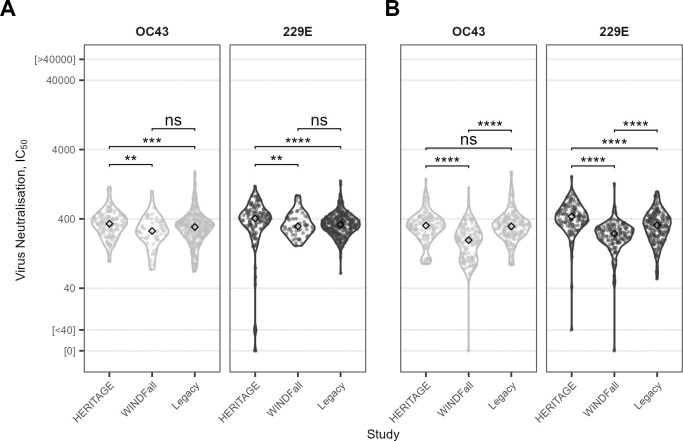
Findings: We found that across all sites most participants had detectable neutralising antibody titres against JN.1 and XEC - the predominant variants in 2024. There were site-related differences in immunity: vaccine-included SARS-CoV-2 strains were better neutralised by participants from the Legacy study - Ancestral, BA.5, XBB.1.5 initially, and JN.1 after a homologous booster in autumn 2024. For HERITAGE, neutralisation of both alpha- (HCoV-229E) and beta-coronaviruses (HCoV-OC43) was higher than WINDFall suggesting a cross-coronavirus serological response in West Africa. Finally, antigenic cartography identified two distinct antibody landscapes, with JN.1 and XEC antigenically distant in Legacy, but not in HERITAGE and WINDFall.

Interpretation: There is international heterogeneity in SARS-CoV-2 antibody immunity. Global recommendations for vaccine strain selection should incorporate data from diverse populations to ensure accurate, equitable recommendations.

Funding: The Wellcome Trust.


Conflict of interest statement

Declarations of interests YB and JMN & DH within the HERITAGE study team own shares of Yemaachi Biotech. ECW reports consulting for AstraZeneca and CSL-Seqirus unrelated to this work. DLVB reports discussions between the Francis Crick institute and GSK for SARS-CoV-2 antiviral testing, and grants to the Crick from AstraZeneca unrelated to this work. Declarations from other consortium authors deemed not relevant to this work.

Figures
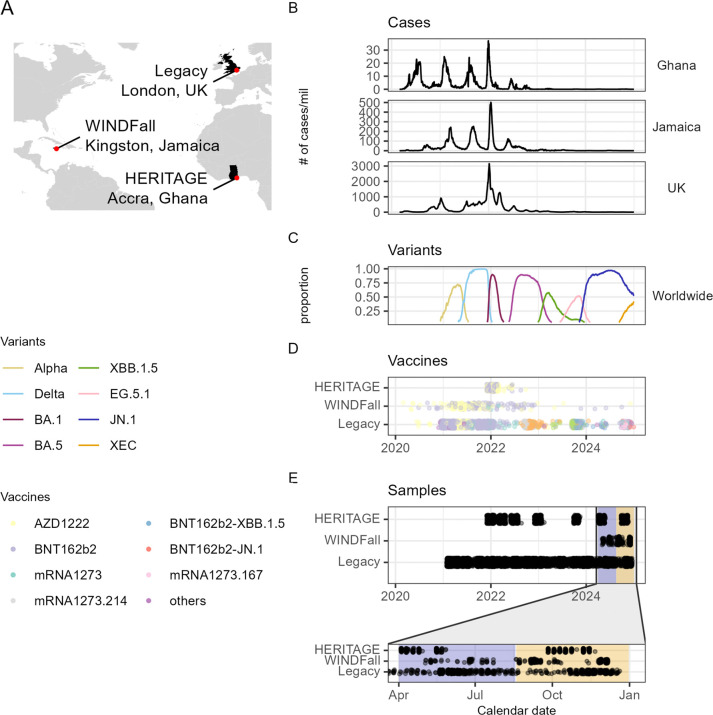
Figure 1 |
Figure 1 |. The West Africa, West Indies, West London consortium in 2024
(A) Map showing the 3 contributing studies to WWWc. (B) Numbers of daily new confirmed COVID-19 cases per million population over 2024–25 (World Health Organization (2025); Population based on various sources (2024) – with major processing by Our World in Data). Retrieval date: 5 June 2025 (C) The proportion of SARS-CoV-2 sequences corresponding to each of the main variants worldwide. Data from GISAID, with analysis from COVspectrum. Retrieval date: 6 June 2025 (D) Vaccines within WWWc are shown for HERITAGE, WINDFall, and Legacy (E) Serum samples used in this study, splitting 2024 into cohorts Period 1 (April 1st – August 18th) and Period 2 (August 19th – December 31st). See Tables 1 & 2 for demographic information for Period 1 and Period 2 respectively. Vaccine nomenclature: AZD1222 (ChAdOx-1, Oxford/AstraZeneca; adenoviral vector), BNT162b2 (Pfizer/BioNTech; mRNA vector), mRNA1273 (Moderna; mRNA vector), mRNA1273.214 (Moderna bivalent Ancestral & BA.1; mRNA vector), BNT162b2-XBB.1.5 (Pfizer/BioNTech monovalent XBB.1.5; mRNA vector), BNT162b2-JN.1 (Pfizer/BioNTech monovalent JN.1; mRNA vector), mRNA1273.167 (Moderna monovalent JN.1; mRNA vector).
Figure 2 |
Figure 2 |. Continental heterogeneity in SARS-CoV-2 serological immunity during 2024
Serum neutralisation titres against SARS-CoV-2 variants from HERITAGE, WINDFall, and Legacy participants at two time points in 2024: (A) Period 1, P1, April 1st – August 18th; and (B) Period 2, P2, August 19th – December 31st. Titres are compared between time points for JN.1 (C) and XEC (D). Titres are plotted as Log2-transformed 50% inhibitory concentrations (IC50), the reciprocal of the serum dilution at which 50% of viral infection is inhibited. Significance was determined by two-tailed Wilcoxon rank-sum tests and is indicated by asterisks: * p < 0.05; ** p < 0.01; *** p < 0.001; **** P < 0.0001; ns, not significant (p ≥ 0.05).
Figure 3 |
Figure 3 |. Spatial differences in antibody immunity in a matched West Africa, West Indies, West London sub-cohort
(A) Serum samples retained after matching, splitting 2024 into time points Period 1 (April 1st – August 18th) and Period 2 (August 19th – December 31st) indicated with the dashed line. See Table 4 & Supplemental Table 1 for demographic information for the matched Period 2 and Period 1, respectively. (B) Serum neutralisation titres in Period 2 2024 (August 19th – December 31st) from HERITAGE, WINDFall, and Legacy participants matched based on age group (≤35, 35–50, ≥50), sex, and number of vaccinations (≥2 doses).Titres are plotted as Log2-transformed 50% inhibitory concentrations (IC50), the reciprocal of the serum dilution at which 50% of viral infection is inhibited. Significance was determined by two-tailed Wilcoxon rank-sum tests and is indicated by asterisks: * p < 0.05; ** p < 0.01; *** p < 0.001; **** P < 0.0001; ns, not significant (p ≥ 0.05).
Figure 4 |
Figure 4 |. Common coronavirus neutralising immunity differs around the world
Serum neutralisation titres against human coronaviruses OC43 and 229E from HERITAGE, WINDFall, and Legacy participants at two timepoints in 2024: (A) Period 1, April 1st – August 18th; and (B) Period 2, August 19th – December 31st. Titres are plotted as Log2-transformed 50% inhibitory concentrations (IC50), the reciprocal of the serum dilution at which 50% of viral infection is inhibited. Significance was determined by two-tailed Wilcoxon rank-sum tests and is indicated by asterisks: * p < 0.05; ** p < 0.01; *** p < 0.001; **** P < 0.0001; ns, not significant (p ≥ 0.05).
Figure 5 |
Figure 5 |. Geographic differences in antigenic space
Antigenic maps of SARS-CoV-2 variants for each study and timepoint in 2024, with columns HERITAGE, WINDFall, and Legacy (columns left to right) and rows Period 1 (top) and Period 2 (bottom). Coloured circles denote virus antigens; black squares indicate individual sera; the N labels show the count of sera. Maps were generated in Racmacs; one grid unit represents a two-fold change in neutralization titre. Proximity between a serum and a variant reflects stronger neutralisation of that variant.

References

    1. Zhang W, Kedzierski L, Chua BY, Mayo M, Lonzi C, Rigas V, et al. Robust and prototypical immune responses toward COVID-19 vaccine in First Nations peoples are impacted by comorbidities. Nat Immunol. 2023. Jun;24(6):966–78. - PMC - PubMed
    1. Choe YJ, Blatt DB, Lee HJ, Choi EH. Associations between geographic region and immune response variations to pneumococcal conjugate vaccines in clinical trials: A systematic review and meta-analysis. Int J Infect Dis. 2020. Mar;92:261–8. - PubMed
    1. Voigt EA, Ovsyannikova IG, Haralambieva IH, Kennedy RB, Larrabee BR, Schaid DJ, et al. Genetically defined race, but not sex, is associated with higher humoral and cellular immune responses to measles vaccination. Vaccine. 2016. Sep 22;34(41):4913–9. - PMC - PubMed
    1. Mentzer AJ, Dilthey AT, Pollard M, Gurdasani D, Karakoc E, Carstensen T, et al. High-resolution African HLA resource uncovers HLA-DRB1 expression effects underlying vaccine response. Nat Med. 2024. May;30(5):1384–94. - PMC - PubMed
    1. Höhler T, Reuss E, Freitag CM, Schneider PM. A functional polymorphism in the IL-10 promoter influences the response after vaccination with HBsAg and hepatitis A. Hepatology. 2005. Jul;42(1):72–6. - PubMed

Publication types

LinkOut - more resources