. 2025 May 30;28(7):112797.
doi: 10.1016/j.isci.2025.112797. eCollection 2025 Jul 18.

Angiotensin AT1R expressing cells within the ventral hypothalamus modulate integrative control of cardiometabolic functions

Affiliations

Angiotensin AT1R expressing cells within the ventral hypothalamus modulate integrative control of cardiometabolic functions

Jhonatan Pasos et al. iScience. .

Abstract

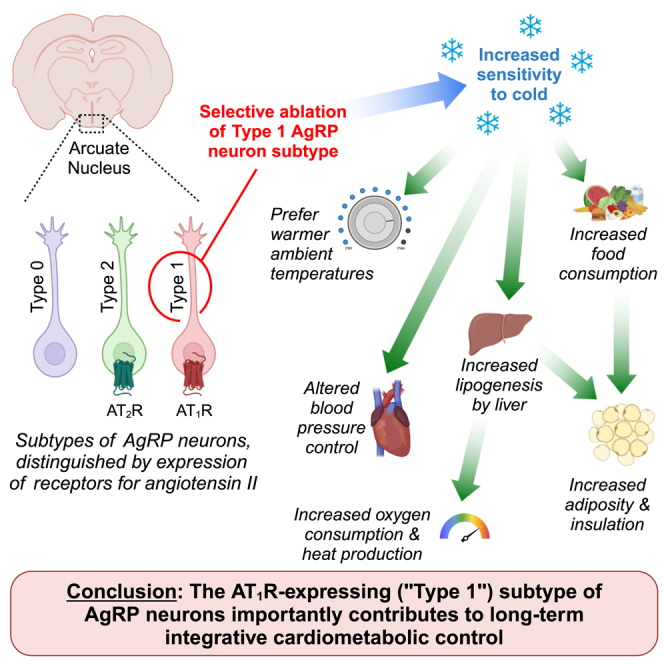
Subtypes of agouti-related peptide (AgRP) neurons can be distinguished based upon expression of angiotensin II receptors. The type 1 subtype, which expresses the angiotensin type 1 receptor (Agtr1a), was examined for its role in the integrative control of cardiometabolic functions. Mice expressing Cre-recombinase via the Agtr1a locus received bilateral microinjection of an AAV vector encoding Cre-dependent expression of caspase-3 into the arcuate nucleus of mice housed at 22°C or 30°C. Ablation of Agtr1a + cells caused increased food intake, adiposity, resting metabolic rate and shifts in nutrient partitioning, elevated temperature preference, loss of core temperature defense, and changes in blood pressure and heart rate. Many phenotypes were ameliorated by housing animals at thermoneutrality. Thus, Agtr1a + cells in the ventral hypothalamus (including the type 1 AgRP neuron) influence cardiometabolic control through modulation of thermoregulatory responses to cold. Some functions of these cells appear to oppose canonical roles of other AgRP neuron subtypes.

Keywords: Molecular biology; Neuroscience; Omics.


Conflict of interest statement

The authors declare no competing interests.

Figures
None
Graphical abstract
Figure 1
Figure 1
Ablation of type 1 AgRP neurons causes sustained increases in food intake, weight gain and adiposity, and resting energy expenditure (A) Cartoon illustrating approach to induce apoptosis in the Agtr1a-expressing (type 1) subtype of AgRP neurons. (B) Average daily food intake during the first two weeks after virus injection. n = 6m + 8f control vs. 3m + 6f ablated. (C) Change in body mass across first two weeks after virus injection. n = 15m + 18f control vs. 9m + 12f ablated. (D–G) (D) Body mass, (E) fat-free mass (FFM), (F) fat mass, and (G) proportional fat mass. (H) 24 h average aerobic heat production. (I–K) (I) 24 h average heat production, (J) resting metabolic rate (RMR), and (K) activity-dependent heat production corrected for FFM and fat mass by GLM. For D–K, n = 21m + 10f control vs. 10m + 6f ablated. Summary data plotted as mean ± SEM (B–G) or estimated marginal mean ± SEM with FFM = 21.30 g and fat mass = 8.75 g (H–K). ∗p < 0.05 versus control group by 2-tailed independent t test (A and B), or Šídák multiple comparisons procedure (D–K). Related data can be found in Tables S1–S4.
Figure 2
Figure 2
Ablation of type 1 AgRP neurons alters thermoregulatory behavior, metabolic responses to cold stimuli, and defense of core temperature (TC) (A) Preferred ambient temperature, assessed by a thermal place preference test. n = 10m vs. 6m. (B–D) (B) 24 h average aerobic heat production, (C) resting metabolic rate (RMR), and (D) activity-dependent heat production corrected for FFM and fat mass by GLM. (E) Body masses before and after radiotelemeter implantation and viral vector injections into the ARC. (F) 24 h average TC before and after virus injections. (G) 24 h average TC before and 12 weeks after virus injections at 22°C, and during brief sequential 3 days exposures to 30°C and 16°C. (H) Hourly average TC throughout the light cycle before and 12 weeks after virus injections, when mice were housed at 22°C. For B–D, n = 21m + 10f control and 10m + 6f ablated at 22°C versus 4m + 5f control and 4m + 3f at 30°C. For E–H, n = 6m. Summary data plotted as mean ± SEM (A and E–H), or estimated marginal mean ± SEM with FFM = 18.94 and fat mass = 5.71 g (B–D). ∗p < 0.05 versus control group (A–D and G–H) or against pre-ablation baseline (F) by 2-tailed independent t test (A), or Šídák multiple comparisons procedure (B–H). Related data can be found in Figure S4 and Tables S8 and S9.
Figure 3
Figure 3
Ablation of type 1 AgRP neurons alters hepatic lipid production pathways (A and B) Expression of Ucp1, Dio2, and Ppargc1a genes in (A) interscapular brown adipose (control n = 6m + 7f vs. ablated n = 4m + 5m) and (B) inguinal white adipose (control n = 5m + 8f vs. ablated n = 4m + 4m) 3 weeks after ablation, in mice housed at 22°C vs. 30°C. (C) Differentially expressed genes in liver, 3 weeks after ablation (n = 3m + 3f) or control (n = 3m + 3f), in mice housed at 22°C. (D) Differentially expressed genes in liver, three weeks after ablation in mice housed at 22°C (n = 3m + 3f) versus 30°C (n = 3m + 3f). (E) Venn diagram identifying genes that were differentially expressed following ablation only when mice were housed at 22°C. (F) Enriched molecular functions of genes identified in D, identified by ShinyGo 0.81. (G) Expression of Scd2 in liver 3 weeks after ablation, in mice housed at 22°C (control n = 5m + 9f; ablated n = 4m + 5f) or 30°C (control n = 2m + 5f; ablated n = 4m + 3f). ∗p < 0.05 by Šídák multiple comparisons procedure (A and F). Related data can be found in Tables S15, S16, S17, S18, S19, S20, S21, and S22.
Figure 4
Figure 4
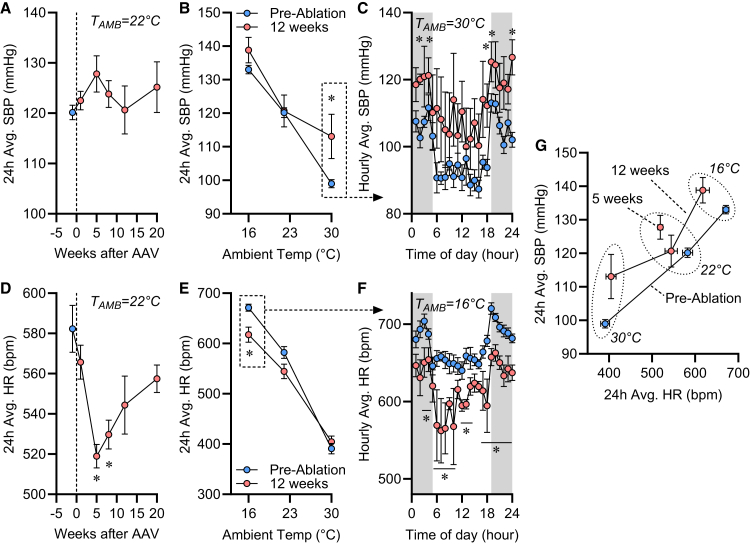
Ablation of Type 1 AgRP neurons alters blood pressure control (A) 24 h average systolic blood pressure (SBP) before and after virus injections. (B) 24 h average SBP before and 12 weeks after virus injections, at 22°C and during brief sequential 3 days exposures to 30°C and 16°C. (C) Hourly average SBP throughout the light cycle before and 12 weeks after virus injections, when mice were housed at 30°C. (D) 24 h average heart rate (HR) before and after virus injections. (E) 24 h average HR before and 12 weeks after virus injections, at 22°C and during brief sequential 3 days exposures to 30°C and 16°C. (F) Hourly average HR throughout the light cycle before and 12 weeks after virus injections, when mice were housed at 16°C. (G) Association of SBP to HR data, replotted from A–B and D–E. Deming regression comparison of lines p < 0.001. For all , n = 6m. Summary data plotted as mean ± SEM. ∗p < 0.05 against pre-ablation baseline (A and D) or versus control group (B–C and E–F) by Šídák multiple comparisons procedure.
Figure 5
Figure 5
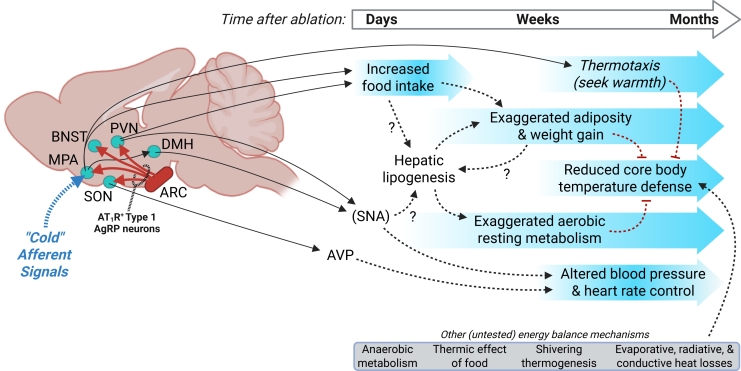
Working model Within the ventral hypothalamus, angiotensin II type 1 receptor (AT1R/Agtr1a) expression is largely restricted to type 1 agouti-related peptide (AgRP) neurons of the hypothalamic arcuate nucleus (ARC). These neurons project to the paraventricular nucleus of the hypothalamus (PVN), bed nucleus of the stria terminalis (BNST), medial preoptic area (MPA), and supraoptic nucleus (SON). The current study demonstrates that conditional ablation of AT1R-expressing cells of the ventral hypothalamus results in progressive alterations of an array of energy balance phenotypes. Within days after ablation, food intake is exaggerated, increasing body mass and adiposity. This is rapidly followed by increased aerobic energy expenditure due to increased resting metabolic rate, which appears to involve hepatic lipogenesis but not canonical adipose non-shivering thermogenic mechanisms. All of these phenotypes were prevented by housing animals at thermoneutral (30°C) ambient temperatures, prompting the hypothesis that the type 1 AgRP neuron projections to the MPA mediate some combination of these phenotypes, as glutamatergic MPA projections to the dorsomedial hypothalamus (DMH) are understood to coordinate behavioral and thermogenic responses to cold ambient temperatures through control of sympathetic nervous activity (SNA) to various peripheral tissues. Finally, ablation of AT1R-expressing cells in the ventral hypothalamus also resulted in progressive reductions in core body temperature defense during cold (22°C or 16°C) exposures, along with multiphasic ambient temperature-dependent alterations in blood pressure and heart rate in the weeks and months following ablation. Various additional mechanisms contributing to heat production and retention kinetics remain untested, but may contribute to the observed phenotypes. AVP, arginine vasopressin.

References

    1. Hall K.D., Sacks G., Chandramohan D., Chow C.C., Wang Y.C., Gortmaker S.L., Swinburn B.A. Quantification of the effect of energy imbalance on bodyweight. Lancet (London, England) 2011;378:826–837. doi: 10.1016/S0140-6736(11)60812-X. - DOI - PMC - PubMed
    1. Oliveira V., Kwitek A.E., Sigmund C.D., Morselli L.L., Grobe J.L. Recent Advances in Hypertension: Intersection of Metabolic and Blood Pressure Regulatory Circuits in the Central Nervous System. Hypertension. 2021;77:1061–1068. doi: 10.1161/HYPERTENSIONAHA.120.14513. - DOI - PMC - PubMed
    1. Fothergill E., Guo J., Howard L., Kerns J.C., Knuth N.D., Brychta R., Chen K.Y., Skarulis M.C., Walter M., Walter P.J., Hall K.D. Persistent metabolic adaptation 6 years after “The Biggest Loser” competition. Obesity (Silver Spring, Md.) 2016;24:1612–1619. doi: 10.1002/oby.21538. - DOI - PMC - PubMed
    1. Hall K.D., Kahan S. Maintenance of Lost Weight and Long-Term Management of Obesity. Med. Clin. North Am. 2018;102:183–197. doi: 10.1016/j.mcna.2017.08.012. - DOI - PMC - PubMed
    1. Sapouckey S.A., Morselli L.L., Deng G., Patil C.N., Balapattabi K., Oliveira V., Claflin K.E., Gomez J., Pearson N.A., Potthoff M.J., et al. Exploration of cardiometabolic and developmental significance of angiotensinogen expression by cells expressing the leptin receptor or agouti-related peptide. Am. J. Physiol. Regul. Integr. Comp. Physiol. 2020;318:R855–R869. doi: 10.1152/ajpregu.00297.2019. - DOI - PMC - PubMed

LinkOut - more resources