


Potassium Replacement Practices and Their Association With Blood Transfusion Outcomes in Surgical and Critical Care Patients: A Systematic Review
- PMID: 40585692
- PMCID: PMC12204379
- DOI: 10.7759/cureus.84978
Potassium Replacement Practices and Their Association With Blood Transfusion Outcomes in Surgical and Critical Care Patients: A Systematic Review
Abstract
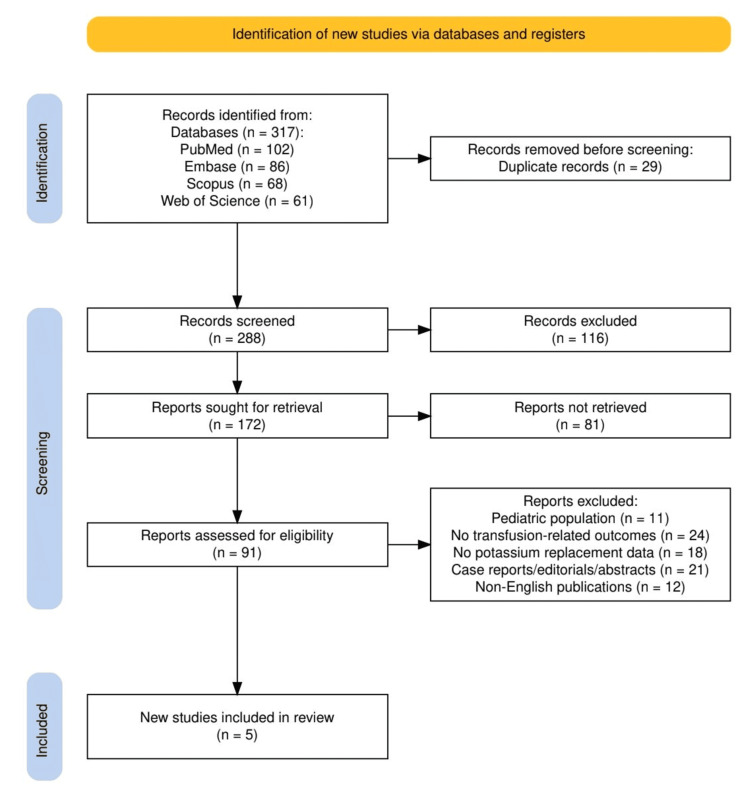
This systematic review examines the association between potassium replacement strategies and blood transfusion outcomes in surgical and critical care settings. Despite the frequent use of potassium supplementation to address hypokalemia in hospitalized patients, its direct and indirect impact on transfusion requirements remains underrecognized. A structured literature search identified five eligible studies that investigated both potassium management and transfusion outcomes across diverse high-acuity populations. Findings revealed that aggressive or routine electrolyte monitoring and replacement may contribute to iatrogenic anemia through repeated phlebotomy, while preoperative hypokalemia was associated with increased need for transfusion in select cohorts. Although the degree of association varied, several studies suggested that individualized potassium replacement protocols could play a role in optimizing transfusion practices. These insights highlight the importance of integrated electrolyte and transfusion management to improve patient safety and conserve resources in perioperative and intensive care environments.
Keywords: blood transfusion; critical care; electrolyte imbalance; hemoglobin; hypokalemia; icu; perioperative management; potassium replacement; surgery; transfusion outcomes.
Copyright © 2025, Yousuf et al.
Conflict of interest statement
Conflicts of interest: In compliance with the ICMJE uniform disclosure form, all authors declare the following: Payment/services info: All authors have declared that no financial support was received from any organization for the submitted work. Financial relationships: All authors have declared that they have no financial relationships at present or within the previous three years with any organizations that might have an interest in the submitted work. Other relationships: All authors have declared that there are no other relationships or activities that could appear to have influenced the submitted work.
Figures
Similar articles
-
The effectiveness of interventions to meet family needs of critically ill patients in an adult intensive care unit: a systematic review update.JBI Database System Rev Implement Rep. 2016 Mar;14(3):181-234. doi: 10.11124/JBISRIR-2016-2477. JBI Database System Rev Implement Rep. 2016. PMID: 27532144
-
Preoperative blood transfusions for sickle cell disease.Cochrane Database Syst Rev. 2016 Apr 6;4(4):CD003149. doi: 10.1002/14651858.CD003149.pub3. Cochrane Database Syst Rev. 2016. Update in: Cochrane Database Syst Rev. 2020 Jul 2;7:CD003149. doi: 10.1002/14651858.CD003149.pub4. PMID: 27049331 Free PMC article. Updated.
-
Transfusion thresholds for guiding red blood cell transfusion.Cochrane Database Syst Rev. 2021 Dec 21;12(12):CD002042. doi: 10.1002/14651858.CD002042.pub5. Cochrane Database Syst Rev. 2021. PMID: 34932836 Free PMC article.
-
What is the value of routinely testing full blood count, electrolytes and urea, and pulmonary function tests before elective surgery in patients with no apparent clinical indication and in subgroups of patients with common comorbidities: a systematic review of the clinical and cost-effective literature.Health Technol Assess. 2012 Dec;16(50):i-xvi, 1-159. doi: 10.3310/hta16500. Health Technol Assess. 2012. PMID: 23302507 Free PMC article.
-
Accreditation through the eyes of nurse managers: an infinite staircase or a phenomenon that evaporates like water.J Health Organ Manag. 2025 Jun 30. doi: 10.1108/JHOM-01-2025-0029. Online ahead of print. J Health Organ Manag. 2025. PMID: 40574247
References
-
- Understanding adherence and deviations in potassium replacement protocols: a mixed method study. O'Neill K, Meyer J, Manias E, et al. Intensive Crit Care Nurs. 2025;88:104013. - PubMed
-
- Dillon FX. Anesthesia Student Survival Guide: A Case-Based Approach. New York, NY: Springer; 2009. Electrolytes, fluids, acid-base analysis, and transfusion therapy; pp. 199–227.
-
- A review of the PubMed PICO tool: using evidence-based practice in health education. Brown D. Health Promot Pract. 2020;21:496–498. - PubMed
Publication types
LinkOut - more resources
Full Text Sources