Minimization of proteome reallocation explains metabolic transition in hierarchical utilization of carbon sources
- PMID: 40586598
- PMCID: PMC12282068
- DOI: 10.1128/msystems.00690-25
Minimization of proteome reallocation explains metabolic transition in hierarchical utilization of carbon sources
Abstract
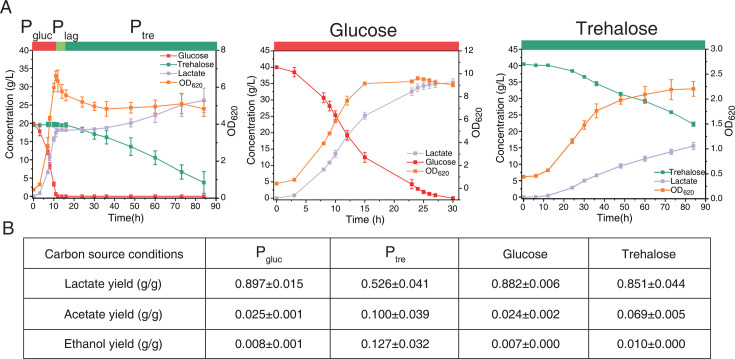
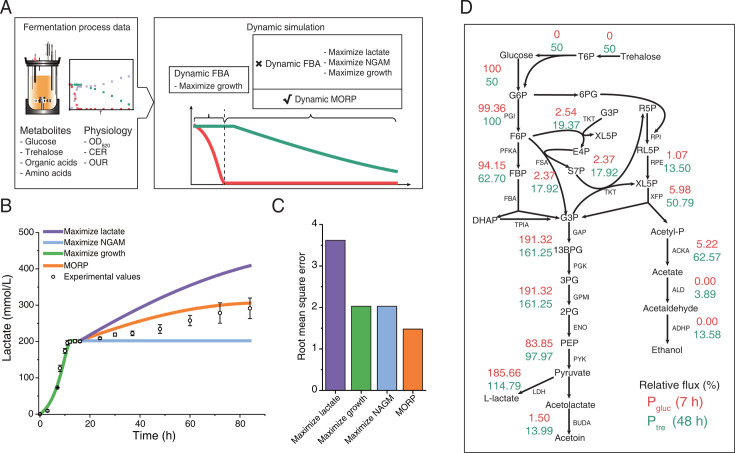
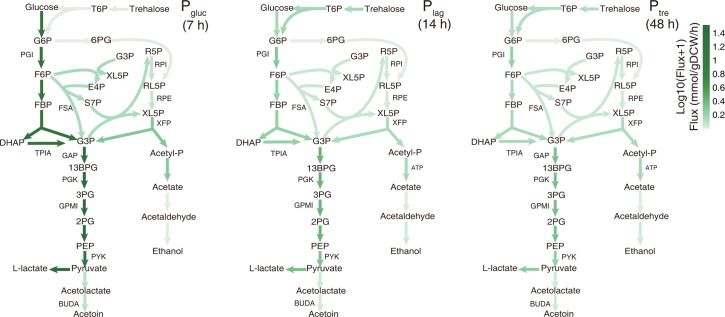
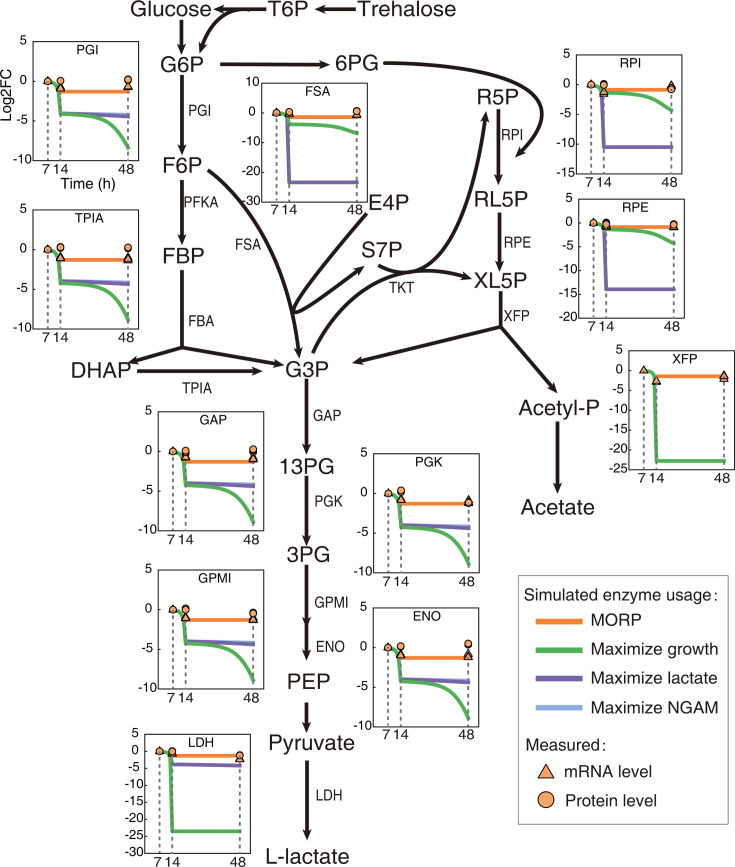
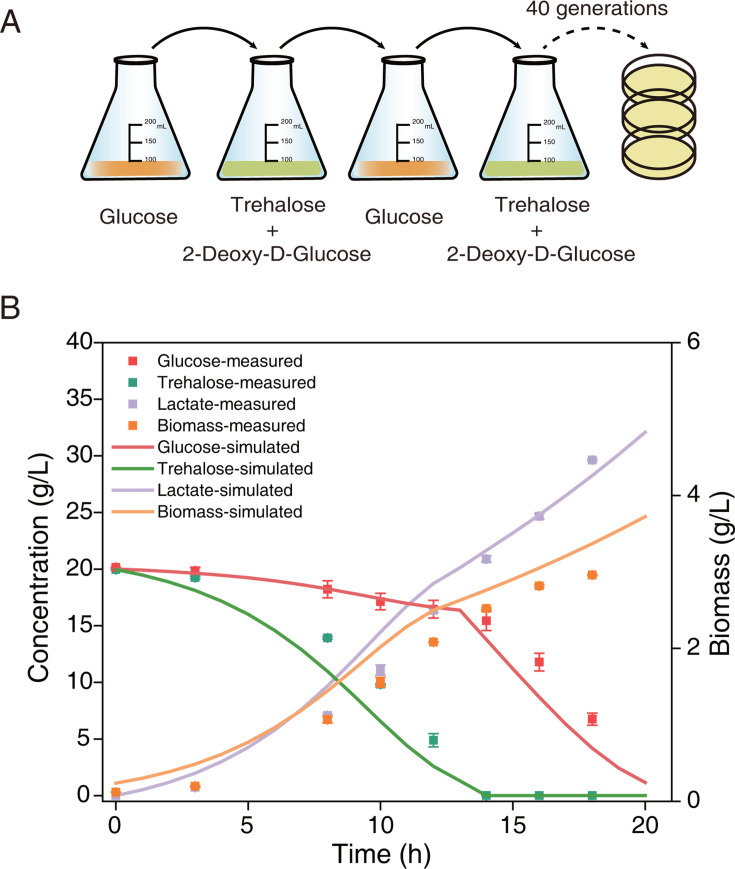
Cells choose between alternative pathways in metabolic networks under diverse environmental conditions, but the principles governing the choice are insufficiently understood, especially in response to dynamically changing conditions. Here, we observed that the lactic acid bacterium Bacillus coagulans displayed homolactic fermentation on glucose or trehalose as the sole carbon source but transitioned from homolactic to heterolactic fermentation during the hierarchical utilization of glucose and trehalose when growing on the mixture. We simulated the observation by dynamic minimization of reallocation of the proteome (dMORP) using an enzyme-constrained genome-scale metabolic model, which coincided with our omics data. Moreover, we evolved strains to co-utilize mixed carbon sources and repress the choice of heterolactic fermentation, and the dynamics after co-utilization of carbon sources were also captured by dMORP. Altogether, the findings suggest that upon environmental changes, bacteria tend to minimize proteome reallocation and accordingly adjust metabolism, and dMORP would be useful in simulating cellular dynamics.IMPORTANCERedundancy in metabolic networks empowers cells to choose between distinct metabolic strategies under changing environments. However, what drives the cellular choice remains poorly understood. We hypothesized that in response to rapid environmental changes, cells might minimize reallocation of the proteome and accordingly adjust metabolism. We found that this hypothesis could interpret a metabolic transition in the lactic acid bacterium Bacillus coagulans during the hierarchical utilization of glucose and trehalose, which was validated using systems biology approaches. Furthermore, we presented a framework with the objective function of minimizing proteome allocation, allowing for the simulation and understanding of cellular responses to dynamic perturbations.
Keywords: enzyme constraint; metabolic model; metabolic transition; mixed carbon sources.
Conflict of interest statement
The authors declare no conflict of interest.
Figures
References
-
- Shen Y, Dinh HV, Cruz ER, Chen Z, Bartman CR, Xiao T, Call CM, Ryseck R-P, Pratas J, Weilandt D, Baron H, Subramanian A, Fatma Z, Wu Z-Y, Dwaraknath S, Hendry JI, Tran VG, Yang L, Yoshikuni Y, Zhao H, Maranas CD, Wühr M, Rabinowitz JD. 2024. Mitochondrial ATP generation is more proteome efficient than glycolysis. Nat Chem Biol 20:1123–1132. doi: 10.1038/s41589-024-01571-y - DOI - PMC - PubMed
MeSH terms
Substances
Grants and funding
LinkOut - more resources
Full Text Sources