


A validation study on the accuracy and precision of gaze and vergence using stereoscopic eye-tracking technology
- PMID: 40593383
- PMCID: PMC12213999
- DOI: 10.3758/s13428-025-02731-1
A validation study on the accuracy and precision of gaze and vergence using stereoscopic eye-tracking technology
Abstract
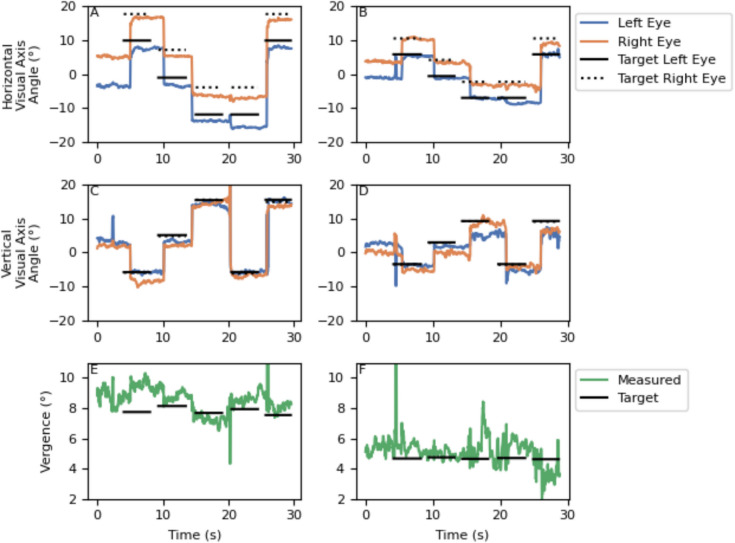
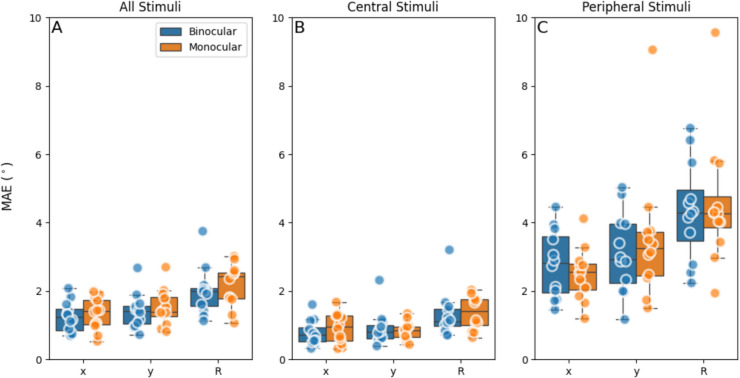
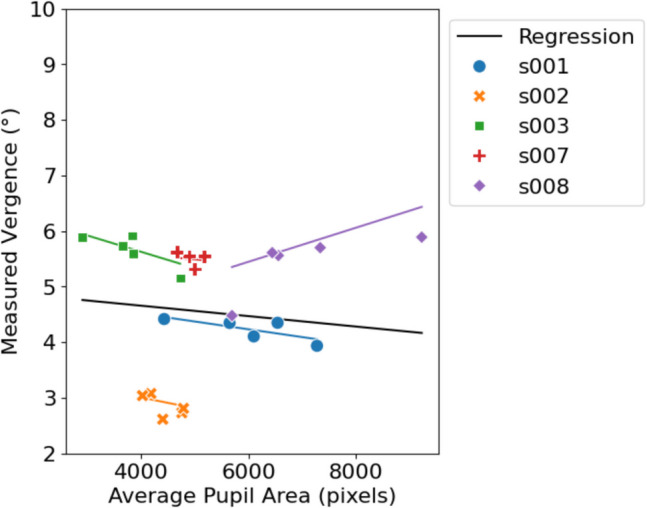
Binocular video-based eye-tracking allows for gaze and vergence measurements, but the accuracy and precision of vergence are barely addressed. Here, we investigate the accuracy and precision of both gaze and vergence measurements using a stereoscopic eye-tracking system. Previous studies have evaluated stereoscopic eye-trackers for gaze eccentricities up to 16°. We validated a custom-built stereoscopic eye-tracker with two cameras and two infrared light sources for gaze eccentricities up to 21°. Additionally, we studied the impact of fixation distance and pupil size on vergence accuracy. Participants with normal binocular vision (N = 8) performed fixation tasks, enabling the assessment of both gaze and vergence errors. The stereoscopic system provided gaze estimates with a mean absolute error (MAE) of less than 1° within the central visual field. However, the accuracy decreased for peripheral angles larger than 14°. We found a MAE of 0.89 ± 0.58° in measuring vergence and a strong linear association between target vergence and measured vergence, with a slope of 0.99 ± 0.05. In contrast to previous studies using single-camera eye-trackers, we found no systematic influence of pupil size on the vergence measurements. Although there was high agreement between estimated and ground truth vergence in the central field, the system did struggle to maintain accuracy at larger eccentricities. This limitation arises primarily from the loss of reliable glints rather than technical constraints, indicating the need for alternative approaches to enhance accuracy in wider fields of view.
Keywords: Gaze accuracy; Gaze eccentricity; Pupil size; Stereoscopic eye-tracking; Vergence measurement.
© 2025. The Author(s).
Conflict of interest statement
Declarations. Ethics approval: All procedures involved in collecting and analyzing data from human participants were conducted in accordance with the ethical standards of the 1964 Declaration of Helsinki and its subsequent amendments. Procedures were reviewed and approved by the Medical Ethical Committee of Amsterdam University Medical Centers. Consent to participate: Informed consent was obtained from all individual participants included in the study. Consent for publication: Participants provided informed consent for the publication of any data/results from this study. Conflicts of interest: The authors declare no conflicts of interest related to this work.
Figures






References
-
- Ciuffreda, K. J. (2014). Eye Movements; Vergence. In M. J. Aminoff & R. B. Daroff (Eds.), Encyclopedia of the Neurological Sciences (Second Edition) (pp. 258–259). Academic Press.
Publication types
MeSH terms
LinkOut - more resources
Full Text Sources
