


Knee injury prevention via personalized exercise using EDAS method and Sugeno Weber operator under complex q rung orthopair fuzzy data
- PMID: 40593909
- PMCID: PMC12218411
- DOI: 10.1038/s41598-025-03327-7
Knee injury prevention via personalized exercise using EDAS method and Sugeno Weber operator under complex q rung orthopair fuzzy data
Abstract
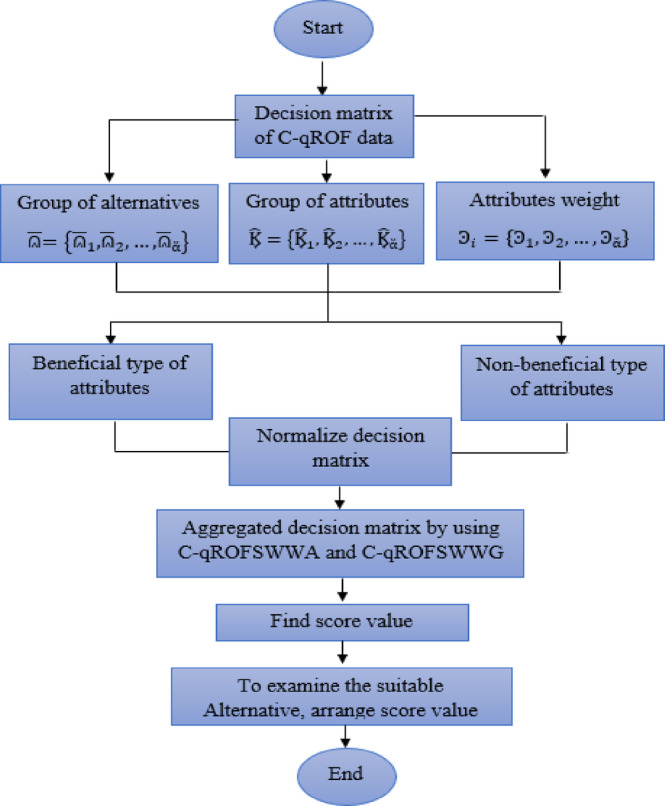
Knee injuries are common in several people, frequently controlling for significant injuries and health care costs. This article explains the role of personalized exercise prescriptions in preventing knee injuries. For this purpose, we used the multicriteria decision-making (MCDM) technique to select the best alternative, including criteria such as level of muscle strength improvement, cardiovascular endurance, recovery time, and improvement in flexibility and range of motion. The complex q-rung orthopair fuzzy set (C-qROFS) is a prevailing tool for managing ambiguity by combining satisfactory, dissatisfactory, and complex phase data. It is the extent of fuzzy theories that characterize directional and magnitude-based uncertainties, allowing more significant decision-making. In existing research work, C-qROFS was defined with different aggregation operators. However, no work is available on combined Segeno Weber aggregation operator (AOs) and EDAS in the framework of C-qROFS. We propose some notion AOs such as C-qROF Sugeno Weber weighted averaging (C-qROFSWWA) and C-qROF Sugeno Weber weighted geometric (C-qROFSWWG) as essential properties. We have also proposed the EDAS technique for C-qROFS. The EDAS technique for C-qROFS certifies efficient decision-making by exploiting C-qROF information to assess alternatives based on proximity to an ideal solution. A real-life example is proposed for selecting the best-personalized exercise using our suggested aggregation operator. We take four alternatives after finding that rank strength training focused on quadriceps and hamstrings is the best alternative for preventing knee injuries. To check the superiority and validity of the suggested technique, a deep comparative study with the existing aggregation operator must be conducted.
Keywords: Complex q-rung orthopair fuzzy set; EDAS technique; MCDM algorithm; Personalized exercise; Sugeno Weber t-norm; t-conorm.
© 2025. The Author(s).
Conflict of interest statement
Declarations. Competing interests: The authors declare no competing interests.
Figures

References
-
- Zadeh, L. A. Fuzzy sets. Inf. Control. 8 (3), 338–353. 10.1016/S0019-9958(65)90241-X (1965). - DOI
-
- Atanassov, K. T. Intuitionistic fuzzy sets. Fuzzy Sets Syst.20 (1), 87–96. 10.1016/S0165-0114(86)80034-3 (1986). - DOI
-
- Khan, M. J., Ding, W., Jiang, S. & Akram, M. Group decision making using circular intuitionistic fuzzy preference relations. Expert Syst. Appl. 126502, (2025).
-
- Kumar, S. Stock selection with intuitionistic fuzzy combined compromise solutions. Appl. Soft Comput.169, 112526 (2025). - DOI
-
- Yager, R. R. Pythagorean fuzzy subsets. In 2013 Joint IFSA World Congress and NAFIPS Annual Meeting (IFSA/NAFIPS). 57–61 (IEEE, 2013).
MeSH terms
LinkOut - more resources
Full Text Sources
Medical
