


Research on the impact of artificial intelligence development on urban low-carbon transformation
- PMID: 40594537
- PMCID: PMC12217087
- DOI: 10.1038/s41598-025-05330-4
Research on the impact of artificial intelligence development on urban low-carbon transformation
Abstract
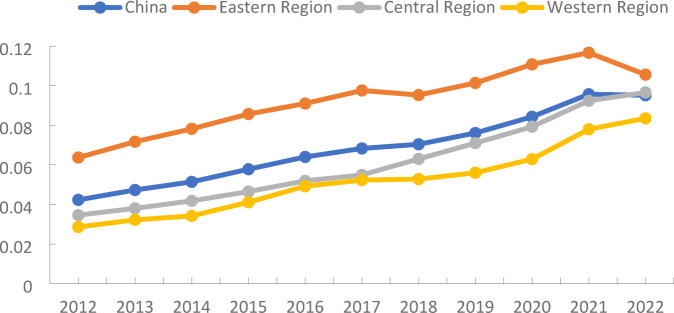
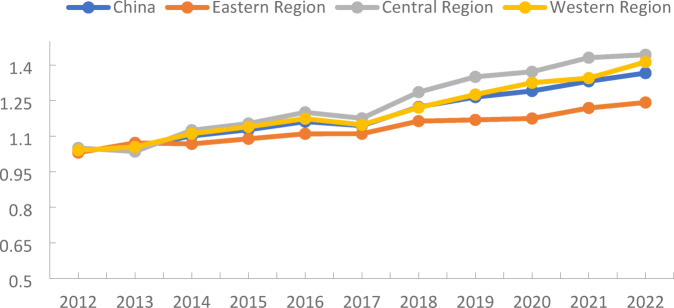
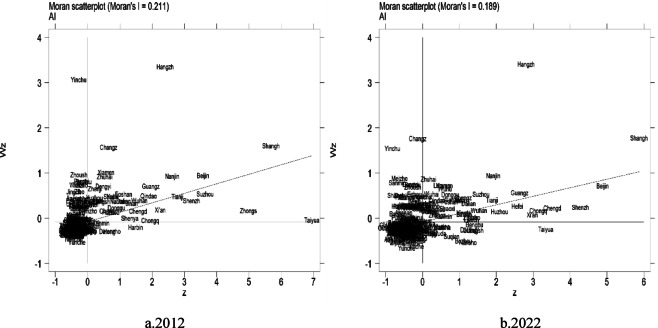
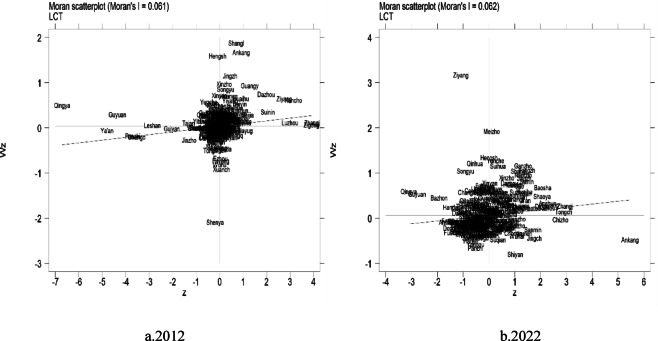
Scientific analysis of the impact of artificial intelligence (AI) development on urban low-carbon transformation has substantial practical implications for better fostering the development of AI and high-quality urbanization. Based on the panel data of 226 cities in China from 2012 to 2022, this study first designed a comprehensive evaluation index system for the development of AI and urban low-carbon transformation. Secondly, the entropy weight-TOPSIS method and the super-efficiency SBM model were used to measure the development level of AI and the efficiency of urban low-carbon transformation respectively. Then, a fixed effect model and a spatial Durbin model were constructed to explore the impact of AI development on urban low-carbon transformation. The following research findings were obtained: First, China's AI development level and urban low-carbon transformation efficiency are both generally growing. Specifically, the former increased from 0.0423 in 2012 to 0.0952 in 2022, while the latter increased from 1.0404 in 2012 to 1.3662 in 2022. Second, the development of AI has a significant positive role in promoting the low-carbon transformation of cities. Third, AI development has a pronounced positive effect on urban low-carbon transformation in China's eastern and western regions, while no significant effect is observed in the central region; the development of AI in non-sub-provincial capital cities and general prefecture-level cities contributes to promoting the low-carbon transformation of cities, while the development of AI in municipalities directly under the Central Government and sub-provincial cities has no significant effect on the low-carbon transformation of cities; the development of AI in resource-based cities and non-resource-based cities has a significant promoting effect on the efficiency of low-carbon transformation. Fourth, the development of AI has a strong spatial association with the low-carbon transformation of cities. Finally, based on these findings, targeted policy suggestions were put forward to better leverage the role of artificial intelligence in the low-carbon transformation of cities.
Keywords: Artificial intelligence development; China; City; Low-carbon transformation.
© 2025. The Author(s).
Conflict of interest statement
Declarations. Competing interests: The authors declare no competing interests.
Figures
References
-
- He, L. & Zhang, X. The distribution effect of urbanization: Theoretical deduction and evidence from China. J. Habitat Int.123, 102544. 10.1016/j.habitatint.2022.102544 (2022).
-
- Zhou, W., Zhuang, Y. & Chen, Y. How does artificial intelligence affect pollutant emissions by improving energy efficiency and developing green technology. J. Energy Econ.131, 107355. 10.1016/j.eneco.2024.107355 (2024).
-
- Guo, Q., Zeng, D. & Lee, C. C. Impact of smart City pilot on energy and environmental performance: China-based empirical evidence. J. Sustainable Cities Soc.97, 104731. 10.1016/j.scs.2023.104731 (2023).
-
- Wang, C., Zhan, J. & Xin, Z. Comparative analysis of urban ecological management models incorporating low-carbon transformation. J. Technol. Forecast. Social Change. 159, 120190. 10.1016/j.techfore.2020.120190 (2020).
-
- Bulkeley, H., Broto, V. C., Hodson, M. & Marvin, S. Cities and Low Carbon Transitions. (Routledge, London, 2013).
Grants and funding
LinkOut - more resources
Full Text Sources
