


Finite element analysis of the modified intramedullary nail-II for managing reverse obliquity trochanteric fractures
- PMID: 40595997
- PMCID: PMC12217256
- DOI: 10.1038/s41598-025-05748-w
Finite element analysis of the modified intramedullary nail-II for managing reverse obliquity trochanteric fractures
Abstract
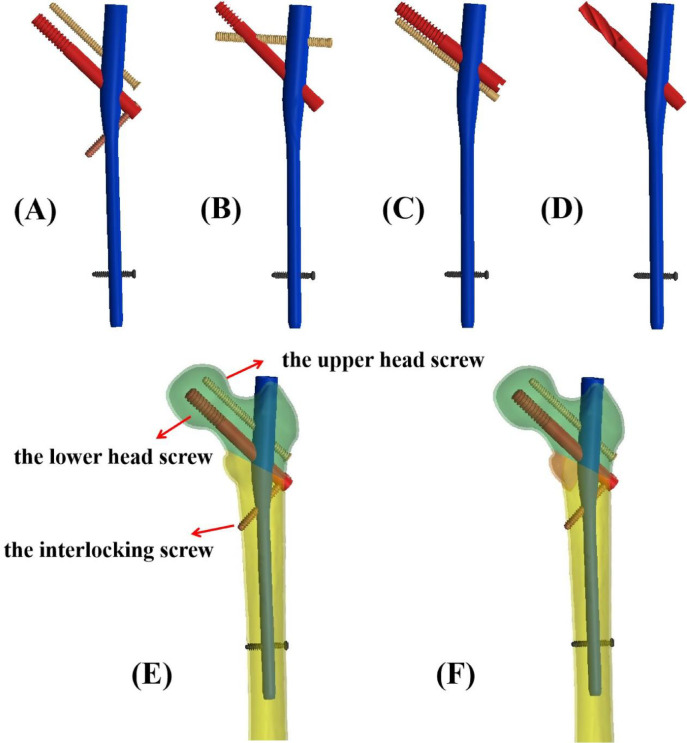
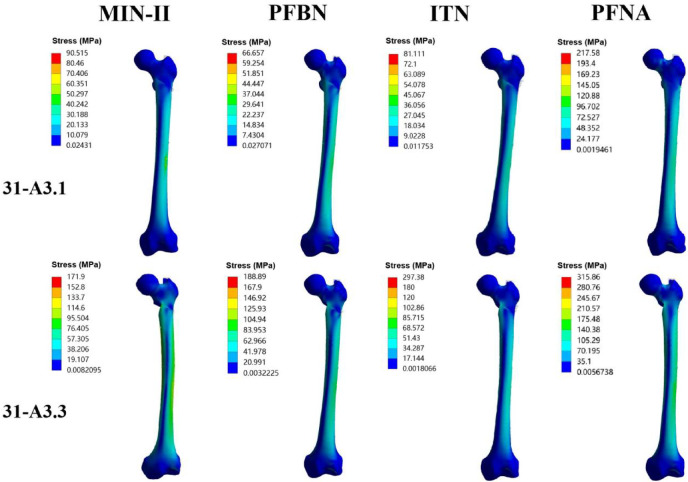
Cephalomedullary nails are widely used to fix unstable femoral trochanteric fractures nowadays. However, for reverse obliquity trochanteric (ROT) fractures, the fixation failure rate of existing cephalomedullary nails is high, resulting in many complications. Our team aimed to propose the modified intramedullary nail-II (MIN-II) to improve the fixation effects of ROT fractures and make biomechanical comparisons between MIN-II and three other cephalomedullary nails by finite element method. AO/OTA 31-A3.1 and 31-A3.3 ROT fracture models were established via a series of femoral CT data. Four cephalomedullary nails were constructed, including MIN-II, proximal femoral bionic nail (PFBN), InterTAN nail (ITN), and proximal femoral nail antirotation (PFNA). Then, these implants were assembled onto the above ROT fracture models. After setting boundary conditions, the mesh convergence test and model validation were performed. The evaluation indicators comprised von Mises stress (VMS) and displacement. To compare the mechanical stability of four implants, the percent difference (PD) was calculated. The values of maximal VMS on implants were 176.81 MPa, 292.04 MPa, 227.36 MPa, and 306.45 MPa in 31-A3.1 ROT fracture and 257.32 MPa, 349.90 MPa, 372.93 MPa, and 679.75 MPa in 31-A3.3 ROT fracture for the MIN-II, PFBN, ITN, and PFNA models under axial loads of 2100 N. Compared to the PFNA model, the PD reduction of MIN-II was 42.3% in 31-A3.1 ROT fracture and 62.1% in 31-A3.3 ROT fracture. The values of maximal displacement were 14.38 mm, 18.95 mm, 18.86 mm, and 20.53 mm in 31-A3.1 ROT fracture and 16.40 mm, 19.02 mm, 19.21 mm, and 20.56 mm in 31-A3.3 ROT fracture for the MIN-II, PFBN, ITN, and PFNA models. In comparison with the PFNA group, the MIN-II group showed a 30.0% reduction in 31-A3.1 ROT fracture and a 20.2% reduction in 31-A3.3 ROT fracture for this indicator, respectively. The values of maximal VMS on bones and maximal displacement of fracture surface exhibited similar trends for the four fixation groups. The modified intramedullary nail-II displayed the best biomechanical stability among the four cephalomedullary nails for the management of reverse obliquity trochanteric fractures. Hence, the MIN-II might be a good option for patients with ROT fractures.
Keywords: Biomechanical; Cephalomedullary; Finite element; Fracture; Modified; Reverse obliquity; Stability.
© 2025. The Author(s).
Conflict of interest statement
Declarations. Competing interests: The authors declare no competing interests. Consent to participate/consent to publish: All patients or their family members have signed the informed consent before surgery and provided the consent to publish and report individual clinical data.
Figures




References
-
- Park, S. Y., Yang, K. H., Yoo, J. H., Yoon, H. K. & Park, H. W. The treatment of reverse obliquity intertrochanteric fractures with the intramedullary hip nail. J. Trauma65, 852–857 (2008). - PubMed
MeSH terms
LinkOut - more resources
Full Text Sources
Medical
