


The impact of breaking up prolonged sitting with physical activity during simulated dayshifts and nightshifts on sleep architecture: a randomised controlled trial
- PMID: 40596018
- PMCID: PMC12219180
- DOI: 10.1038/s41598-025-04955-9
The impact of breaking up prolonged sitting with physical activity during simulated dayshifts and nightshifts on sleep architecture: a randomised controlled trial
Abstract
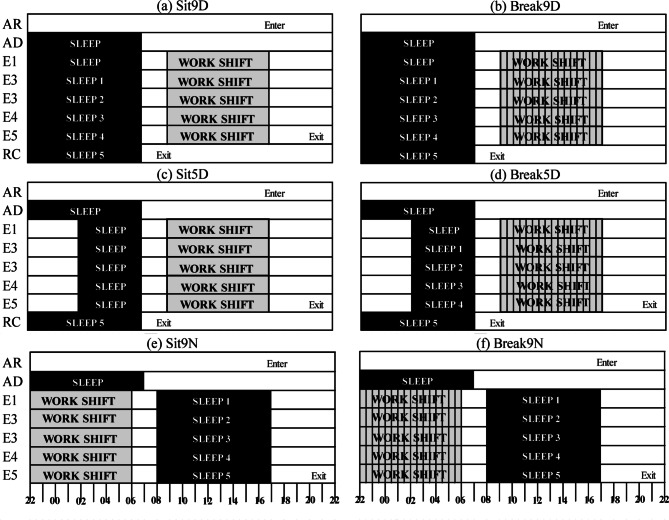
Inadequate sleep is common and contributes to poor health outcomes. Physical activity has a positive impact on sleep outcomes, however the prevalence of physical inactivity is increasing, coupled with the rise of sedentary behaviour at work. Interventions that promote physical activity and reduce sedentary behaviour are essential, as they can improve sleep. The current study investigated the effects of breaking up prolonged sitting with physical activity during the day or night, compared to not breaking up sitting, on sleep architecture during a 9 h or 5 h sleep opportunity. Participants (n = 125, 51% male, 23.4 ± 4.8 years of age) completed an in-laboratory sleep study, with five simulated shifts during the day or night. Sleep opportunities were either 9 h or 5 h following each shift. Participants were allocated to one of six conditions: Sit9D or Break9D (sedentary or breaking up sitting day and 9 h sleep opportunity), Sit5D or Break5D (sedentary or breaking up sitting day and 5 h sleep opportunity), or Sit9N or Break9N (sedentary or breaking up sitting night and 9 h sleep opportunity). Sleep was monitored using polysomnography. In the analysis of day shifts, mixed model ANOVAs demonstrated a significant physical activity *sleep opportunity interaction for total sleep time (p < 0.001), sleep onset latency (p < 0.001), time spent in N2 (p < 0.001) and N3 (p = 0.03). Post-hoc analyses revealed that participants in the 9 h sleep opportunity conditions had longer total sleep time, shorter sleep onset latency, and more slow-wave sleep (N3) during sleep opportunities 1-4 but not sleep opportunity 5. There were no significant differences in sleep architecture between physical activity condition for the nightshift conditions. Better sleep quality was seen in the 9 h condition compared to the 5 h condition, and breaking up sitting did not affect sleep. Given the benefits of breaking up sitting on health, our findings suggest a breaking up sitting intervention can be promoted without detrimental impacts on sleep.
Keywords: Breaking up sitting; Physical activity; Sedentary behaviour; Shift work.
© 2025. The Author(s).
Conflict of interest statement
Competing interests: No conflict of interest was declared by the authors.
Figures
References
-
- Adams, R. J. et al. Sleep health of Australian adults in 2016: results of the 2016 sleep health foundation National survey. Sleep. Health. 3, 35–42 (2017). - PubMed
-
- CDC & About Sleep. Sleep (2024). https://www.cdc.gov/sleep/about/index.html.
-
- Metse, A. P. & Bowman, J. A. Prevalence of self-reported suboptimal sleep in Australia and receipt of sleep care: results from the 2017 National social survey. Sleep. Health. 6, 100–109 (2020). - PubMed
Publication types
MeSH terms
LinkOut - more resources
Full Text Sources
Medical
