


A novel double machine learning approach for detecting early breast cancer using advanced feature selection and dimensionality reduction techniques
- PMID: 40596255
- PMCID: PMC12214636
- DOI: 10.1038/s41598-025-06426-7
A novel double machine learning approach for detecting early breast cancer using advanced feature selection and dimensionality reduction techniques
Abstract
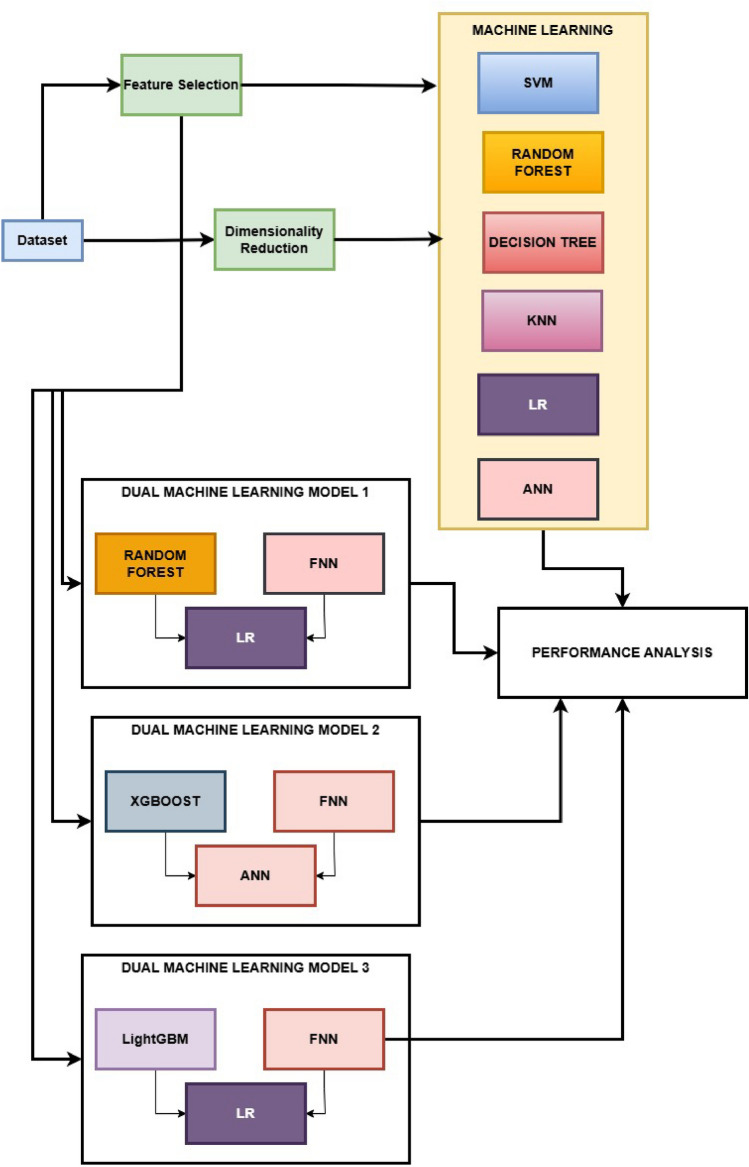
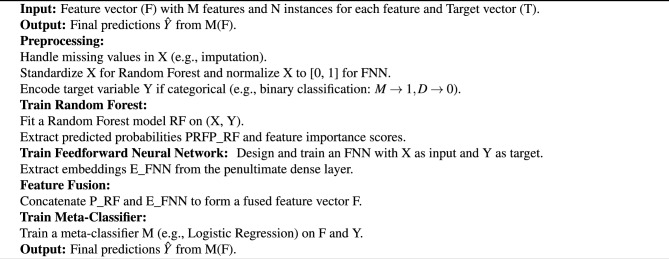
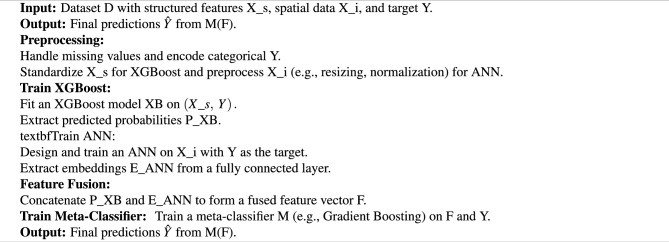
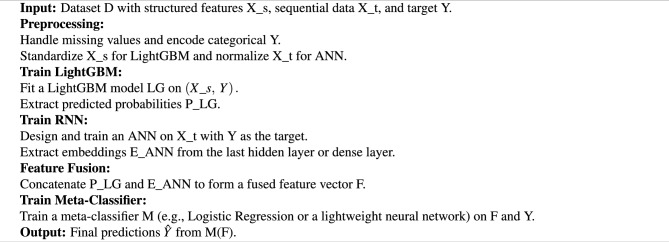
In this paper, three Double Machine Learning (DML) models are proposed to enhance the accuracy of breast cancer detection using machine learning techniques using breast cancer detection dataset. The DML models learn the primary features using machine learning and deep learning models. Then, these features are fused by a meta-classifier to achieve the best classification performance. The first DML model combines the interpretability of Random Forest (RF) with the deep learning capabilities of a Feedforward Neural Network (FNN). RF processes structured features, providing class probabilities and feature importance scores, while the FNN learns non-linear relationships and generates embeddings. These outputs are fused into a combined feature vector, which is then used by a meta-classifier for final predictions. This approach effectively captures both structured features and non-linear patterns, making it suitable for datasets with complex dependencies. The second model pairs eXtreme Gradient Boosting (XGBoost), a highly efficient boosting algorithm for tabular data, with an Artificial Neural Network (ANN). XGBoost optimizes decision tree ensembles and provides class probabilities, while the ANN processes numerical data to learn deeper representations. A meta-classifier then uses the fused outputs from both XGBoost and ANN for final predictions. This model is particularly effective for datasets combining structured features (handled by XGBoost) with numerical features (handled by ANN). The third model integrates LightGBM, a fast and scalable gradient-boosting framework, with an ANN, which is well-suited for analyzing sequential data. LightGBM processes structured features to provide probabilities and importance scores, while the ANN learns temporal dependencies from sequential data. The outputs from LightGBM and ANN are concatenated and passed into a meta-classifier for decision-making. This model is ideal for datasets with both static features (LightGBM) and continuous data (ANN), such as time-series datasets or datasets with sequential dependencies. These DML models, when combined with dimensionality reduction (PCA) and feature selection, significantly improve the performance of breast cancer detection systems by leveraging both structured and sequential data with high accuracy of 0.99.
Keywords: Breast Cancer; Decision Tree; Double machine learning; Feature Selection; KNN; Machine Learning; PCA; Random Forest; SVM.
© 2025. The Author(s).
Conflict of interest statement
Declarations. Competing interests: The authors declare no competing interests.
Figures

References
-
- Agarwal, A., Ranjithamani, A., Velayudham, A., Shunmugam, A. & Ismail, M. Machine learning technique for the assembly-based image classification system. J. Nucl. Energy Sci. & Power Gener. Technol. 10 (2021).
-
- Panchal, B. Breast cancer detection dataset. Available at: https://www.kaggle.com/datasets/bittupanchal/breast-cancer-detection-dat... (2021).
-
- Ullah, Z., Qi, L., Binu, D., Rajakumar, B. & Ismail, B. 2-d canonical correlation analysis based image super-resolution scheme for facial emotion recognition. Multimed. Tools Appl.81, 13911–13934. 10.1007/s11042-022-11922-3 (2022).
-
- Mayo Clinic. Breast cancer symptoms and causes. Available at https://www.mayoclinic.org/diseases-conditions/breast-cancer/symptoms-ca... (2023). Accessed: 2025-01-16.
-
- Delen, D., Walker, G. & Kadam, A. Predicting breast cancer survivability: a comparison of three data mining methods. Artif. Intell. Medicine34, 113–127. 10.1016/J.ARTMED.2004.07.002 (2005). - PubMed
MeSH terms
LinkOut - more resources
Full Text Sources
Medical
