


Association between bipolar disorder and diabetic ketoacidosis/hyperosmolar hyperglycemic state
- PMID: 40596274
- PMCID: PMC12217833
- DOI: 10.1038/s41598-025-08087-y
Association between bipolar disorder and diabetic ketoacidosis/hyperosmolar hyperglycemic state
Erratum in
-
Correction: Association between bipolar disorder and diabetic ketoacidosis/hyperosmolar hyperglycemic state.Sci Rep. 2025 Sep 26;15(1):33314. doi: 10.1038/s41598-025-20723-1. Sci Rep. 2025. PMID: 41006696 Free PMC article. No abstract available.
Abstract
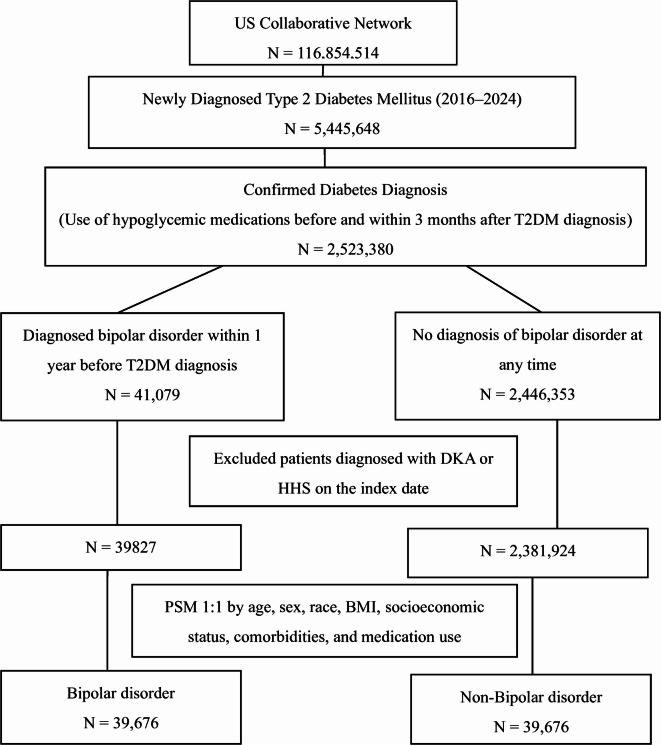
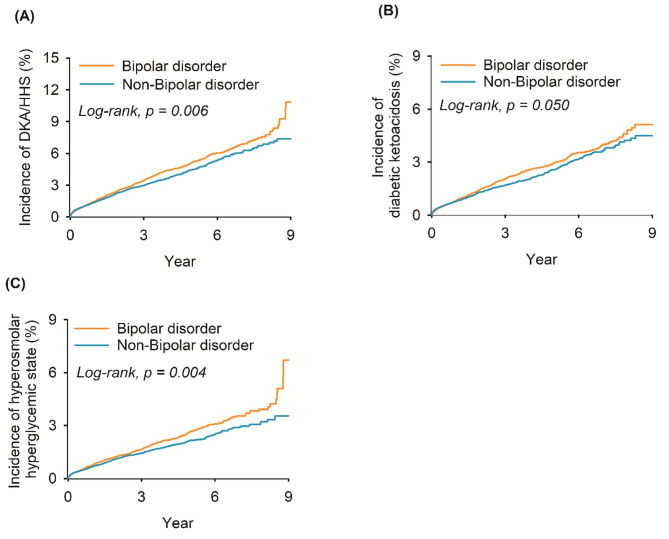
Individuals with bipolar disorder have a higher prevalence of type 2 diabetes mellitus (T2DM) and are at increased risk for diabetes-related complications. However, little is known about the association between bipolar disorder and acute hyperglycemic crises, including diabetic ketoacidosis (DKA) and hyperosmolar hyperglycemic state (HHS). This study aimed to evaluate whether bipolar disorder is associated with an increased risk of DKA and HHS in individuals with newly diagnosed T2DM. We conducted a retrospective cohort study using the TriNetX electronic health records network. Adults diagnosed with T2DM between 2016 and 2024 who received at least one glucose-lowering medication were included. Patients with a recorded diagnosis of bipolar disorder within one year before T2DM onset formed the exposure group, while those without bipolar disorder served as controls. Individuals with pre-existing hyperglycemic crises were excluded. Propensity score matching (1:1) was applied to balance demographic factors, body mass index, comorbidities, and medication use. The primary outcome was the incidence of DKA or HHS, analyzed using Cox proportional hazards models to estimate hazard ratios (HRs) with 95% confidence intervals (CIs). After matching (N = 39,676 per group), patients with bipolar disorder had a significantly higher risk of hyperglycemic crises (HR 1.65, 95% CI 1.45-1.88). Separate analyses revealed an increased risk of DKA (HR 1.58, 95% CI 1.37-1.82) and HHS (HR 1.95, 95% CI 1.30-2.94). Subgroup analyses suggested that the association was more pronounced in younger patients, White individuals, those with cerebrovascular disease, and those on insulin therapy. Bipolar disorder may be associated with a higher risk of acute hyperglycemic crises in patients with newly diagnosed T2DM. These findings highlight the need for integrated psychiatric and diabetes care to mitigate metabolic decompensation. Future prospective studies are warranted to further explore the mechanisms underlying this association and to develop targeted interventions.
Keywords: Bipolar; DKA; Diabetes; HHS.
© 2025. The Author(s).
Conflict of interest statement
Declarations. Competing interests: The authors declare no competing interests. Ethics approval and consent to participate: Human Ethics and Consent to Participate declarations: not applicable. The study protocol was approved by the Institutional Review Board of Chung Shan Medical University Hospital, identified by the reference number CS2-23159.
Figures
References
-
- McIntyre, R. S. et al. Bipolar disorders. Lancet396(10265), 1841–1856. 10.1016/S0140-6736(20)31544-0 (2020). - PubMed
-
- Enger, C., Jones, M. E., Kryzhanovskaya, L., Doherty, M. & McAfee, A. T. Risk of developing diabetes and dyslipidemia among adolescents with bipolar disorder or schizophrenia. Int. J. Adolesc. Med. Health. 25(1), 3–11. 10.1515/ijamh-2013-0002 (2013). - PubMed
-
- Lindekilde, N. et al. Prevalence of type 2 diabetes in psychiatric disorders: an umbrella review with meta-analysis of 245 observational studies from 32 systematic reviews. Diabetologia65(3), 440–456. 10.1007/s00125-021-05609-x (2022). - PubMed
-
- Mitchell, A. J. & Hardy, S. A. Screening for metabolic risk among patients with severe mental illness and diabetes: a National comparison. Psychiatr Serv.64(10), 1060–1063. 10.1176/appi.ps.201200514 (2013). - PubMed
-
- Holt, R. I. G. & Mitchell, A. J. Diabetes mellitus and severe mental illness: mechanisms and clinical implications. Nat. Rev. Endocrinol.11(2), 79–89. 10.1038/nrendo.2014.203 (2015). - PubMed
MeSH terms
Grants and funding
LinkOut - more resources
Full Text Sources
Medical
