


Unveiling the genetic basis of floral scent formation in roses using weighted gene co-expression and protein-protein interaction network analyses
- PMID: 40596377
- PMCID: PMC12214688
- DOI: 10.1038/s41598-025-08137-5
Unveiling the genetic basis of floral scent formation in roses using weighted gene co-expression and protein-protein interaction network analyses
Abstract
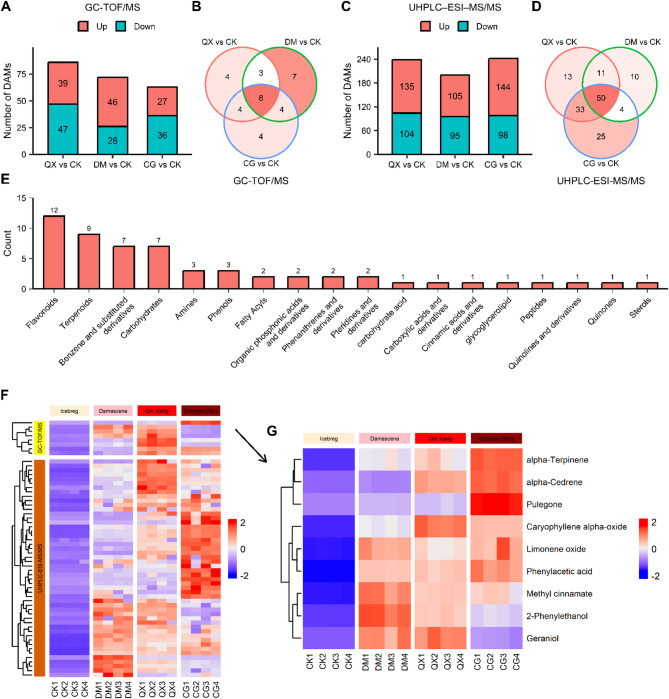
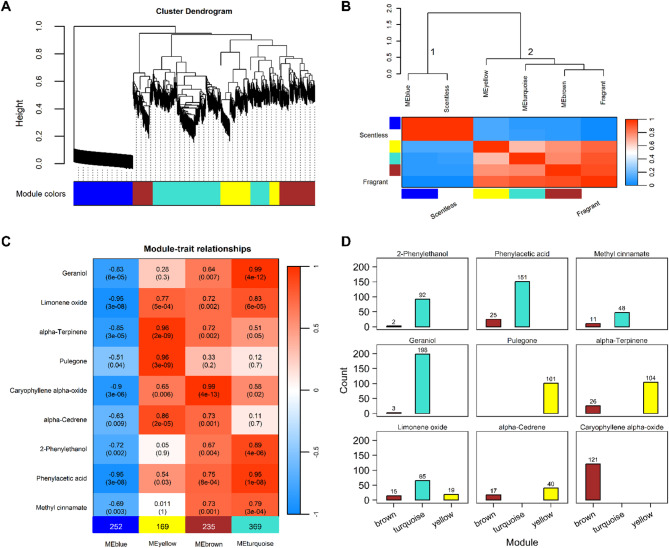
Rosa species hold considerable economic and medicinal importance, used in traditional medicine, essential oils, and landscaping. However, the mechanisms of floral scent formation in roses are not well understood, hindering genetic improvement. To bridge this gap, we conducted a combined transcriptome and metabolome analysis, identifying nine key fragrance compounds. Using Weighted Gene Co-expression Network Analysis (WGCNA), we linked 574 genes to these compounds. From these, we identified candidate genes through differential expression, functional annotations, and protein-protein interaction (PPI) networks. We predicted candidate genes, NUDIX1, NUDIX2, GERD, AFS1, AFS2, CYP82G1, HMG1, NCED2, CCD7, PSY, ICMEL2, MAD1, and MAD2 that might terpenoid-related genes, as well as potential benzenoid/phenylpropanoid-related candidate genes, DET2, DET3, ICS2, PAL1, UGT74B1, MYB330, GST, CAD1, HST, PCBER1, LAC15, CSE, PER25, PER47, PER63, FBA, LNK2, PRE1, and PRE6. Additionally, three function-unknown genes, LOC112167529, LOC112174760, and LOC112183447, were predicted as candidate genes potentially involved in the formation of floral scent.
Keywords: Rosa; Floral scent; Hub gene; PPI; WGCNA.
© 2025. The Author(s).
Conflict of interest statement
Declarations. Ethics statement: The authors declare that they have followed all the rules of ethical conduct regarding originality, data processing and analysis, duplicate publication, and biological material. Competing interests: The authors declare no competing interests.
Figures



References
-
- Katekar, V. P., Rao, A. B. & Sardeshpande, V. R. Review of the Rose essential oil extraction by hydrodistillation: an investigation for the optimum operating condition for maximum yield. Sustainable Chem. Pharm.29, 100783 (2022).
-
- Gang, D. R. Evolution of flavors and scents. Annu. Rev. Plant. Biol.56(1), 301–325 (2005). - PubMed
MeSH terms
Substances
Grants and funding
LinkOut - more resources
Full Text Sources
Research Materials
Miscellaneous
