


Mamba-fusion for privacy-preserving disease prediction
- PMID: 40596404
- PMCID: PMC12215979
- DOI: 10.1038/s41598-025-06306-0
Mamba-fusion for privacy-preserving disease prediction
Abstract
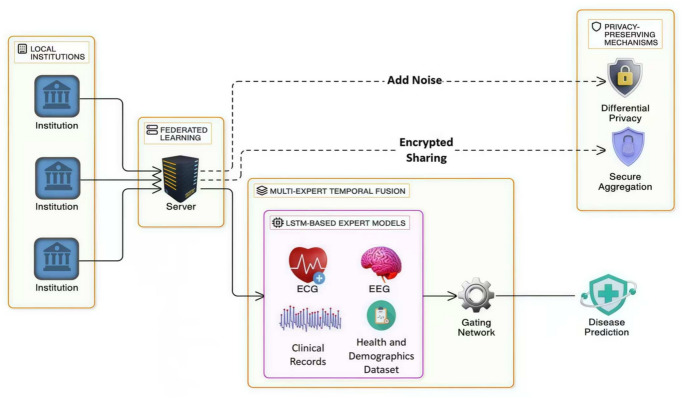
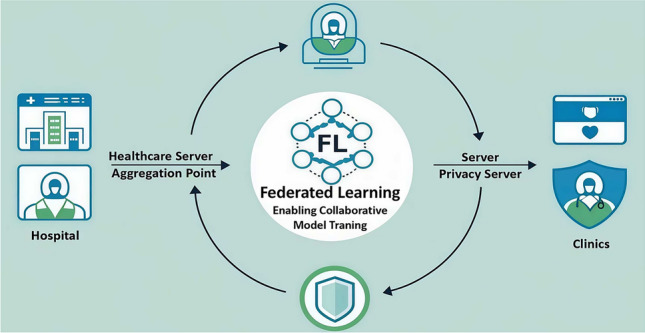
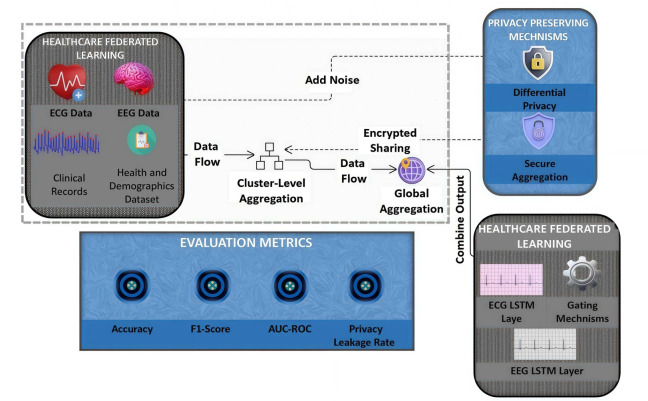
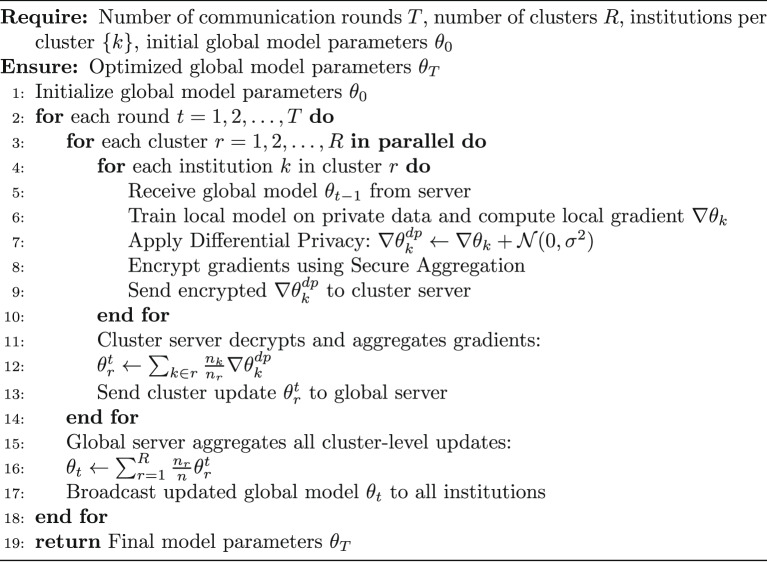
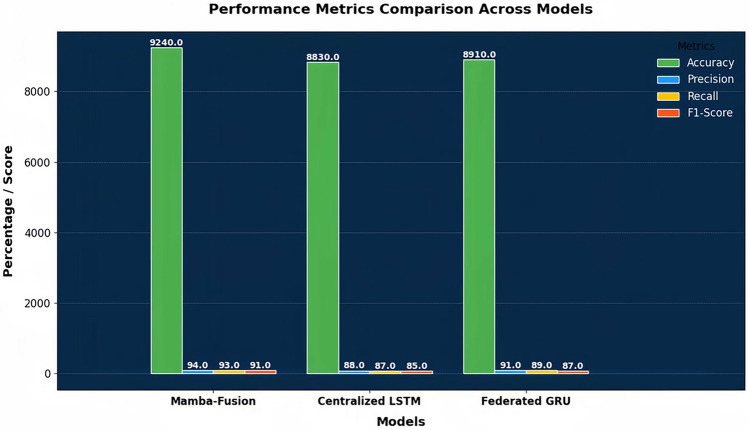
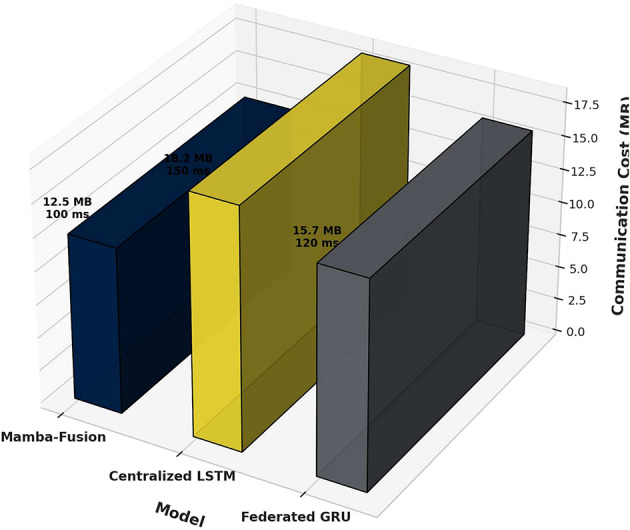
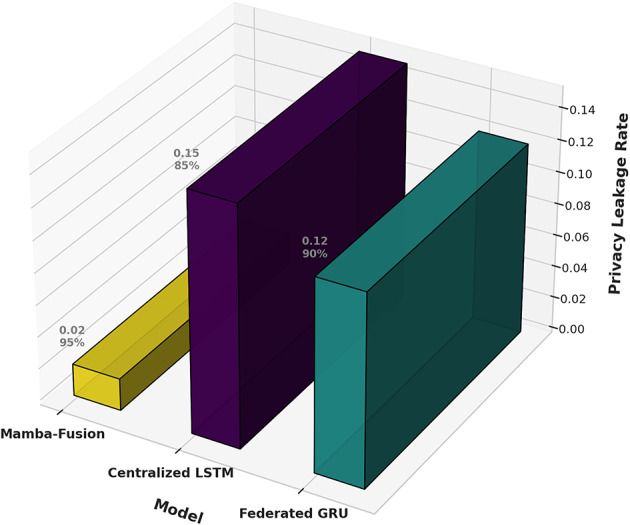
Accurate disease prediction is essential for improving patient outcomes. Privacy regulations like GDPR and HIPAA limit data sharing, hindering the development of robust predictive models across institutions. FL and multi-modal fusion frameworks counter these problems but are restricted in scalability, inter-client communication, and heterogeneity of data modalities. Techniques which provide privacy on data have an issue whereby they cause a reduction in performance or are computationally costly. This paper presents Mamba-Fusion for Disease prediction, a privacy-preserving framework for multi-modal data. It uses a hierarchical FL architecture to minimize the communication costs and improve the architecture's scalability solution and a Mixture of Experts (MoE) with LSTM based layers for dynamic temporal integration. The latest techniques like, differential privacy, secure aggregation protect both the data and its accuracy of the data as well. Experimental results on multi-modal clinical measurements, ECG, EEG, clinical notes, and demographic data support the applied framework. We have then used Mamba-Fusion to achieve 92:4% accuracy, 0:91 F-Score, and 0:96 AUC-ROC by keeping the privacy leakage at 0:02 and communication costs to 12:5 MB, which make it superior to conventional FL techniques. These results affirm Mamba-Fusion as an applications that are secure enough to support collaborative healthcare analytics on a large scale.
Keywords: Chronic disease prediction; Differential privacy in healthcare; Hierarchical aggregation mechanism; Multi-modal data fusion; Privacy-preserving federated learning; Scalable healthcare analytics.
© 2025. The Author(s).
Conflict of interest statement
Declarations. Competing interests: The authors declare no competing interests. Institutional review board statement: Not applicable. All methods were carried out in accordance with relevant guidelines and regulations. Informed consent statement: Not applicable.
Figures
References
-
- Aggarwal, Meenakshi, Khullar, Vikas, & Goyal, Nitin. A comprehensive review of federated learning: Methods, applications, and challenges in privacy-preserving collaborative model training. Applied Data Science and Smart Systems, pages 570–575, (2024).
-
- Ahamed, Md. Faysal, Hossain, Md. Munawar, Nahiduzzaman, Md., Islam, Md. Rabiul, Islam, Md. Robiul, Ahsan, Mominul, Haider, Julfikar. A review on brain tumor segmentation based on deep learning methods with federated learning techniques. Computerized Medical Imaging and Graphics, 110: 102313, (2023a). ISSN 0895-6111. 10.1016/j.compmedimag.2023.102313. URL https://www.sciencedirect.com/science/article/pii/S0895611123001313. - PubMed
-
- Faysal Ahamed, Md. et al. Automated detection of colorectal polyp utilizing deep learning methods with explainable ai. IEEE Access12, 78074–78100. 10.1109/ACCESS.2024.3402818 (2024). - DOI
-
- Faysal Ahamed, Md., Nahiduzzaman, Md., Rabiul Islam, Md., Naznine, Mansura, Ayari, Mohamed Arselene, Khandakar, Amith, Haider, Julfikar: Detection of various gastrointestinal tract diseases through a deep learning method with ensemble elm and explainable ai. Expert Systems with Applications, 256:124908, 2024b. ISSN 0957-4174. 10.1016/j.eswa.2024.124908. URL https://www.sciencedirect.com/science/article/pii/S0957417424017755.
MeSH terms
Grants and funding
LinkOut - more resources
Full Text Sources
Miscellaneous
