


Sympathetic reactivity to physiological stress is associated with expanded cardiac extracellular volume in humans
- PMID: 40597238
- PMCID: PMC12220307
- DOI: 10.1186/s12916-025-04197-6
Sympathetic reactivity to physiological stress is associated with expanded cardiac extracellular volume in humans
Abstract
Background: Expanded extracellular volume (ECV) is an early marker of myocardial interstitial fibrosis in patients with hypertension. Animal studies suggest that surges in sympathetic nerve activity (SNA) might contribute more to the development of interstitial fibrosis than the resting level of SNA. The aim of this study was to investigate whether resting SNA or greater SNA reactivity to a stressor may be associated with expanded ECV in humans across a range of blood pressures.
Methods: This was a cross-sectional study in 19 individuals with varying levels of ambulatory systolic blood pressure (111-153 mmHg, 48 ± 13 years, 26.5 ± 2.6 kg/m2, n = 10 diagnosed with hypertension and n = 9 normotensive controls). Beat-to-beat non-invasive blood pressure (Finometer), heart rate (3-lead ECG) and muscle SNA (MSNA; peroneal microneurography) were recorded simultaneously during baseline, and throughout a cold pressor test (physiological stress), with hand immersion in 3-4 °C water. LV chamber size, wall thickness and ECV were assessed using cardiac magnetic resonance imaging.
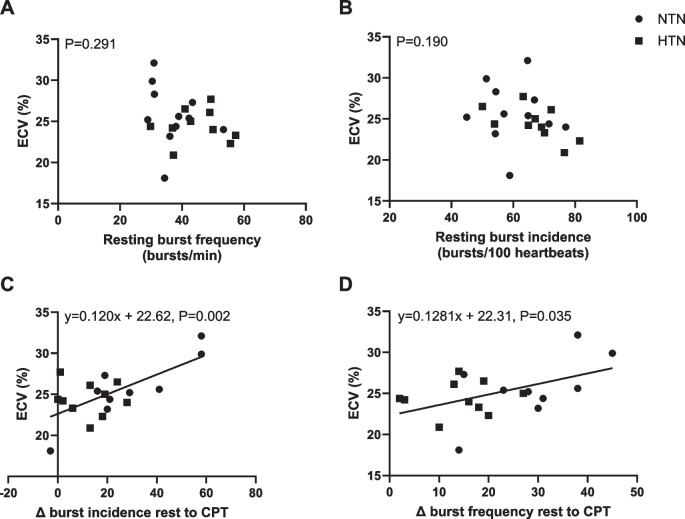
Results: Resting MSNA was not associated with cardiac ECV (B coefficient = - 0.07, 95% CI (- 0.24-0.10), P = 0.549), but SNA reactivity to the cold pressor test was a predictor of ECV independent of daytime systolic blood pressure (B coefficient = 0.12, 95% CI (0.05-0.20), P = 0.007). We determined associations between ECV and MSNA variables using liner regressions, with ECV as the dependent variable.
Conclusions: Our findings show that SNA responses to physiological stress were predictive of ECV, whereas resting SNA was not, independent of the level of blood pressure. Thus, surges in SNA during stress might be more important in cardiac remodelling than overall resting levels of SNA. Further studies should test this hypothesis in larger cohorts.
Keywords: Cardiac fibrosis; Extracellular volume; Stressor; Sympathetic nerve activity.
© 2025. The Author(s).
Conflict of interest statement
Declarations. Ethics approval and consent to participate: Ethical approval for this study was granted by South-West Bristol NHS Research Ethics Committee (20/SW/0006) and the Health Research Authority. Consent for publication: Not applicable. Competing interests: The authors declare no competing interests.
Figures


References
-
- Bombelli M, Vanoli J, Facchetti R, et al. Impact of the increase in left ventricular mass on the risk of long-term cardiovascular mortality: a prospective cohort study. Hypertension. 2023;80(6):1321–30. 10.1161/HYPERTENSIONAHA.122.19988[publishedOnlineFirst:2023/04/19]. - PubMed
MeSH terms
Grants and funding
LinkOut - more resources
Full Text Sources
Medical
Research Materials
