


Properties of adaptive, cluster-randomised controlled trials with few clusters: a simulation study
- PMID: 40597312
- PMCID: PMC12211755
- DOI: 10.1186/s13012-025-01443-6
Properties of adaptive, cluster-randomised controlled trials with few clusters: a simulation study
Abstract
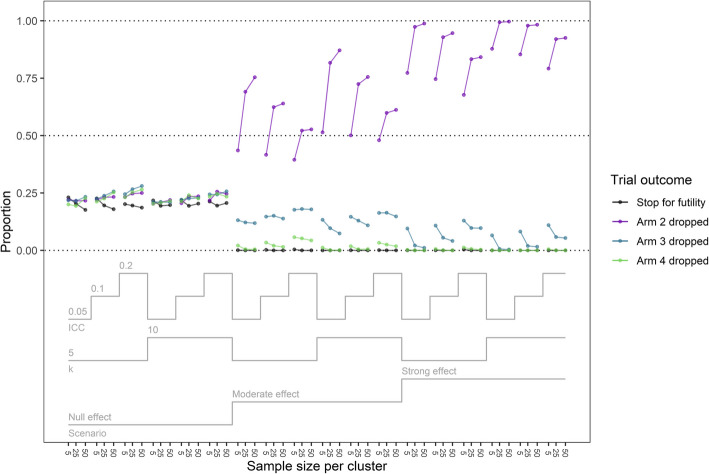
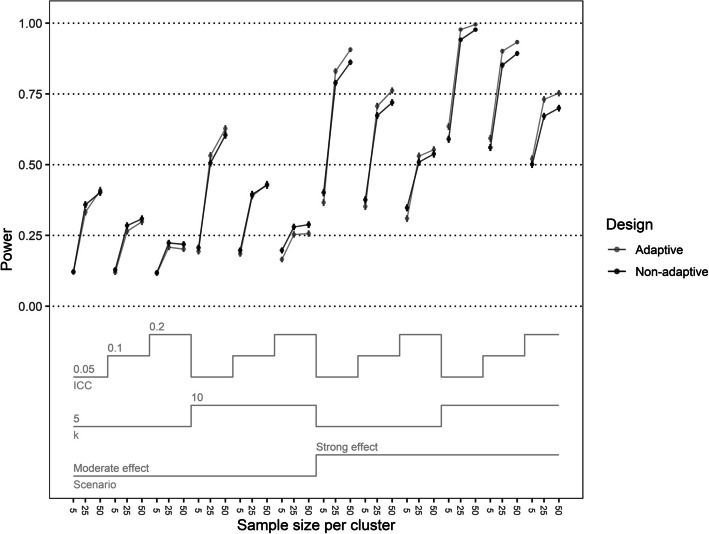
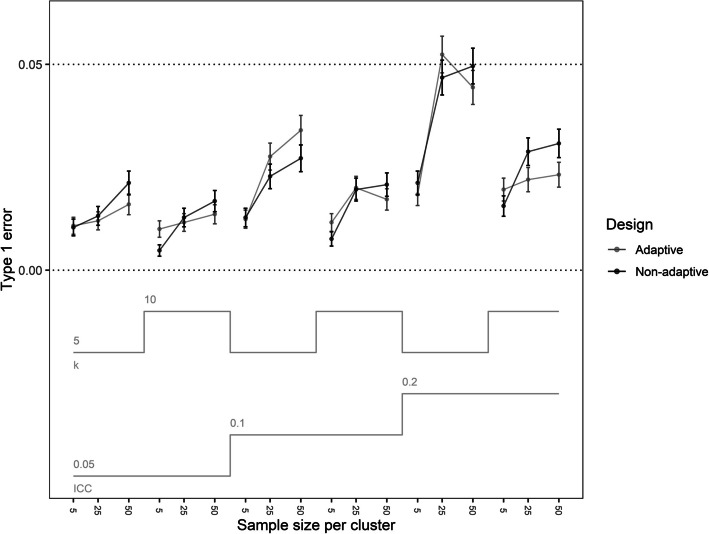
Trials optimising implementation strategies are complex, assess multicomponent strategies, and cluster randomise. We define optimisation as identifying the best combination of components for multi-component implementation strategies. Multi-arm, fixed, cluster randomised control trials (cRCTs) can assess multiple implementation components but suffer from low power due to challenges of recruitment. Adaptive designs offer increased efficiency, when compared to "fixed trial" approaches. A simulation study was conducted to assess whether adaptive designs are feasible (acceptable operating characteristics and adaptive interim decisions) for implementation cRCTs with few clusters. A four-arm cRCT was simulated under varying trial properties. The trials were simulated using fixed design and adaptive design parameters (number of interim analyses, timing of interim analysis, actions at interim e.g. allowing for early stopping for futility, arm dropping) and modelled using Bayesian hierarchical models. The power and type 1 error were compared between the fixed and adaptive designs, and the number of correct interim decisions under the adaptive design were examined. When the intra-class correlation (ICC) was high, the proportion of trials that incorrectly dropped the most effective arm increased. There were small power gains for adaptive designs, without increasing type 1 error. Power gains attenuated when ICC was high and sample size was low. Type 1 error was lower comparable between adaptive and non-adaptive designs. Adaptive designs are feasible for cRCTs with few clusters. They are not as feasible when the ICC is high due to increased risk of incorrect adaptive interim decisions.
Keywords: Adaptive designs; Bayesian; Implementation; Optimisation; Simulation.
© 2025. The Author(s).
Conflict of interest statement
Declarations. Ethics approval and consent to participate: Not applicable. Consent for publication: Not applicable. Competing interests: The authors declare that they have no competing interests.
Figures
References
-
- Nathan N, et al. Implementation of a School Physical Activity Policy Improves Student Physical Activity Levels: Outcomes of a Cluster-Randomized Controlled Trial. J Phys Act Health. 2020;17(10):1009–18. - PubMed
Publication types
MeSH terms
Grants and funding
LinkOut - more resources
Full Text Sources
