


Does the Chinese version of 20-item Toronto alexithymia scale (TAS-20-C) measure alexithymia in Chinese young adolescents? Evidence from confirmatory factor analysis, network analysis, and latent profile analysis
- PMID: 40597410
- PMCID: PMC12220322
- DOI: 10.1186/s40359-025-03028-w
Does the Chinese version of 20-item Toronto alexithymia scale (TAS-20-C) measure alexithymia in Chinese young adolescents? Evidence from confirmatory factor analysis, network analysis, and latent profile analysis
Abstract
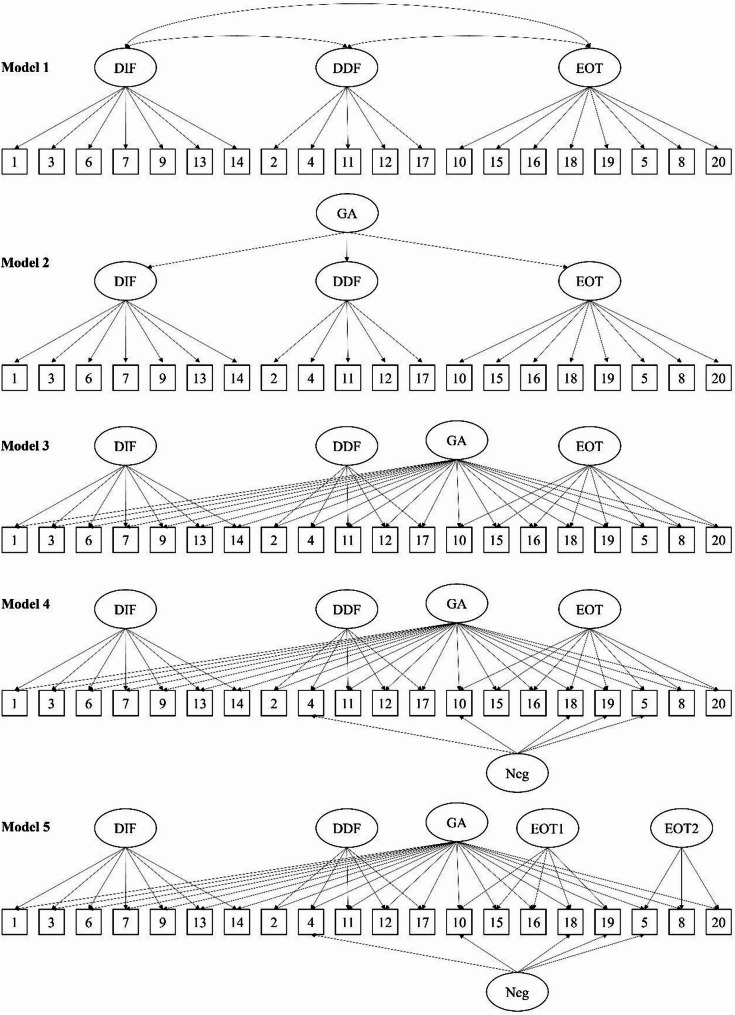
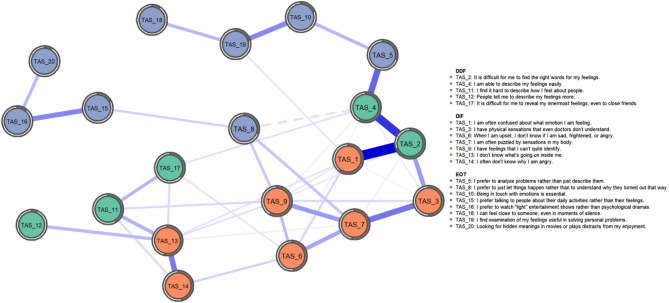
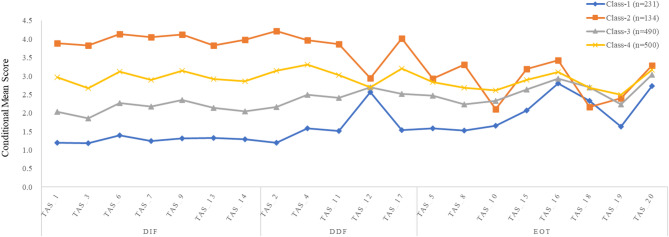
The 20-item Toronto Alexithymia Scale (TAS-20) is a measure of three components of alexithymia: difficulty identifying feelings (DIF), difficulty describing feelings (DDF), and externally oriented thinking (EOT). Although TAS-20 is being increasingly used to measure the alexithymia construct, ongoing controversies remain regarding its internal structure and cross-cultural and cross-group applicability. This study evaluated the psychometric properties of the Chinese version of TAS-20 (TAS-20-C) among 1,355 Chinese young adolescents (mean age = 13.13; SD = 1.00; 52.6% boys) through multiple analytic approaches (i.e., confirmatory factor analysis, network analysis, and latent profile analysis). The confirmatory factor analysis showed reasonable goodness-of-fit for the bi-factorial model with three-dimensional structure and a negatively keyed item factor. However, the results derived from all analytic approaches suggested several items with poor psychometric properties (items 5, 10, 16, 18, 19, 20 from EOT and item 12 from DDF), including poor factor loading on their intended factor, low connectivity and predictability in the item network, and insufficient discrimination across heterogeneous groups. These issues could be attributed to an overabundance of negatively keyed items, translation biases, and the poor readability of certain items. The findings highlight the need for targeted revisions to both the wording and the content for these items, and offer insights into higher priority interventions aimed at improving alexithymia.
Keywords: Alexithymia; Confirmatory factor analysis; Latent profile analysis; Network analysis; Psychometric properties; TAS-20; Young adolescents.
© 2025. The Author(s).
Conflict of interest statement
Declarations. Ethics approval and consent to participate: The study was approved by the Ethical Committee of Anhui Normal University with the approval code of AHNU-ET2024034 (approval date 3/7/2024). All procedures are in accordance with the ethical standards of the institution, the committee and the Declaration of Helsinki. Written informed consent was obtained from all parents/or legal guardian. Consent for publication: Not applicable. Competing interests: The authors declare no competing interests.
Figures
References
-
- Nemiah JC, Freyberger H, Sifneos PE. Alexithymia: A view of the psychosomatic process. In: Hill OW, editor. Modern trends in psychosomatic medicine. Volume 3. London: Butterworths; 1976. pp. 430–9.
MeSH terms
Grants and funding
LinkOut - more resources
Full Text Sources
