


Placental transfer of SARS-CoV-2 antibodies in mother-neonate pairs: a prospective nested cohort study
- PMID: 40597729
- PMCID: PMC12217198
- DOI: 10.1186/s12879-025-11225-6
Placental transfer of SARS-CoV-2 antibodies in mother-neonate pairs: a prospective nested cohort study
Abstract
Background: Newborns depend on the transfer of IgG across the placenta to acquire protection against pathogens. We assessed the placental transfer of SARS-CoV-2 antibodies, primarily derived from infection, from seropositive pregnant women enrolled in a pregnancy cohort in Kilifi, Kenya.
Methods: The study was nested within a prospective observational multi-country cohort study. All available paired maternal delivery and cord blood samples were selected. Maternal sera were tested for SARS-CoV-2 receptor binding domain (RBD) IgM/IgG total antibodies using the Wantai assay. For positive samples, maternal and corresponding cord blood samples were tested for SARS-CoV-2 IgG antibodies against the spike (anti-spike) and nucleocapsid proteins (anti-NCP) using ELISA kits from Euroimmun.
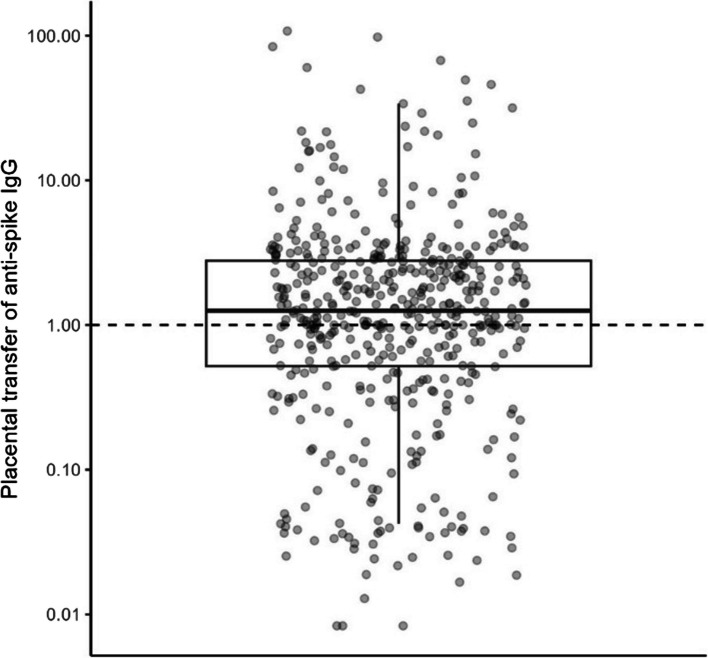
Results: A total of 492 (56.1%) out of 877 maternal delivery samples were positive for RBD IgM/IgG total antibodies. Of these, 416 (84.6%) were seropositive for either anti-NCP IgG, anti-spike IgG antibodies or both. A total of 412 out of 496 (83%) cord blood samples tested positive for either anti-NCP or anti-spike antibodies. The geometric mean ratio was 1.04 (95% CI: 0.90, 1.21), indicating no significant difference between the anti-spike IgG concentration in cord and maternal blood samples. The log-transformed maternal and cord blood anti-spike IgG concentrations showed a weak positive correlation (r = 0.364, n = 496, p < 0.001). No maternal or neonatal factors were associated with the anti-spike IgG placental transfer ratio.
Conclusion: Placental transfer of SARS-CoV-2 antibodies was evident in a population of pregnant women whose immunity was primarily derived from infection given the low SARS-CoV-2 vaccine coverage in the study area. The positive correlation between maternal and cord blood anti-spike concentrations suggests that interventions that increase maternal antibody concentrations such as vaccination may increase passive immunity and protection against severe COVID-19 disease in neonates.
Keywords: COVID-19; Efficiency; Placental transfer; SARS-CoV-2 antibodies; Seropositivity.
© 2025. The Author(s).
Conflict of interest statement
Declarations. Ethics approval and consent to participate: All participants provided written informed consent to participate in the PRECISE study including biological sample collection and storage and use of the data and samples for future research. The study was approved by the Aga Khan University Ethics Review Committee (2018/REC-74) and King’s College London BDM Research Ethics Subcommittee (Ref HR-17/18–7855. This study adhered to the ethical principles outlined in the Declaration of Helsinki. Consent for publication: Not applicable. Competing interests: The authors declare no competing interests.
Figures



References
-
- Puopolo KM, Flannery DD, Gouma S, Dhudasia MB, Mukhopadhyay S, Pfeifer MR, et al. Comparison of Maternal and Neonatal Antibody Levels after COVID-19 Vaccination vs SARS-CoV-2 Infection. JAMA Netw Open. 2022;5(11):E2240993. Available from: https://jamanetwork.com/journals/jamanetworkopen/fullarticle/2798223. Cited 2024 Feb 29 - PMC - PubMed
-
- Partey FD, Obiri D, Bonney EY, Pobee ANA, Damptey IK, Ennuson K, et al. Efficient transplacental transfer of SARS-CoV-2 antibodies between naturally exposed mothers and infants in Accra, Ghana. Sci Rep. 2024;14(1):1–10. Available from: https://www.nature.com/articles/s41598-024-61496-3. Cited 2025 May 14 - PMC - PubMed
-
- Vivanti AJ, Vauloup-Fellous C, Prevot S, Zupan V, Suffee C, Do Cao J, et al. Transplacental transmission of SARS-CoV-2 infection. Nat Commun 2020 11:1. 2020;11(1):1–7. Available from: https://www.nature.com/articles/s41467-020-17436-6. Cited 2025 Apr 18 - PMC - PubMed
-
- Lucot-Royer L, Nallet C, Vouga M, Puyraveau M, Mauny F, Marty-Quinternet S, et al. Analysis of the transplacental transmission of SARS CoV-2 virus and antibody transfer according to the gestational age at maternal infection. Scient Rep 2024 14:1. 2024;14(1):1–9. Available from: https://www.nature.com/articles/s41598-024-53580-5. Cited 2025 Apr 18 - PMC - PubMed
-
- Tallarek AC, Urbschat C, Fonseca Brito L, Stanelle-Bertram S, Krasemann S, Frascaroli G, et al. Inefficient placental virus replication and absence of neonatal cell-specific immunity upon Sars-CoV-2 infection during pregnancy. Front Immunol. 2021;12:698578. Available from: www.frontiersin.org. Cited 2025 Apr 18 - PMC - PubMed
Publication types
MeSH terms
Substances
Grants and funding
- MR/P027938/1/United Kingdom Research and Innovation Grand Challenges Research Fund GROW Award scheme
- MR/P027938/1/United Kingdom Research and Innovation Grand Challenges Research Fund GROW Award scheme
- MR/P027938/1/United Kingdom Research and Innovation Grand Challenges Research Fund GROW Award scheme
- MR/P027938/1/United Kingdom Research and Innovation Grand Challenges Research Fund GROW Award scheme
- MR/P027938/1/United Kingdom Research and Innovation Grand Challenges Research Fund GROW Award scheme
- MR/P027938/1/United Kingdom Research and Innovation Grand Challenges Research Fund GROW Award scheme
- MR/P027938/1/United Kingdom Research and Innovation Grand Challenges Research Fund GROW Award scheme
- MR/P027938/1/United Kingdom Research and Innovation Grand Challenges Research Fund GROW Award scheme
- MR/P027938/1/United Kingdom Research and Innovation Grand Challenges Research Fund GROW Award scheme
- MR/P027938/1/United Kingdom Research and Innovation Grand Challenges Research Fund GROW Award scheme
- MR/P027938/1/United Kingdom Research and Innovation Grand Challenges Research Fund GROW Award scheme
- MR/P027938/1/United Kingdom Research and Innovation Grand Challenges Research Fund GROW Award scheme
- MR/P027938/1/United Kingdom Research and Innovation Grand Challenges Research Fund GROW Award scheme
LinkOut - more resources
Full Text Sources
Medical
Miscellaneous
