


Emotional symptom networks in ICU nurses: a comparative network analysis of tertiary-A and tertiary-B hospitals in China
- PMID: 40598086
- PMCID: PMC12210707
- DOI: 10.1186/s12912-025-03409-x
Emotional symptom networks in ICU nurses: a comparative network analysis of tertiary-A and tertiary-B hospitals in China
Abstract
Background: Intensive Care Unit (ICU) nurses experience significant psychological distress due to the high-stakes and high-intensity nature of their work environments. This study aims to explore the differences in emotional symptom networks between tertiary-A and tertiary-B hospital ICU nurses using network analysis to identify central symptoms and inform targeted interventions.
Method: A total of 498 ICU nurses were divided into two groups based on hospital level: the tertiary-A hospital group (n = 174) and the tertiary-B hospital group (n = 324). Mood states were measured using the Profile of Mood States-Short Form (POMS-SF). Network analysis was employed to estimate and compare the symptom networks between the two groups, identify central symptoms that link distinct symptom clusters, and conduct network comparison tests to assess differences in overall and local network structures.
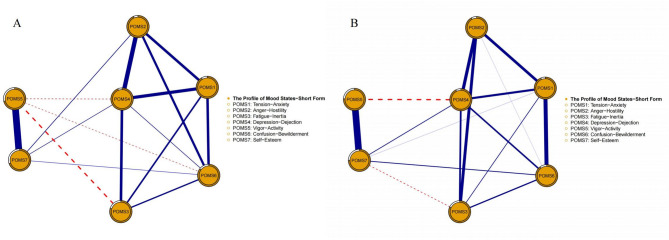
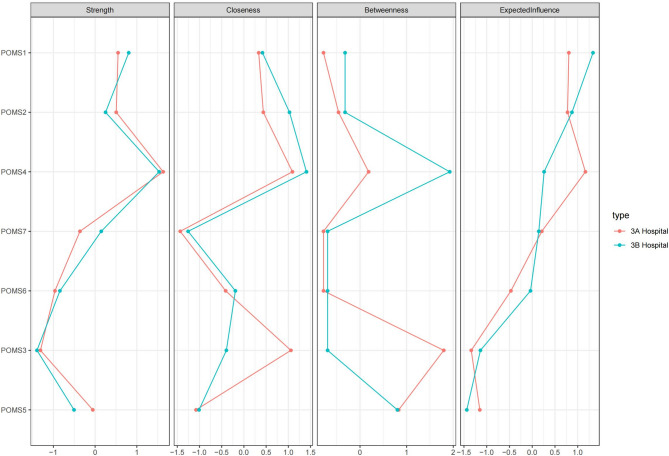
Results: In the tertiary-A hospital group, the most prominent symptoms were POMS4 (Depression-Dejection), POMS1 (Tension-Anxiety), and POMS2 (Anger-Hostility), with the expected influence value indicating that POMS4 (Depression-Dejection) was the most significant. In the tertiary-B hospital group, the most significant central symptoms were POMS1 (Tension-Anxiety), POMS2 (Anger-Hostility), and POMS4 (Depression-Dejection), where POMS1 (Tension-Anxiety) had the highest expected influence value. The network comparison test revealed significant differences in the network invariance test (M = 0.345, P = 0.003) and the Global expected influence invariance test (S = 0.173, P = 0.020).
Conclusion: This study identifies distinct emotional symptom networks in ICU nurses across tertiary-A and tertiary-B hospitals, with depression-dejection (POMS4) central in tertiary-A hospitals and tension-anxiety (POMS1) more prominent in tertiary-B hospitals. These findings highlight the need for tailored interventions and hospital-tier-specific mental health support to address the unique emotional challenges faced by ICU nurses, ultimately improving nurse well-being and patient care quality.
Clinical trial registration: Not applicable.
Keywords: Hospital levels; ICU nurses; Mood states; Network analysis.
© 2025. The Author(s).
Conflict of interest statement
Declarations. Ethics approval and consent to participate: The study was reviewed and approved by the Ethics Committee of the Sixth People’s Hospital of Nantong (Approval No: NTLYLL2025002). All procedures complied with the ethical standards of the Declaration of Helsinki. Written informed consent was obtained from all participants, including explicit agreement for the publication of anonymized data. Participation was voluntary with guaranteed confidentiality and the right to withdraw without penalty. Consent for publication: All participants consented to publication of anonymized data through signed informed consent forms. Competing interests: The authors declare no competing interests.
Figures
References
-
- Quesada-Puga C, Izquierdo-Espin FJ, Membrive-Jimenez MJ, Aguayo-Estremera R, Canadas-De La Fuente GA, Romero-Bejar JL, Gomez-Urquiza JL. Job satisfaction and burnout syndrome among intensive-care unit nurses: A systematic review and meta-analysis. Intensive Crit Care Nurs. 2024;82:103660. - DOI - PubMed
-
- El Khamali R, Mouaci A, Valera S, Cano-Chervel M, Pinglis C, Sanz C, Allal A, Attard V, Malardier J, Delfino M, et al. Effects of a multimodal program including simulation on job strain among nurses working in intensive care units: A randomized clinical trial. JAMA. 2018;320(19):1988–97. - DOI - PMC - PubMed
LinkOut - more resources
Full Text Sources
